

Effective Movement at Work: Exercises for Back Pain

Targeted movement at the workplace exercises are an effective method to counteract the effects of prolonged sitting. Even a few minutes of stretching, mobilization, or strengthening can release tension and improve concentration.
Why Movement at Your Desk is Essential
The human body is made for movement, not for continuous sitting. However, modern work life in the office or home office often forces us into a rigid position. The consequences are well-known: back pain, a stiff neck, and an afternoon slump that affects productivity.
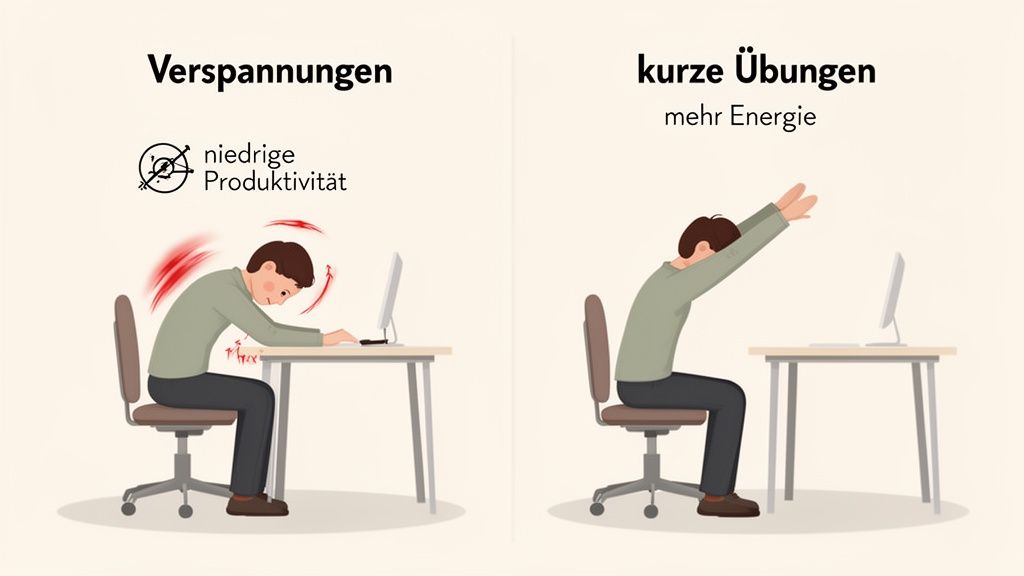
Therefore, exercises at the workplace are not an option, but a necessity for your health. They directly counteract the negative effects of a lack of movement.
The Noticeable Consequences of Too Little Movement
Prolonged sitting slows down metabolism and reduces muscle activity, especially in the legs. This leads to lower calorie consumption and poorer blood circulation. Less oxygen to the brain results in fatigue and poor concentration.
At the same time, the one-sided posture strains the spine and joints. Muscles shorten, fascia stick together, and the risk of chronic pain increases with every day of inactivity.
Lack of exercise is more than just laziness. It is a measurable risk factor that affects your physical and mental performance.
The Changing World of Work Exacerbates the Problem
The rise of the home office has worsened the situation. The commute, which unconsciously provided movement, is eliminated. Trips to the printer, coffee machine, or colleagues are shorter or no longer exist.
A study by Techniker Krankenkasse provides facts: 42% of working people primarily work sitting down. In the home office, 56% of people move less than in the office. And 48% state that they lack the motivation for activity at home. More details can be found in the TK Movement Study.
This lost daily movement must be consciously compensated for. The good news: you don't need an elaborate workout. Short, targeted movement at the workplace exercises can be easily integrated into your daily routine.
They help to minimize the negative effects. An adjustable-height desk is a useful partner in this regard. It allows for easy switching between sitting and standing and is a good basis for activity breaks.
Relieve Neck and Shoulder Tension at Your Desk
After hours in front of the screen, the neck and shoulders often feel stiff. This is a normal reaction to the rigid head posture in everyday office life. Simple stretching exercises can quickly help here.
They loosen the muscles, promote blood circulation, and can be performed inconspicuously at the workplace.
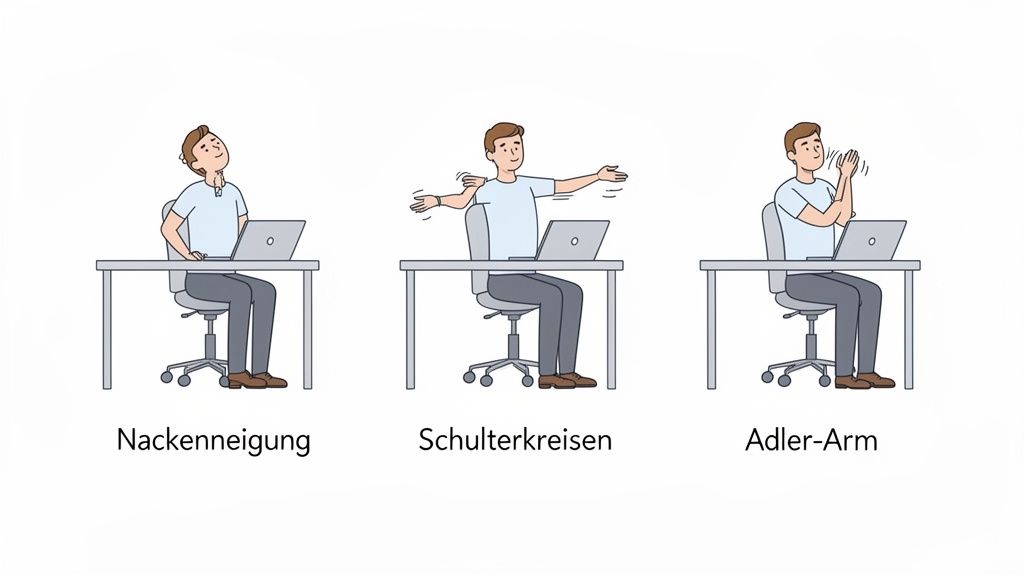
Regularity is crucial. A few minutes per hour are enough to break through the negative consequences of prolonged sitting and improve well-being. These movements at the workplace are a good starting point.
Lateral Neck Stretch for Loosening
This exercise targets the lateral neck muscles, which are often heavily strained. It is an effective method to relieve acute stiffness.
Sit upright on your chair, feet firmly on the floor. Slowly tilt your head towards your right shoulder until you feel a gentle stretch on the left side of your neck.
To intensify the stretch, you can gently place your right hand on your head. Important: do not apply pressure. Hold the position for 15 to 20 seconds and breathe calmly. Then switch sides. Repeat the exercise two to three times per side.
Shoulder Circles for Tense Shoulders
During concentrated work, shoulders are often unconsciously pulled up. This is a main cause of tension in the upper back. Shoulder circles mobilize this area and can release blockages.
-
Backward circles: Sit upright, arms hanging loosely. Slowly pull your shoulders up towards your ears. Then move them in a large circular motion backward and down again. Do 10 to 15 repetitions.
-
Forward circles: Then change direction. Pull your shoulders from bottom to back, then up and in a wide arc forward. Again, do 10 to 15 repetitions.
This exercise can be easily incorporated during a phone call or while thinking.
A short stretching session interrupts static strain. It signals the body to relax and realign itself.
Eagle Arms for the Shoulder Girdle
This exercise, known in yoga as Garudasana arms, stretches the area between the shoulder blades. This is where tension often settles.
Extend both arms straight forward. Place your right arm over your left, so that your elbows cross. Bend your forearms upwards and try to bring your palms together.
Lift your intertwined arms slightly until you feel a stretch in your upper back. Hold this position for 15 to 20 seconds. Release your arms, shake them out briefly, and repeat the exercise with your left arm over your right.
Further exercises can be found in our article on effective neck exercises against neck pain.
Mobilizing the Spine and Hips at Your Desk
Those who sit for hours often experience a stiff back and immobile hips. The core muscles are barely challenged, while the hip flexors are permanently shortened.
Targeted mobilization exercises make the joints supple again and prevent tension.
You can perform these exercises discreetly on your office chair. Even better is to stand up occasionally. An adjustable-height desk makes it easier to switch between sitting and standing, which stimulates blood circulation and relieves the spine.
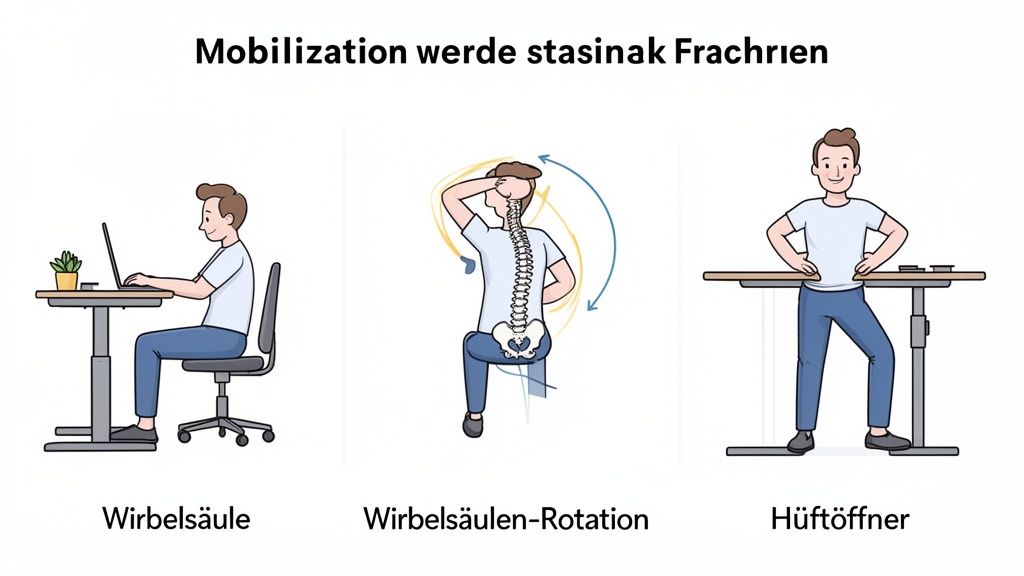
Seated Cat-Cow for a Flexible Spine
This yoga exercise mobilizes the entire spine and counteracts a slumped posture.
Scoot to the front edge of your chair and place your feet firmly on the floor. Rest your hands loosely on your knees.
- Cow Pose (Inhale): Inhale and push your chest forward. Your lower back goes into a slight arch, gaze lifts.
- Cat Pose (Exhale): Exhale and round your back vertebra by vertebra. Pull your chin to your chest and round yourself.
Repeat this alternation 8 to 10 times. Perform the movements slowly and in rhythm with your breath.
Spinal mobilization should be done regularly. Incorporate this exercise several times a day to nourish your intervertebral discs and stay flexible.
Spinal Rotation to Loosen the Torso
Rotations improve the mobility of the thoracic spine and relieve tension in the middle back. This exercise works well while sitting.
Sit upright. Slowly turn your upper body to the right and grasp the outside of your right knee with your left hand. You can support your right hand behind you on the chair to aid the rotation.
Hold the position for about 15 seconds and breathe calmly. Then switch sides.
Gentle Hip Openers for Tight Hip Flexors
The hip flexors, especially the psoas muscle, tend to shorten from sitting. This can lead to lower back pain. A simple hip opener provides relief here.
Remain seated upright and place your right ankle on your left knee. Lean your upper body slightly forward with a straight back until you feel a stretch in your right hip and glutes.
Hold this stretch for 20 to 30 seconds before switching sides. More information can be found in our guide on relieving psoas tension.
The 45-10-5 principle has proven effective. Experts recommend sitting for a maximum of 45 minutes per hour, standing for 10 minutes, and actively moving for 5 minutes. Over an eight-hour day, you accumulate an additional 40 minutes of activity.
Simple Strengthening Exercises Without Equipment
Movement at the workplace is more than just stretching. Short strengthening exercises strengthen the supportive muscles and improve posture. You don't need any special equipment for this. Your desk, your chair, and your body are enough.
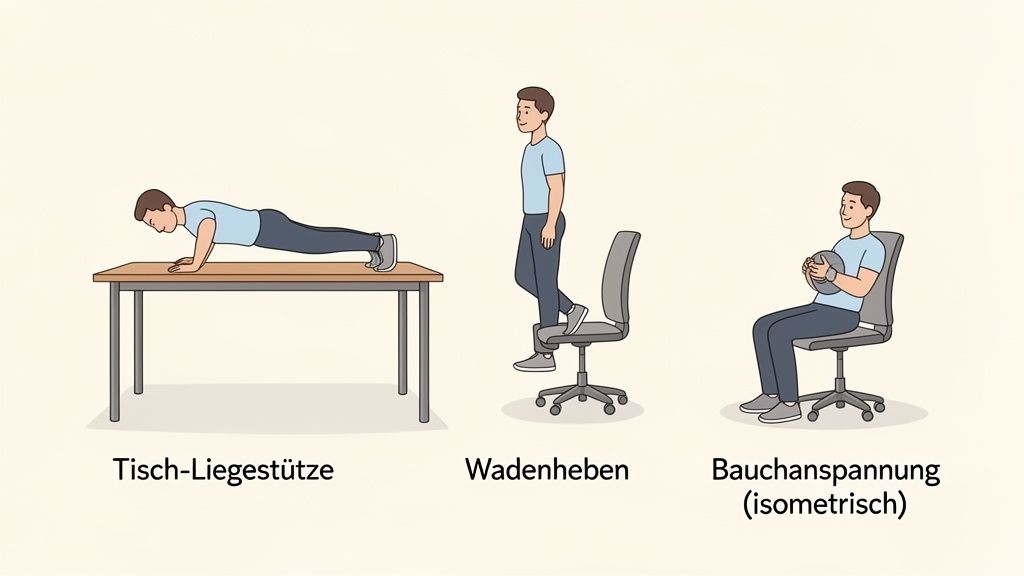
Such units stimulate metabolism and counteract muscle imbalances that arise from sitting.
Desk Push-ups for Chest and Shoulders
Desk push-ups are a good beginner's variation of the classic. They strengthen the muscles in the chest, shoulders, and arms.
Stand about a meter away from your desk. Place your hands slightly wider than shoulder-width apart on the edge of the desk. Your body should form a straight line from head to toe.
Slowly bend your arms and lower your upper body towards the desk in a controlled manner. Then push yourself back up with power.
- Beginners: Start with 2 sets of 8–10 repetitions.
- Advanced: Increase to 3 sets of 12–15 repetitions.
Squats and Calf Raises While Standing
Squats strengthen the large muscle groups in the legs and glutes, which are crucial for stable posture. Your adjustable-height desk provides a good opportunity to stand up for this.
Stand hip-width apart, with your toes pointing slightly outward. Keep your back straight and lower your glutes as if you were sitting on a chair. Only go as deep as feels comfortable, then push yourself back up.
A short set of squats before a meeting can stimulate blood circulation and promote mental alertness.
Combine squats with calf raises. For this, stand upright and slowly push yourself onto your tiptoes. Hold the top position briefly and then lower your heels back down in a controlled manner.
- Squats: Aim for 2–3 sets of 10–15 repetitions.
- Calf raises: Do 2–3 sets of 15–20 repetitions.
Isometric Tension for the Core
Isometric exercises are inconspicuous and can be performed while sitting. You tense a muscle without moving a joint.
Sit upright on your chair, both feet firmly on the floor. Tense your abdominal muscles firmly. Continue breathing calmly.
Hold this tension for 10 to 15 seconds, then release. You can perform this exercise several times throughout the day. Further ideas can be found in our guide on effective gymnastics with an office chair.
How to Develop a Personal Movement Routine
The best exercises for more movement at the workplace are only effective if they become a habit. A personal routine is the key to success. It helps to establish movement as an integral part of the workday.
A well-thought-out plan ensures that you remain consistent. It's not about perfection, but about building a sustained, healthy habit.
Building Blocks for Your Individual Plan
A realistic plan combines different types of exercises. Block fixed time slots for movement breaks in your calendar. A simple reminder can help with this.
Office workers often spend more than 80% of their working time sitting, according to a field study by the German Social Accident Insurance (DGUV). Regular, short exercises every 45 to 60 minutes compensate for this deficit. More details can be found in the Study on Movement Behavior in Hybrid Work.
Here are three building blocks for your routine:
- Stretching: Ideal in the morning or after long periods of sitting. Plan two to three stretching exercises for the neck and shoulders.
- Mobilization: Perfect for the lunch break to keep joints supple. Spinal rotations or the seated cat-cow exercise are well-suited.
- Strengthening: Incorporate these exercises in the afternoon to counteract the energy slump. Squats or desk push-ups stimulate circulation.
Example of a Daily Routine
A fixed structure helps to maintain an overview. Adapt this template flexibly to your schedule.
| Time of Day | Focus | Example Exercise (Duration: approx. 2–3 minutes) |
|---|---|---|
| 09:30 AM | Stretching | Lateral neck stretch (3x per side) and shoulder circles. |
| 11:00 AM | Mobilization | Seated cat-cow (10 repetitions). |
| 02:00 PM | Strengthening | 1 set of squats (12 repetitions) standing. |
| 03:30 PM | Activation | Spinal rotation while sitting and calf raises while standing. |
Your routine must suit you. Start small, perhaps with two breaks a day, and gradually increase. The goal is a sustainable habit, not coercion.
How to Stay Motivated in the Long Term
Adapt your exercises to your environment and schedule. On days with many meetings, inconspicuous stretches while sitting are suitable. If you have more time, use your adjustable-height desk for strengthening exercises while standing.
Listen to your body. Does your neck feel tense? Exchange the planned strengthening exercise for a targeted stretch. Flexibility is important so that your routine doesn't become a burden.
Frequently Asked Questions About Exercises at the Workplace
Here you will find answers to the most common questions, so you can start right away.
How often should I do exercises at the workplace?
Regularity is more important than intensity. Treat yourself to a movement break of two to five minutes every 45 to 60 minutes. This rhythm breaks the rigid sitting posture and keeps circulation and muscles active.
Consider these breaks a fixed part of your workday. A timer or calendar reminder helps to make it a habit.
What to do for acute back pain?
Caution is advised with pain. Gentle mobilization exercises like seated cat-cow or slight spinal rotations are often better than intense strengthening. They can release blockages without overstraining irritated muscles.
Only go as far as the pain threshold, never beyond. For severe or persistent pain, you should seek medical advice before starting an exercise program.
Which exercises are the most inconspicuous in the office?
There are many discreet exercises you can perform unnoticed:
- Isometric tension: Inconspicuously tense your abdominal or gluteal muscles for a few seconds.
- Foot circles: Circle your feet under the desk in both directions.
- Shoulder circles: Small, slow circles with the shoulders loosen the neck area.
- Lateral neck stretch: Gently tilt your head to the side, even during a phone call.
Finding motivation on stressful days is a challenge. Start with the smallest possible exercise. Often, simply standing up briefly and stretching is enough to overcome internal resistance.
How do I motivate myself on stressful days?
Especially on hectic days, movement breaks are important to relieve stress and clear your head. Set the bar as low as possible.
On such days, only commit to a single exercise for two minutes. Link the movement to an existing habit. For example: "After I finish a task, I'll do five squats." This way, the exercises become routine.
An ergonomic workplace is the foundation for an active daily life. With an adjustable-height desk from Deskspace, you create the conditions to effortlessly switch between sitting, standing, and activity breaks. Find the right model now at https://deskspace.de.


