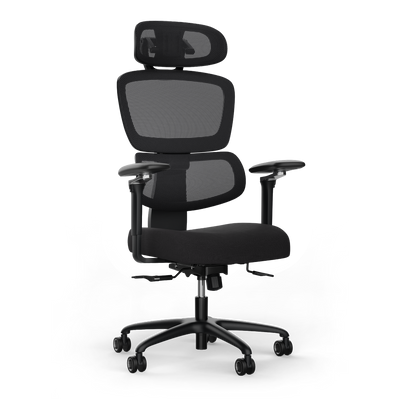
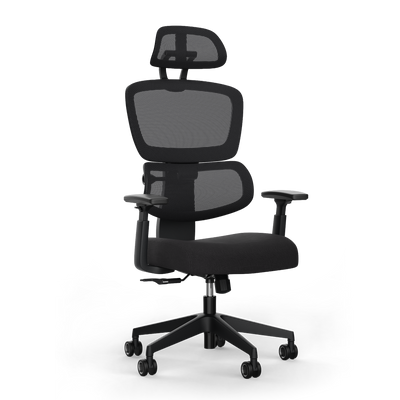


Office chairs for tall people: A guide to ergonomics, weight capacity, and dimensions

For tall individuals, the right office chair is not a luxury. It is a necessity. Standard models are designed for average sizes and often force tall people into unhealthy postures. The result is pain, reduced concentration, and long-term health problems. A suitable chair offers a higher backrest, a deeper seat pan, and a greater seat height. These features optimally support the body.
Why standard office chairs are unsuitable for tall people
Imagine working in clothes that are two sizes too small. They are uncomfortable, restrictive, and unusable. A standard office chair feels the same way for a tall person. It is not ergonomically designed for your proportions. It forces your body into an unhealthy posture.

The weaknesses of such a chair are numerous. They negatively affect your entire body statics. If the right support is missing, not only your back and neck suffer. Your concentration and thus your work performance also decrease.
The three core problems of standard chairs
Three deficiencies make standard office chairs unusable for taller users:
-
Too low seat height: Your legs cannot form a healthy 90-degree angle. Often, your knees are higher than your hips. This forces the lower back into an unnatural curvature and stresses the intervertebral discs.
-
Insufficient seat depth: The seat pan is too short. Your thighs do not rest completely on it. This creates pressure points, disrupts blood circulation, and deprives you of support.
-
Too short backrest: The backrest usually only reaches the middle of your back. The upper back and shoulder area are not supported. If a headrest is missing, neck tension is pre-programmed.
This lack of support leads to constant incorrect loading. Your body tries to compensate for the lack of support by tensing muscles. This leads to chronic pain and rapid fatigue.
Standard vs. XXL office chair in direct comparison
To illustrate the differences, let's compare the features of a standard office chair with those of a model for tall people.
| Feature | Standard office chair | Office chair for tall people |
|---|---|---|
| Load capacity | Up to 120 kg | Often 150 kg to 200 kg+ |
| Seat height | approx. 42-53 cm | Often 48-60 cm or higher |
| Seat depth | approx. 40-45 cm | Often 48-55 cm (adjustable) |
| Seat width | approx. 48-50 cm | Often 52 cm or wider |
| Backrest height | approx. 55-65 cm | Often 70 cm or higher (with headrest) |
| Adjustment ranges | Limited | Significantly extended adjustment options |
The table shows significant differences. A chair for tall people is not simply larger. It is designed in all relevant dimensions for higher loads and different body proportions.
The health consequences of unsuitable chairs
The consequences of poor sitting posture are well-documented scientifically. They range from everyday tension to serious musculoskeletal disorders.
A suitable ergonomic chair can reduce the risk of such complaints by up to 30 percent. The market is responding to this finding. The demand for robust, larger models is growing. Studies show that chairs for tall people often require a seat width of over 55 cm and generous adjustment ranges. You can find additional insights into market developments in the office chair market statistics on flexispot.de.
An office chair for tall people is not an optional improvement. It is a health necessity. It is the foundation for long-term well-being and sustainable performance.
Investing in a suitable chair pays off directly. You prevent pain and create the conditions for concentrated work without physical compromises.
What matters when choosing an office chair for tall people
When you are looking for an office chair for tall people, technical details are crucial. This is where the wheat is separated from the chaff. These values determine safety, longevity, and comfort. A quick look at the product data sheet tells you everything.
The trick is to interpret the numbers correctly. A chair doesn't just have to be large. It needs a stable construction that can permanently handle the higher weight and different leverage.
The foundation: Load capacity and reinforced mechanism
The most important item on your list is the maximum load capacity. Most standard chairs are designed for a maximum of 120 kg. For tall and heavier people, this is often not enough. The chair constantly operates at its limit.
A load capacity of at least 150 kg is a necessity. It guarantees that all components are designed for the higher load. This applies from the gas spring to the mechanism to the base. A reinforced synchronous mechanism ensures that the chair can handle dynamic movements without losing stability.
A chair that constantly operates at its load limit wears out faster. It becomes a safety risk over time. A higher load capacity gives you the necessary reserve for long and safe use.
The demand for such robust seating solutions is high. According to the German Office and Workplace Furniture Industry Association (IBA), the office furniture industry generated 2.4 billion euros in 2024. The office chair segment remained stable. This is a clear sign of the continued demand for quality. You can read more about the stabilization of demand for office furniture on iba.online.
The ideal dimensions and adjustment ranges
Immediately after load capacity come the dimensions and adjustment options. A chair can be robust. If the proportions do not match your body, it is ergonomically worthless. Look out for these key values:
- Seat height: You need an adjustable seat height of at least 50 cm to over 55 cm. This way, your feet are flat on the floor, and your knees form a healthy 90-degree angle.
- Seat depth: An adjustable seat depth of approx. 48 cm to 55 cm is ideal. This ensures that your thighs rest fully, without the seat edge pressing into your hollows. As a rule of thumb: there should be about three to four finger widths of space between your hollow and the front edge of the seat.
- Seat width: A wider seat pan of at least 52 cm gives you more freedom of movement and prevents a confined feeling.
- Backrest height: The backrest should be at least 60 cm high, measured from the seat. A backrest that reaches your shoulder blades and supports your entire upper body is perfect.
These dimensions are guidelines. They help you rule out unsuitable models from the outset. They ensure that the chair not only supports your weight but can also be adjusted to your height.
Quality of materials and components
The quality of the installed parts determines the longevity of your chair. A polished aluminum or steel base is more stable and durable than plastic variants. Also pay attention to the castors. Larger, load-dependent braked universal castors run better on all floors and give the chair a firm stand.
The heart of the height adjustment is the gas spring. Models for tall people often use springs of safety class 4. These are specifically tested for higher loads.
Upholstery and cover also make a difference. High-quality cold foam remains dimensionally stable longer than simple foam. Breathable mesh fabrics or robust fabrics ensure comfort and withstand daily use. These details determine whether a chair is worn out after a year or represents a long-term investment in your health.
How to correctly measure for your new chair
The search for the perfect office chair for tall people begins at home. Only if you know your own body measurements can you assess whether a chair suits you. Precise measurement is the key to a chair that feels custom-made.
Take a moment for three simple measurements. You only need a tape measure and a free wall. These minutes decide whether you sit comfortably and healthily for the next few years.

Step 1: Determine the optimal seat height
The correct seat height is the basis for a healthy posture. If your feet are flat on the floor and your knees form an angle of about 90 degrees, the pressure is optimally distributed. This relieves your lower back.
Here's how to find your ideal seat height:
- Sit on a chair or stool. Your feet must be firmly and flat on the floor.
- Your thighs should be parallel to the floor or slightly sloping. Your knees are at the same height as your hips or slightly below.
- Measure the distance from the floor to the top edge of your knee pit. This is your ideal seat height.
Note this value. A good office chair must be adjustable to at least this dimension, ideally with some upward leeway. Remember that seat height and desk height work together. We show you how to calculate the optimal desk height in another guide.
Step 2: Determine the correct seat depth
The seat depth is crucial for supporting your thighs. If the seat is too short, pressure points arise. If it is too long, it presses into the hollows of your knees and disrupts blood circulation. You want to avoid both.
A correctly adjusted seat depth distributes your body weight evenly over the seat surface. This relieves the spine and gives you a stable, upright sitting position.
Follow these steps:
- Sit upright. Lean your back against a straight wall.
- Measure the distance from your buttocks to your knee pit.
- Subtract 4 to 5 cm from this measurement. This corresponds to about three finger widths.
The result is your perfect seat depth. This distance between the seat edge and the knee pit is important. It ensures that no nerves or blood vessels are pinched and you can move your lower legs freely.
Step 3: Determine the necessary backrest height
The backrest is the backbone of your chair. For tall people, it is essential that it supports the entire back up to the shoulders. A backrest that is too short leaves the upper back and neck unsupported. This leads to tension.
Here's how to find the right height:
- Remain seated upright, either on a chair or on the floor with your back straight.
- Measure the distance from the seat to the top edge of your shoulder blades.
- This value is the minimum height your backrest should have.
For good support, the backrest should be even higher. A backrest that reaches the shoulders supports the spine along its entire length. If the chair has an adjustable headrest, that's ideal. This way, your neck can also relax.
With these three values, you are well prepared. Now you can specifically compare the technical data of office chairs. This ensures that your new model not only looks large but also perfectly fits you ergonomically.
Advanced ergonomic features that make a difference
The right dimensions and a high load capacity are the foundation. But sophisticated ergonomic features transform an office chair for tall people into a tool for active, healthy sitting. These details make the difference between simple sitting and genuine physical relief.

Good ergonomic features promote movement, support problem areas, and dynamically adapt to your posture. This interplay makes a chair a worthwhile investment in your health.
The synchronized mechanism for active sitting
Sitting rigidly in one position for hours harms the back. The synchronized mechanism prevents precisely that. It links the movement of the backrest with the tilt of the seat pan.
When you lean back, the seat pan tilts slightly backward with you. This has a great effect. The angle between your upper body and thighs opens up. This improves blood circulation and relieves pressure on the intervertebral discs.
The chair encourages constant, unconscious changes in posture. Your body remains in motion even while sitting. This supplies the intervertebral discs with nutrients and prevents muscle tension.
Targeted relief through lumbar support
Our lumbar spine has a natural S-curve, the lordosis. Without proper support, we often slump. The lower back becomes rounded, and the intervertebral discs are stressed.
An adjustable lumbar support addresses this. It fills the hollow in the lumbar region and supports the natural curvature of your spine. The result is an upright, stable, and relaxed sitting posture.
Good lumbar support can be adjusted in height and ideally also in depth. Only then can you precisely align the support point with the shape of your spine for maximum support.
Targeted support of the lower back is fundamental for pain-free work. In our guide to office chairs with lumbar support, you will find more information.
4D armrests against neck tension
A tense neck and aching shoulders are typical companions of a long workday. 4D armrests are an effective tool to prevent these complaints. They can be adjusted in four dimensions and offer maximum flexibility.
- Height: Adjust the armrests so that your forearms rest at a 90-degree angle, without shrugging your shoulders.
- Width: Adjust the distance to your body so that your arms remain relaxed.
- Depth: Slide the pads forward or backward to support your forearms during any activity.
- Angle: Rotate the pads slightly inward to relieve your wrists when typing.
Thanks to this precise adjustability, your shoulders no longer have to bear the entire weight of your arms. This significantly reduces tension in the shoulder and neck area.
Indispensable for tall users: Headrest and seat depth adjustment
For tall people, two functions are crucial. A height-adjustable and tiltable headrest is essential. It supports the head and cervical spine. It provides relief when you lean back and prevents your head from falling forward.
Even more important is the seat depth adjustment. It ensures that your long thighs rest fully on the seat surface. Without this function, either the seat edge would press into your hollows or the support surface would be too short. A correctly adjusted seat depth is the basic prerequisite for a stable posture.
Your checklist for buying the right chair
Finding the perfect office chair for tall people can be difficult. Many models advertise with the label "ergonomic." Few meet the special requirements for dimensions, stability, and adjustability.
This checklist is your practical tool. You can use it to systematically evaluate offers. This way, you ensure that you don't overlook any important details and make an informed decision. The goal is a chair that allows you to work healthily and productively in the long term.
First, the basics: What must the chair be able to do?
Before we delve into the details of ergonomics, the basics must be right. These points are non-negotiable. They are the foundation for your safety and the longevity of the chair.
-
Load capacity: A look at the maximum load capacity is mandatory. For tall and heavy individuals, the chair should be designed for at least 150 kg. This guarantees that all components can withstand the higher forces.
-
Seat height: Measure your optimal seat height and compare it with the chair's adjustment range. The value should reach at least 50 cm, preferably up to 60 cm. Only then can you achieve the important 90-degree angle in your knees.
-
Seat depth: An adjustable seat depth is crucial. It should cover a range of approximately 48 to 55 cm. This ensures that your thighs rest fully on the seat.
-
Backrest height: A high backrest is a must. Measured from the seat, it should be at least 60 cm high. This supports the entire back up to the shoulders. An adjustable headrest is a great advantage.
The icing on the cake: What truly makes a chair ergonomic?
Once the foundation is right, the details come into play. They make the difference between "just sitting" and "healthy sitting." These features promote active sitting and prevent tension.
A good ergonomic chair doesn't force you into a rigid posture. It encourages movement and supports your body exactly where you need it. It adapts to you, not the other way around.
Look for these three core functions:
-
Synchronized mechanism: This is the standard for dynamic sitting. This mechanism links the tilt of the backrest and the seat. This keeps you constantly moving. These small changes in posture are good for your intervertebral discs.
-
Adjustable lumbar support: A support that you can adjust in height and depth is indispensable. It stabilizes the S-curve of your lumbar spine and prevents a rounded back.
-
4D armrests: These armrests can be adjusted in height, width, depth, and angle. They support the weight of your arms and relieve the entire shoulder and neck area.
A look at the fine print: Quality and certificates
Take a close look at the quality of the materials and workmanship. Robust components and recognized seals of approval give you security. You are making a long-term investment in your health.
-
Materials: A base made of steel or aluminum is more stable than plastic. For upholstery, cold foam is a good choice as it remains dimensionally stable. Breathable mesh fabrics or durable fabric covers ensure comfort.
-
Components: Look for a gas spring of Class 4. It is designed for higher loads. Large, load-dependent braked universal castors provide stability and protect the floor covering.
-
Certificates: The GS mark ("Geprüfte Sicherheit" - Tested Safety) is a strong indicator of quality. It confirms that the chair meets German safety standards. Additional seals, for example from TÜV, often also confirm the ergonomics.
With these seals, you can be sure that the chair has been built for continuous use and higher loads.
Buying Checklist for your XXL Office Chair
| Criterion | Your requirement | Model meets (Yes/No) |
|---|---|---|
| Load capacity | min. 150 kg | |
| Seat height | min. 50-60 cm | |
| Seat depth | adjustable, approx. 48-55 cm | |
| Backrest height | min. 60 cm + headrest | |
| Mechanism | Synchronized mechanism | |
| Lumbar support | height-/depth-adjustable | |
| Armrests | 4D-adjustable | |
| Base material | Steel or aluminum | |
| Gas spring | Class 4 | |
| Certificates | GS mark / TÜV |
Print it out or save it on your phone. This way, you can systematically check each model to see if it meets your requirements.
Deskspace models and useful accessories for tall users
Choosing the right office chair is an important step. To ergonomically design a workplace for tall people, the chair, desk, and accessories must work together perfectly. We show you which solutions Deskspace offers for these requirements.

Our models are designed to meet the criteria of tall users as well. High load capacity, extended adjustment ranges, and robust materials are standard for us, not special equipment.
Suitable chair models for high demands
Tall users need chairs that offer more. They require a high backrest, a generous seat depth, and a sufficient maximum seat height.
The Deskspace MOVE PRO is an ideal choice here. It was developed for users up to a height of 1.95 m. It combines a high, adjustable backrest with an adjustable seat depth and 4D armrests. This creates comprehensive ergonomic support. All details on the adjustment options can be found directly on the product page. Learn more about the ergonomic office chair MOVE PRO.
Useful accessories that complete the workplace
Additional accessories help close ergonomic gaps and increase comfort. For tall people, these components are particularly valuable.
-
Monitor mounts: A monitor arm is indispensable for bringing the screen precisely to eye level. This way, you avoid a hunched posture and prevent neck tension. The monitor can be positioned independently of the desk height.
-
Footrests: Even with a height-adjustable chair, a footrest can be useful. It ensures a stable position for the feet and relieves the leg muscles. This is particularly useful if the desk does not perfectly match the optimal seat height.
A well-thought-out setup of chair and accessories creates an ergonomic unit. Each element contributes to relieving your body and enabling a healthy working posture.
In addition to the right chair and accessories, the general organization of your workplace also plays a major role. Take a look at the Clean Desk Principle to further optimize your setup. The combination of proper equipment and good organization is the key to a healthy and efficient work environment.
What you should know about office chairs for tall people
Finally, we answer the most common questions from our consultations. Here you will find clear and direct answers to help you with your purchase decision.
How high should the backrest be for someone over 1.95 m?
For people over 1.95 m, the backrest is a crucial factor. As a rule of thumb: It should be at least 60 cm high, measured from the seat.
Ideally, the backrest supports the back up to the shoulder blades. An additional, adjustable headrest is a must here. Only then will the entire upper body be optimally supported, and neck tension prevented.
Is it enough if a chair has a high load capacity?
No. A high load capacity of 150 kg or more is the basis for stability, but it's only half the battle. At least as important are the correct dimensions and adjustment options.
What good is the most stable chair if your legs don't fit under the table? Look for a sufficiently high seat adjustment (often over 50 cm), an adjustable seat depth (at least 45–50 cm), and a wide seat (over 50 cm). Without these adjustments, even the most robust chair forces tall people into an unhealthy posture.
A high load capacity guarantees stability. But only the right dimensions and adjustment ranges ensure true ergonomics and comfort. Both must be right.
What certificates should I look for in XXL chairs?
Recognized seals of approval are a good guide to recognizing quality. They confirm that a chair delivers what it promises.
- GS mark ("Geprüfte Sicherheit" - Tested Safety): This seal confirms that the chair meets German safety standards. A strong indicator of quality.
- TÜV certification: Independent testers like TÜV Rheinland examine not only safety but often also ergonomics.
- Component testing: For chairs designed for heavy loads, it is important that individual components such as the gas spring or the base are also designed and tested for the higher weight.
With these seals, you can be sure that the chair has been built for continuous use and higher loads.
Can I upgrade a standard office chair with a longer gas spring?
This is an idea we strongly advise against. Technically, replacing the gas spring may be possible. However, it is a dangerous intervention in the statics of the chair.
A longer spring shifts the center of gravity upwards. This severely impairs stability and increases the risk of tipping. Furthermore, the manufacturer's warranty expires with such modifications. It is better to invest in an office chair that was designed for tall people from the outset. This is the safer and ergonomically smarter decision.
An ergonomic workplace is not a matter of cost. It is an investment in your health and productivity. At Deskspace, you will find tested and certified office chairs that have been developed for high demands. Discover our selection now and find the perfect chair for you at https://deskspace.de.


