{"variants":[{"id":47311584723287,"name":null,"title":"None \/ Black \/ Frame Only","option1":"None","option2":"Black","option3":"Frame Only","available":true,"inventory_policy":"continue","inventory_quantity":20,"limited_pre_order":false,"negative_stock_count":null,"price":332900,"compare_at_price":442900,"_karla_estimated_ship_date_start":null,"_karla_estimated_ship_date_end":null,"_container_id":null},{"id":47311584887127,"name":null,"title":"None \/ White \/ Frame Only","option1":"None","option2":"White","option3":"Frame Only","available":true,"inventory_policy":"continue","inventory_quantity":142,"limited_pre_order":false,"negative_stock_count":null,"price":332900,"compare_at_price":442900,"_karla_estimated_ship_date_start":null,"_karla_estimated_ship_date_end":null,"_container_id":null},{"id":50541195592023,"name":null,"title":"None \/ Grey \/ Frame Only","option1":"None","option2":"Grey","option3":"Frame Only","available":true,"inventory_policy":"continue","inventory_quantity":18,"limited_pre_order":false,"negative_stock_count":null,"price":332900,"compare_at_price":442900,"_karla_estimated_ship_date_start":null,"_karla_estimated_ship_date_end":null,"_container_id":null},{"id":40677505171499,"name":null,"title":"Black \/ Black \/ 120 x 60 cm","option1":"Black","option2":"Black","option3":"120 x 60 cm","available":true,"inventory_policy":"continue","inventory_quantity":20,"limited_pre_order":false,"negative_stock_count":null,"price":440900,"compare_at_price":573900,"_karla_estimated_ship_date_start":null,"_karla_estimated_ship_date_end":null,"_container_id":null},{"id":40265028468779,"name":null,"title":"Black \/ Black \/ 140 x 70 cm","option1":"Black","option2":"Black","option3":"140 x 70 cm","available":true,"inventory_policy":"continue","inventory_quantity":20,"limited_pre_order":false,"negative_stock_count":null,"price":535900,"compare_at_price":690900,"_karla_estimated_ship_date_start":null,"_karla_estimated_ship_date_end":null,"_container_id":null},{"id":40265028501547,"name":null,"title":"Black \/ Black \/ 160 x 80 cm","option1":"Black","option2":"Black","option3":"160 x 80 cm","available":true,"inventory_policy":"continue","inventory_quantity":20,"limited_pre_order":false,"negative_stock_count":null,"price":569900,"compare_at_price":746900,"_karla_estimated_ship_date_start":null,"_karla_estimated_ship_date_end":null,"_container_id":null},{"id":47245598064983,"name":null,"title":"Black \/ Black \/ 180 x 80 cm","option1":"Black","option2":"Black","option3":"180 x 80 cm","available":true,"inventory_policy":"continue","inventory_quantity":20,"limited_pre_order":false,"negative_stock_count":null,"price":624900,"compare_at_price":812900,"_karla_estimated_ship_date_start":null,"_karla_estimated_ship_date_end":null,"_container_id":null},{"id":50541195690327,"name":null,"title":"Black \/ Black \/ 200 x 80 cm","option1":"Black","option2":"Black","option3":"200 x 80 cm","available":true,"inventory_policy":"continue","inventory_quantity":20,"limited_pre_order":false,"negative_stock_count":null,"price":639900,"compare_at_price":838900,"_karla_estimated_ship_date_start":null,"_karla_estimated_ship_date_end":null,"_container_id":null},{"id":40677505204267,"name":null,"title":"Black \/ White \/ 120 x 60 cm","option1":"Black","option2":"White","option3":"120 x 60 cm","available":true,"inventory_policy":"continue","inventory_quantity":93,"limited_pre_order":false,"negative_stock_count":null,"price":440900,"compare_at_price":573900,"_karla_estimated_ship_date_start":null,"_karla_estimated_ship_date_end":null,"_container_id":null},{"id":40265028534315,"name":null,"title":"Black \/ White \/ 140 x 70 cm","option1":"Black","option2":"White","option3":"140 x 70 cm","available":true,"inventory_policy":"continue","inventory_quantity":142,"limited_pre_order":false,"negative_stock_count":null,"price":535900,"compare_at_price":690900,"_karla_estimated_ship_date_start":null,"_karla_estimated_ship_date_end":null,"_container_id":null},{"id":40265028567083,"name":null,"title":"Black \/ White \/ 160 x 80 cm","option1":"Black","option2":"White","option3":"160 x 80 cm","available":true,"inventory_policy":"continue","inventory_quantity":118,"limited_pre_order":false,"negative_stock_count":null,"price":569900,"compare_at_price":746900,"_karla_estimated_ship_date_start":null,"_karla_estimated_ship_date_end":null,"_container_id":"ler25019-c2"},{"id":47245598097751,"name":null,"title":"Black \/ White \/ 180 x 80 cm","option1":"Black","option2":"White","option3":"180 x 80 cm","available":true,"inventory_policy":"continue","inventory_quantity":106,"limited_pre_order":false,"negative_stock_count":null,"price":624900,"compare_at_price":812900,"_karla_estimated_ship_date_start":null,"_karla_estimated_ship_date_end":null,"_container_id":null},{"id":50541195723095,"name":null,"title":"Black \/ White \/ 200 x 80 cm","option1":"Black","option2":"White","option3":"200 x 80 cm","available":true,"inventory_policy":"continue","inventory_quantity":49,"limited_pre_order":false,"negative_stock_count":null,"price":639900,"compare_at_price":838900,"_karla_estimated_ship_date_start":null,"_karla_estimated_ship_date_end":null,"_container_id":null},{"id":50541195755863,"name":null,"title":"Black \/ Grey \/ 120 x 60 cm","option1":"Black","option2":"Grey","option3":"120 x 60 cm","available":true,"inventory_policy":"continue","inventory_quantity":18,"limited_pre_order":false,"negative_stock_count":null,"price":440900,"compare_at_price":573900,"_karla_estimated_ship_date_start":null,"_karla_estimated_ship_date_end":null,"_container_id":null},{"id":50541195854167,"name":null,"title":"Black \/ Grey \/ 140 x 70 cm","option1":"Black","option2":"Grey","option3":"140 x 70 cm","available":true,"inventory_policy":"continue","inventory_quantity":18,"limited_pre_order":false,"negative_stock_count":null,"price":535900,"compare_at_price":690900,"_karla_estimated_ship_date_start":null,"_karla_estimated_ship_date_end":null,"_container_id":null},{"id":50541195886935,"name":null,"title":"Black \/ Grey \/ 160 x 80 cm","option1":"Black","option2":"Grey","option3":"160 x 80 cm","available":true,"inventory_policy":"continue","inventory_quantity":18,"limited_pre_order":false,"negative_stock_count":null,"price":569900,"compare_at_price":746900,"_karla_estimated_ship_date_start":null,"_karla_estimated_ship_date_end":null,"_container_id":null},{"id":50541195919703,"name":null,"title":"Black \/ Grey \/ 180 x 80 cm","option1":"Black","option2":"Grey","option3":"180 x 80 cm","available":true,"inventory_policy":"continue","inventory_quantity":18,"limited_pre_order":false,"negative_stock_count":null,"price":624900,"compare_at_price":812900,"_karla_estimated_ship_date_start":null,"_karla_estimated_ship_date_end":null,"_container_id":null},{"id":50541195952471,"name":null,"title":"Black \/ Grey \/ 200 x 80 cm","option1":"Black","option2":"Grey","option3":"200 x 80 cm","available":true,"inventory_policy":"continue","inventory_quantity":18,"limited_pre_order":false,"negative_stock_count":null,"price":639900,"compare_at_price":838900,"_karla_estimated_ship_date_start":null,"_karla_estimated_ship_date_end":null,"_container_id":"ler25019-c2"},{"id":40677505302571,"name":null,"title":"Walnut \/ Black \/ 120 x 60 cm","option1":"Walnut","option2":"Black","option3":"120 x 60 cm","available":true,"inventory_policy":"continue","inventory_quantity":0,"limited_pre_order":false,"negative_stock_count":null,"price":440900,"compare_at_price":573900,"_karla_estimated_ship_date_start":null,"_karla_estimated_ship_date_end":null,"_container_id":null},{"id":40265028763691,"name":null,"title":"Walnut \/ Black \/ 140 x 70 cm","option1":"Walnut","option2":"Black","option3":"140 x 70 cm","available":true,"inventory_policy":"continue","inventory_quantity":20,"limited_pre_order":false,"negative_stock_count":null,"price":535900,"compare_at_price":690900,"_karla_estimated_ship_date_start":null,"_karla_estimated_ship_date_end":null,"_container_id":null},{"id":40583409401899,"name":null,"title":"Walnut \/ Black \/ 160 x 80 cm","option1":"Walnut","option2":"Black","option3":"160 x 80 cm","available":true,"inventory_policy":"continue","inventory_quantity":20,"limited_pre_order":false,"negative_stock_count":null,"price":569900,"compare_at_price":746900,"_karla_estimated_ship_date_start":null,"_karla_estimated_ship_date_end":null,"_container_id":null},{"id":47245598130519,"name":null,"title":"Walnut \/ Black \/ 180 x 80 cm","option1":"Walnut","option2":"Black","option3":"180 x 80 cm","available":true,"inventory_policy":"continue","inventory_quantity":20,"limited_pre_order":false,"negative_stock_count":null,"price":624900,"compare_at_price":812900,"_karla_estimated_ship_date_start":null,"_karla_estimated_ship_date_end":null,"_container_id":"ler25019-c2"},{"id":50541195985239,"name":null,"title":"Walnut \/ Black \/ 200 x 80 cm","option1":"Walnut","option2":"Black","option3":"200 x 80 cm","available":true,"inventory_policy":"continue","inventory_quantity":20,"limited_pre_order":false,"negative_stock_count":null,"price":639900,"compare_at_price":838900,"_karla_estimated_ship_date_start":null,"_karla_estimated_ship_date_end":null,"_container_id":null},{"id":40677505335339,"name":null,"title":"Walnut \/ White \/ 120 x 60 cm","option1":"Walnut","option2":"White","option3":"120 x 60 cm","available":true,"inventory_policy":"continue","inventory_quantity":0,"limited_pre_order":false,"negative_stock_count":null,"price":440900,"compare_at_price":573900,"_karla_estimated_ship_date_start":null,"_karla_estimated_ship_date_end":null,"_container_id":null},{"id":40265028829227,"name":null,"title":"Walnut \/ White \/ 140 x 70 cm","option1":"Walnut","option2":"White","option3":"140 x 70 cm","available":true,"inventory_policy":"continue","inventory_quantity":116,"limited_pre_order":false,"negative_stock_count":null,"price":535900,"compare_at_price":690900,"_karla_estimated_ship_date_start":null,"_karla_estimated_ship_date_end":null,"_container_id":null},{"id":40583410122795,"name":null,"title":"Walnut \/ White \/ 160 x 80 cm","option1":"Walnut","option2":"White","option3":"160 x 80 cm","available":true,"inventory_policy":"continue","inventory_quantity":50,"limited_pre_order":false,"negative_stock_count":null,"price":569900,"compare_at_price":746900,"_karla_estimated_ship_date_start":null,"_karla_estimated_ship_date_end":null,"_container_id":null},{"id":47245598163287,"name":null,"title":"Walnut \/ White \/ 180 x 80 cm","option1":"Walnut","option2":"White","option3":"180 x 80 cm","available":true,"inventory_policy":"continue","inventory_quantity":57,"limited_pre_order":false,"negative_stock_count":null,"price":624900,"compare_at_price":812900,"_karla_estimated_ship_date_start":null,"_karla_estimated_ship_date_end":null,"_container_id":"ler25019-c2"},{"id":50541196018007,"name":null,"title":"Walnut \/ White \/ 200 x 80 cm","option1":"Walnut","option2":"White","option3":"200 x 80 cm","available":true,"inventory_policy":"continue","inventory_quantity":39,"limited_pre_order":false,"negative_stock_count":null,"price":639900,"compare_at_price":838900,"_karla_estimated_ship_date_start":null,"_karla_estimated_ship_date_end":null,"_container_id":null},{"id":50541196050775,"name":null,"title":"Walnut \/ Grey \/ 120 x 60 cm","option1":"Walnut","option2":"Grey","option3":"120 x 60 cm","available":true,"inventory_policy":"continue","inventory_quantity":0,"limited_pre_order":false,"negative_stock_count":null,"price":440900,"compare_at_price":573900,"_karla_estimated_ship_date_start":null,"_karla_estimated_ship_date_end":null,"_container_id":null},{"id":50541196149079,"name":null,"title":"Walnut \/ Grey \/ 140 x 70 cm","option1":"Walnut","option2":"Grey","option3":"140 x 70 cm","available":true,"inventory_policy":"continue","inventory_quantity":18,"limited_pre_order":false,"negative_stock_count":null,"price":535900,"compare_at_price":690900,"_karla_estimated_ship_date_start":null,"_karla_estimated_ship_date_end":null,"_container_id":null},{"id":50541196181847,"name":null,"title":"Walnut \/ Grey \/ 160 x 80 cm","option1":"Walnut","option2":"Grey","option3":"160 x 80 cm","available":true,"inventory_policy":"continue","inventory_quantity":18,"limited_pre_order":false,"negative_stock_count":null,"price":569900,"compare_at_price":746900,"_karla_estimated_ship_date_start":null,"_karla_estimated_ship_date_end":null,"_container_id":null},{"id":50541196214615,"name":null,"title":"Walnut \/ Grey \/ 180 x 80 cm","option1":"Walnut","option2":"Grey","option3":"180 x 80 cm","available":true,"inventory_policy":"continue","inventory_quantity":18,"limited_pre_order":false,"negative_stock_count":null,"price":624900,"compare_at_price":812900,"_karla_estimated_ship_date_start":null,"_karla_estimated_ship_date_end":null,"_container_id":"ler25019-c2"},{"id":50541196312919,"name":null,"title":"Walnut \/ Grey \/ 200 x 80 cm","option1":"Walnut","option2":"Grey","option3":"200 x 80 cm","available":true,"inventory_policy":"continue","inventory_quantity":18,"limited_pre_order":false,"negative_stock_count":null,"price":639900,"compare_at_price":838900,"_karla_estimated_ship_date_start":null,"_karla_estimated_ship_date_end":null,"_container_id":null},{"id":40677505237035,"name":null,"title":"White \/ Black \/ 120 x 60 cm","option1":"White","option2":"Black","option3":"120 x 60 cm","available":true,"inventory_policy":"continue","inventory_quantity":9,"limited_pre_order":false,"negative_stock_count":null,"price":440900,"compare_at_price":573900,"_karla_estimated_ship_date_start":null,"_karla_estimated_ship_date_end":null,"_container_id":null},{"id":40265028599851,"name":null,"title":"White \/ Black \/ 140 x 70 cm","option1":"White","option2":"Black","option3":"140 x 70 cm","available":true,"inventory_policy":"continue","inventory_quantity":20,"limited_pre_order":false,"negative_stock_count":null,"price":535900,"compare_at_price":690900,"_karla_estimated_ship_date_start":null,"_karla_estimated_ship_date_end":null,"_container_id":null},{"id":40265028632619,"name":null,"title":"White \/ Black \/ 160 x 80 cm","option1":"White","option2":"Black","option3":"160 x 80 cm","available":true,"inventory_policy":"continue","inventory_quantity":14,"limited_pre_order":false,"negative_stock_count":null,"price":569900,"compare_at_price":746900,"_karla_estimated_ship_date_start":null,"_karla_estimated_ship_date_end":null,"_container_id":null},{"id":47245598196055,"name":null,"title":"White \/ Black \/ 180 x 80 cm","option1":"White","option2":"Black","option3":"180 x 80 cm","available":true,"inventory_policy":"continue","inventory_quantity":20,"limited_pre_order":false,"negative_stock_count":null,"price":624900,"compare_at_price":812900,"_karla_estimated_ship_date_start":null,"_karla_estimated_ship_date_end":null,"_container_id":null},{"id":50541196345687,"name":null,"title":"White \/ Black \/ 200 x 80 cm","option1":"White","option2":"Black","option3":"200 x 80 cm","available":true,"inventory_policy":"continue","inventory_quantity":20,"limited_pre_order":false,"negative_stock_count":null,"price":639900,"compare_at_price":838900,"_karla_estimated_ship_date_start":null,"_karla_estimated_ship_date_end":null,"_container_id":null},{"id":40677505269803,"name":null,"title":"White \/ White \/ 120 x 60 cm","option1":"White","option2":"White","option3":"120 x 60 cm","available":true,"inventory_policy":"continue","inventory_quantity":9,"limited_pre_order":false,"negative_stock_count":null,"price":440900,"compare_at_price":573900,"_karla_estimated_ship_date_start":null,"_karla_estimated_ship_date_end":null,"_container_id":null},{"id":40265028665387,"name":null,"title":"White \/ White \/ 140 x 70 cm","option1":"White","option2":"White","option3":"140 x 70 cm","available":true,"inventory_policy":"continue","inventory_quantity":62,"limited_pre_order":false,"negative_stock_count":null,"price":535900,"compare_at_price":690900,"_karla_estimated_ship_date_start":null,"_karla_estimated_ship_date_end":null,"_container_id":null},{"id":40265028730923,"name":null,"title":"White \/ White \/ 160 x 80 cm","option1":"White","option2":"White","option3":"160 x 80 cm","available":true,"inventory_policy":"continue","inventory_quantity":14,"limited_pre_order":false,"negative_stock_count":null,"price":569900,"compare_at_price":746900,"_karla_estimated_ship_date_start":null,"_karla_estimated_ship_date_end":null,"_container_id":null},{"id":47245598228823,"name":null,"title":"White \/ White \/ 180 x 80 cm","option1":"White","option2":"White","option3":"180 x 80 cm","available":true,"inventory_policy":"continue","inventory_quantity":89,"limited_pre_order":false,"negative_stock_count":null,"price":624900,"compare_at_price":812900,"_karla_estimated_ship_date_start":null,"_karla_estimated_ship_date_end":null,"_container_id":null},{"id":50541196378455,"name":null,"title":"White \/ White \/ 200 x 80 cm","option1":"White","option2":"White","option3":"200 x 80 cm","available":true,"inventory_policy":"continue","inventory_quantity":42,"limited_pre_order":false,"negative_stock_count":null,"price":639900,"compare_at_price":838900,"_karla_estimated_ship_date_start":null,"_karla_estimated_ship_date_end":null,"_container_id":null},{"id":50541196411223,"name":null,"title":"White \/ Grey \/ 120 x 60 cm","option1":"White","option2":"Grey","option3":"120 x 60 cm","available":true,"inventory_policy":"continue","inventory_quantity":9,"limited_pre_order":false,"negative_stock_count":null,"price":440900,"compare_at_price":573900,"_karla_estimated_ship_date_start":null,"_karla_estimated_ship_date_end":null,"_container_id":null},{"id":50541196443991,"name":null,"title":"White \/ Grey \/ 140 x 70 cm","option1":"White","option2":"Grey","option3":"140 x 70 cm","available":true,"inventory_policy":"continue","inventory_quantity":18,"limited_pre_order":false,"negative_stock_count":null,"price":535900,"compare_at_price":690900,"_karla_estimated_ship_date_start":null,"_karla_estimated_ship_date_end":null,"_container_id":null},{"id":50541196476759,"name":null,"title":"White \/ Grey \/ 160 x 80 cm","option1":"White","option2":"Grey","option3":"160 x 80 cm","available":true,"inventory_policy":"continue","inventory_quantity":14,"limited_pre_order":false,"negative_stock_count":null,"price":569900,"compare_at_price":746900,"_karla_estimated_ship_date_start":null,"_karla_estimated_ship_date_end":null,"_container_id":"ler25019-c2"},{"id":50541196509527,"name":null,"title":"White \/ Grey \/ 180 x 80 cm","option1":"White","option2":"Grey","option3":"180 x 80 cm","available":true,"inventory_policy":"continue","inventory_quantity":18,"limited_pre_order":false,"negative_stock_count":null,"price":624900,"compare_at_price":812900,"_karla_estimated_ship_date_start":null,"_karla_estimated_ship_date_end":null,"_container_id":null},{"id":50541196542295,"name":null,"title":"White \/ Grey \/ 200 x 80 cm","option1":"White","option2":"Grey","option3":"200 x 80 cm","available":true,"inventory_policy":"continue","inventory_quantity":18,"limited_pre_order":false,"negative_stock_count":null,"price":639900,"compare_at_price":838900,"_karla_estimated_ship_date_start":null,"_karla_estimated_ship_date_end":null,"_container_id":null}]}
{"variants":[{"id":47311370420567,"name":null,"title":"None \/ Black \/ Frame Only","option1":"None","option2":"Black","option3":"Frame Only","available":true,"inventory_policy":"continue","inventory_quantity":-21,"limited_pre_order":false,"negative_stock_count":null,"price":255900,"compare_at_price":343900,"_karla_estimated_ship_date_start":null,"_karla_estimated_ship_date_end":null,"_container_id":null},{"id":50541119537495,"name":null,"title":"None \/ White \/ Frame Only","option1":"None","option2":"White","option3":"Frame Only","available":true,"inventory_policy":"continue","inventory_quantity":3,"limited_pre_order":false,"negative_stock_count":null,"price":255900,"compare_at_price":343900,"_karla_estimated_ship_date_start":null,"_karla_estimated_ship_date_end":null,"_container_id":null},{"id":50541119570263,"name":null,"title":"None \/ Grey \/ Frame Only","option1":"None","option2":"Grey","option3":"Frame Only","available":true,"inventory_policy":"continue","inventory_quantity":45,"limited_pre_order":false,"negative_stock_count":null,"price":255900,"compare_at_price":343900,"_karla_estimated_ship_date_start":null,"_karla_estimated_ship_date_end":null,"_container_id":null},{"id":50541119603031,"name":null,"title":"Black \/ Black \/ 120 x 60 cm","option1":"Black","option2":"Black","option3":"120 x 60 cm","available":true,"inventory_policy":"continue","inventory_quantity":-21,"limited_pre_order":false,"negative_stock_count":null,"price":363900,"compare_at_price":473900,"_karla_estimated_ship_date_start":null,"_karla_estimated_ship_date_end":null,"_container_id":null},{"id":50541119635799,"name":null,"title":"Black \/ Black \/ 140 x 70 cm","option1":"Black","option2":"Black","option3":"140 x 70 cm","available":true,"inventory_policy":"continue","inventory_quantity":-21,"limited_pre_order":false,"negative_stock_count":null,"price":458900,"compare_at_price":568900,"_karla_estimated_ship_date_start":null,"_karla_estimated_ship_date_end":null,"_container_id":null},{"id":50541119668567,"name":null,"title":"Black \/ Black \/ 160 x 80 cm","option1":"Black","option2":"Black","option3":"160 x 80 cm","available":true,"inventory_policy":"continue","inventory_quantity":-21,"limited_pre_order":false,"negative_stock_count":null,"price":492900,"compare_at_price":602900,"_karla_estimated_ship_date_start":null,"_karla_estimated_ship_date_end":null,"_container_id":null},{"id":52162633171287,"name":null,"title":"Black \/ Black \/ 180 x 80 cm","option1":"Black","option2":"Black","option3":"180 x 80 cm","available":true,"inventory_policy":"continue","inventory_quantity":-21,"limited_pre_order":false,"negative_stock_count":null,"price":547900,"compare_at_price":658900,"_karla_estimated_ship_date_start":null,"_karla_estimated_ship_date_end":null,"_container_id":null},{"id":50541119701335,"name":null,"title":"Black \/ White \/ 120 x 60 cm","option1":"Black","option2":"White","option3":"120 x 60 cm","available":true,"inventory_policy":"continue","inventory_quantity":3,"limited_pre_order":false,"negative_stock_count":null,"price":363900,"compare_at_price":473900,"_karla_estimated_ship_date_start":null,"_karla_estimated_ship_date_end":null,"_container_id":null},{"id":50541119734103,"name":null,"title":"Black \/ White \/ 140 x 70 cm","option1":"Black","option2":"White","option3":"140 x 70 cm","available":true,"inventory_policy":"continue","inventory_quantity":3,"limited_pre_order":false,"negative_stock_count":null,"price":458900,"compare_at_price":568900,"_karla_estimated_ship_date_start":null,"_karla_estimated_ship_date_end":null,"_container_id":null},{"id":50541119766871,"name":null,"title":"Black \/ White \/ 160 x 80 cm","option1":"Black","option2":"White","option3":"160 x 80 cm","available":true,"inventory_policy":"continue","inventory_quantity":3,"limited_pre_order":false,"negative_stock_count":null,"price":492900,"compare_at_price":602900,"_karla_estimated_ship_date_start":null,"_karla_estimated_ship_date_end":null,"_container_id":null},{"id":52162633204055,"name":null,"title":"Black \/ White \/ 180 x 80 cm","option1":"Black","option2":"White","option3":"180 x 80 cm","available":true,"inventory_policy":"continue","inventory_quantity":3,"limited_pre_order":false,"negative_stock_count":null,"price":547900,"compare_at_price":658900,"_karla_estimated_ship_date_start":null,"_karla_estimated_ship_date_end":null,"_container_id":null},{"id":50541119799639,"name":null,"title":"Black \/ Grey \/ 120 x 60 cm","option1":"Black","option2":"Grey","option3":"120 x 60 cm","available":true,"inventory_policy":"continue","inventory_quantity":45,"limited_pre_order":false,"negative_stock_count":null,"price":363900,"compare_at_price":473900,"_karla_estimated_ship_date_start":null,"_karla_estimated_ship_date_end":null,"_container_id":null},{"id":50541119832407,"name":null,"title":"Black \/ Grey \/ 140 x 70 cm","option1":"Black","option2":"Grey","option3":"140 x 70 cm","available":true,"inventory_policy":"continue","inventory_quantity":45,"limited_pre_order":false,"negative_stock_count":null,"price":458900,"compare_at_price":568900,"_karla_estimated_ship_date_start":null,"_karla_estimated_ship_date_end":null,"_container_id":null},{"id":50541119865175,"name":null,"title":"Black \/ Grey \/ 160 x 80 cm","option1":"Black","option2":"Grey","option3":"160 x 80 cm","available":true,"inventory_policy":"continue","inventory_quantity":45,"limited_pre_order":false,"negative_stock_count":null,"price":492900,"compare_at_price":602900,"_karla_estimated_ship_date_start":null,"_karla_estimated_ship_date_end":null,"_container_id":null},{"id":52162633236823,"name":null,"title":"Black \/ Grey \/ 180 x 80 cm","option1":"Black","option2":"Grey","option3":"180 x 80 cm","available":true,"inventory_policy":"continue","inventory_quantity":45,"limited_pre_order":false,"negative_stock_count":null,"price":547900,"compare_at_price":658900,"_karla_estimated_ship_date_start":null,"_karla_estimated_ship_date_end":null,"_container_id":null},{"id":50541119897943,"name":null,"title":"White \/ Black \/ 120 x 60 cm","option1":"White","option2":"Black","option3":"120 x 60 cm","available":true,"inventory_policy":"continue","inventory_quantity":-21,"limited_pre_order":false,"negative_stock_count":null,"price":363900,"compare_at_price":473900,"_karla_estimated_ship_date_start":null,"_karla_estimated_ship_date_end":null,"_container_id":null},{"id":50541119930711,"name":null,"title":"White \/ Black \/ 140 x 70 cm","option1":"White","option2":"Black","option3":"140 x 70 cm","available":true,"inventory_policy":"continue","inventory_quantity":-21,"limited_pre_order":false,"negative_stock_count":null,"price":458900,"compare_at_price":568900,"_karla_estimated_ship_date_start":null,"_karla_estimated_ship_date_end":null,"_container_id":null},{"id":50541119963479,"name":null,"title":"White \/ Black \/ 160 x 80 cm","option1":"White","option2":"Black","option3":"160 x 80 cm","available":true,"inventory_policy":"continue","inventory_quantity":-21,"limited_pre_order":false,"negative_stock_count":null,"price":492900,"compare_at_price":602900,"_karla_estimated_ship_date_start":null,"_karla_estimated_ship_date_end":null,"_container_id":null},{"id":52162633269591,"name":null,"title":"White \/ Black \/ 180 x 80 cm","option1":"White","option2":"Black","option3":"180 x 80 cm","available":true,"inventory_policy":"continue","inventory_quantity":-21,"limited_pre_order":false,"negative_stock_count":null,"price":547900,"compare_at_price":658900,"_karla_estimated_ship_date_start":null,"_karla_estimated_ship_date_end":null,"_container_id":null},{"id":50541119996247,"name":null,"title":"White \/ White \/ 120 x 60 cm","option1":"White","option2":"White","option3":"120 x 60 cm","available":true,"inventory_policy":"continue","inventory_quantity":3,"limited_pre_order":false,"negative_stock_count":null,"price":363900,"compare_at_price":473900,"_karla_estimated_ship_date_start":null,"_karla_estimated_ship_date_end":null,"_container_id":null},{"id":50541120029015,"name":null,"title":"White \/ White \/ 140 x 70 cm","option1":"White","option2":"White","option3":"140 x 70 cm","available":true,"inventory_policy":"continue","inventory_quantity":3,"limited_pre_order":false,"negative_stock_count":null,"price":458900,"compare_at_price":568900,"_karla_estimated_ship_date_start":null,"_karla_estimated_ship_date_end":null,"_container_id":null},{"id":50541120061783,"name":null,"title":"White \/ White \/ 160 x 80 cm","option1":"White","option2":"White","option3":"160 x 80 cm","available":true,"inventory_policy":"continue","inventory_quantity":3,"limited_pre_order":false,"negative_stock_count":null,"price":492900,"compare_at_price":602900,"_karla_estimated_ship_date_start":null,"_karla_estimated_ship_date_end":null,"_container_id":null},{"id":52162633302359,"name":null,"title":"White \/ White \/ 180 x 80 cm","option1":"White","option2":"White","option3":"180 x 80 cm","available":true,"inventory_policy":"continue","inventory_quantity":3,"limited_pre_order":false,"negative_stock_count":null,"price":547900,"compare_at_price":658900,"_karla_estimated_ship_date_start":null,"_karla_estimated_ship_date_end":null,"_container_id":null},{"id":50541120094551,"name":null,"title":"White \/ Grey \/ 120 x 60 cm","option1":"White","option2":"Grey","option3":"120 x 60 cm","available":true,"inventory_policy":"continue","inventory_quantity":9,"limited_pre_order":false,"negative_stock_count":null,"price":363900,"compare_at_price":473900,"_karla_estimated_ship_date_start":null,"_karla_estimated_ship_date_end":null,"_container_id":null},{"id":50541120127319,"name":null,"title":"White \/ Grey \/ 140 x 70 cm","option1":"White","option2":"Grey","option3":"140 x 70 cm","available":true,"inventory_policy":"continue","inventory_quantity":45,"limited_pre_order":false,"negative_stock_count":null,"price":458900,"compare_at_price":568900,"_karla_estimated_ship_date_start":null,"_karla_estimated_ship_date_end":null,"_container_id":null},{"id":50541120160087,"name":null,"title":"White \/ Grey \/ 160 x 80 cm","option1":"White","option2":"Grey","option3":"160 x 80 cm","available":true,"inventory_policy":"continue","inventory_quantity":14,"limited_pre_order":false,"negative_stock_count":null,"price":492900,"compare_at_price":602900,"_karla_estimated_ship_date_start":null,"_karla_estimated_ship_date_end":null,"_container_id":"ler25019-c2"},{"id":52162633335127,"name":null,"title":"White \/ Grey \/ 180 x 80 cm","option1":"White","option2":"Grey","option3":"180 x 80 cm","available":true,"inventory_policy":"continue","inventory_quantity":45,"limited_pre_order":false,"negative_stock_count":null,"price":547900,"compare_at_price":658900,"_karla_estimated_ship_date_start":null,"_karla_estimated_ship_date_end":null,"_container_id":null},{"id":50541120192855,"name":null,"title":"Walnut \/ Black \/ 120 x 60 cm","option1":"Walnut","option2":"Black","option3":"120 x 60 cm","available":true,"inventory_policy":"continue","inventory_quantity":-21,"limited_pre_order":false,"negative_stock_count":null,"price":363900,"compare_at_price":473900,"_karla_estimated_ship_date_start":null,"_karla_estimated_ship_date_end":null,"_container_id":null},{"id":50541120225623,"name":null,"title":"Walnut \/ Black \/ 140 x 70 cm","option1":"Walnut","option2":"Black","option3":"140 x 70 cm","available":true,"inventory_policy":"continue","inventory_quantity":-21,"limited_pre_order":false,"negative_stock_count":null,"price":458900,"compare_at_price":568900,"_karla_estimated_ship_date_start":null,"_karla_estimated_ship_date_end":null,"_container_id":null},{"id":50541120258391,"name":null,"title":"Walnut \/ Black \/ 160 x 80 cm","option1":"Walnut","option2":"Black","option3":"160 x 80 cm","available":true,"inventory_policy":"continue","inventory_quantity":-21,"limited_pre_order":false,"negative_stock_count":null,"price":492900,"compare_at_price":602900,"_karla_estimated_ship_date_start":null,"_karla_estimated_ship_date_end":null,"_container_id":null},{"id":52162633367895,"name":null,"title":"Walnut \/ Black \/ 180 x 80 cm","option1":"Walnut","option2":"Black","option3":"180 x 80 cm","available":true,"inventory_policy":"continue","inventory_quantity":-21,"limited_pre_order":false,"negative_stock_count":null,"price":547900,"compare_at_price":658900,"_karla_estimated_ship_date_start":null,"_karla_estimated_ship_date_end":null,"_container_id":"25019-c2"},{"id":50541120291159,"name":null,"title":"Walnut \/ White \/ 120 x 60 cm","option1":"Walnut","option2":"White","option3":"120 x 60 cm","available":true,"inventory_policy":"continue","inventory_quantity":0,"limited_pre_order":false,"negative_stock_count":null,"price":363900,"compare_at_price":473900,"_karla_estimated_ship_date_start":null,"_karla_estimated_ship_date_end":null,"_container_id":null},{"id":50541120323927,"name":null,"title":"Walnut \/ White \/ 140 x 70 cm","option1":"Walnut","option2":"White","option3":"140 x 70 cm","available":true,"inventory_policy":"continue","inventory_quantity":3,"limited_pre_order":false,"negative_stock_count":null,"price":458900,"compare_at_price":568900,"_karla_estimated_ship_date_start":null,"_karla_estimated_ship_date_end":null,"_container_id":null},{"id":50541120356695,"name":null,"title":"Walnut \/ White \/ 160 x 80 cm","option1":"Walnut","option2":"White","option3":"160 x 80 cm","available":true,"inventory_policy":"continue","inventory_quantity":3,"limited_pre_order":false,"negative_stock_count":null,"price":492900,"compare_at_price":602900,"_karla_estimated_ship_date_start":null,"_karla_estimated_ship_date_end":null,"_container_id":null},{"id":52162633400663,"name":null,"title":"Walnut \/ White \/ 180 x 80 cm","option1":"Walnut","option2":"White","option3":"180 x 80 cm","available":true,"inventory_policy":"continue","inventory_quantity":3,"limited_pre_order":false,"negative_stock_count":null,"price":547900,"compare_at_price":658900,"_karla_estimated_ship_date_start":null,"_karla_estimated_ship_date_end":null,"_container_id":"learn25019-c2"},{"id":50541120389463,"name":null,"title":"Walnut \/ Grey \/ 120 x 60 cm","option1":"Walnut","option2":"Grey","option3":"120 x 60 cm","available":true,"inventory_policy":"continue","inventory_quantity":0,"limited_pre_order":false,"negative_stock_count":null,"price":363900,"compare_at_price":473900,"_karla_estimated_ship_date_start":null,"_karla_estimated_ship_date_end":null,"_container_id":null},{"id":50541120422231,"name":null,"title":"Walnut \/ Grey \/ 140 x 70 cm","option1":"Walnut","option2":"Grey","option3":"140 x 70 cm","available":true,"inventory_policy":"continue","inventory_quantity":45,"limited_pre_order":false,"negative_stock_count":null,"price":458900,"compare_at_price":568900,"_karla_estimated_ship_date_start":null,"_karla_estimated_ship_date_end":null,"_container_id":null},{"id":50541120454999,"name":null,"title":"Walnut \/ Grey \/ 160 x 80 cm","option1":"Walnut","option2":"Grey","option3":"160 x 80 cm","available":true,"inventory_policy":"continue","inventory_quantity":45,"limited_pre_order":false,"negative_stock_count":null,"price":492900,"compare_at_price":602900,"_karla_estimated_ship_date_start":null,"_karla_estimated_ship_date_end":null,"_container_id":null},{"id":52162633433431,"name":null,"title":"Walnut \/ Grey \/ 180 x 80 cm","option1":"Walnut","option2":"Grey","option3":"180 x 80 cm","available":true,"inventory_policy":"continue","inventory_quantity":45,"limited_pre_order":false,"negative_stock_count":null,"price":547900,"compare_at_price":658900,"_karla_estimated_ship_date_start":null,"_karla_estimated_ship_date_end":null,"_container_id":"ler25019-c2"}]}
A suitable Desk Height Body Size Chart provides guidance for ergonomically adjusting your workspace. It helps you avoid common mistakes and find a healthy posture.
Quickly Determine Optimal Desk Height
An incorrectly adjusted desk can cause tension and postural damage. A reference table helps you minimize these risks without extensive measurements.
This overview is based on ergonomic guidelines. It is ideal for initial setup or a quick correction.
Quick orientation without professional tools.
Avoidance of typical adjustment errors.
Noticeable relief in sitting and standing positions.
Keep in mind that a chart only provides a guideline. Your individual proportions may require fine-tuning.
Recommended Desk Height by Body Size
The following table shows the optimal height from the floor to the top edge of the desk for different body sizes. Use these values as a starting point.
Body Size
Recommended Desk Height
150 - 160 cm
62 - 66 cm
161 - 170 cm
66 - 70 cm
171 - 180 cm
70 - 74 cm
181 - 190 cm
74 - 78 cm
over 190 cm
78 - 82 cm
This table lays the foundation for an ergonomic workstation design. In the next step, you will learn how to precisely measure and adjust the height.
The Basics of Ergonomic Desk Height
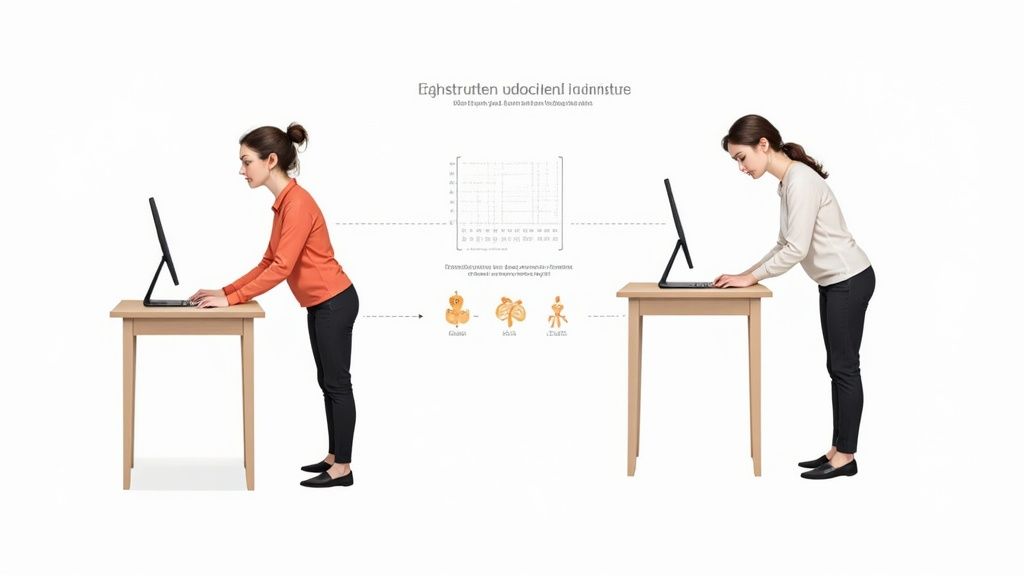
An individually adjusted desk height is the basis for your health and productivity. Incorrect settings lead to neck tension, headaches, and chronic back pain.
Such discomfort affects your well-being and work performance. A correctly adjusted workstation is a necessity for working healthily in the long term.
The Myth of One Size Fits All
The assumption that a fixed desk height of 72 cm is ideal for everyone is a myth. This measurement became established when the variety of body sizes played hardly any role in office furniture. A table that fits a person 1.80 m tall forces a person 1.60 m tall into an unhealthy posture.
This standardization leads to two problems:
Tables that are too high: You unconsciously shrug your shoulders, which leads to tension.
Tables that are too low: You hunch your back, which strains the lower back.
A chart for the correct desk height according to body size provides a good reference point. It helps you find a basic setting that is tailored to your body measurements.
The Development of Ergonomic Standards
Standards for desk height developed with workstation ergonomics. In the 1970s, studies examined the relationship between body size and optimal working height. The derived standard height of 72 cm was adopted by manufacturers for decades. A study by the Federal Institute for Occupational Safety and Health (BAuA) showed that in 2015, around 78% of office workers worked at such tables, although only about 45% of them fell within the suitable body size range. You can find more background on workstation design directly at the BAuA.
This gap between standard furniture and individual needs shows how important personal adjustment is. A height-adjustable desk is the most effective solution for this. It allows for millimeter-precise adjustment to your body proportions.
Detailed Tables for Desk Height According to Standards
Standardized specifications form the basis for healthy workstation design. DIN ISO 5970 and the DGErg provide well-founded values based on research. With their help, you can set up your desk ergonomically and avoid postural damage.
Two central points of contact in Germany are:
The measurements of DIN ISO 5970, which specify concrete heights.
The flexible ranges of the DGErg, which take individual deviations into account.
These tables are your starting point for an ergonomic basic setting. Based on this, you can later fine-tune and adjust the workstation to your proportions.
Comparison of DIN and DGErg Recommendations
This table compares the values according to DIN ISO 5970 and the guidelines of the DGErg for different body sizes.
Body Size
DIN 5970 Height
DGErg Recommendation
Note
Under 165 cm
62 - 68 cm
64 - 70 cm
DGErg tends to recommend slightly higher values.
165 - 175 cm
68 - 72 cm
70 - 73 cm
The overlap area is largest here.
175 - 185 cm
72 - 76 cm
73 - 76 cm
Both standards are very close to each other.
Over 185 cm
76 - 82 cm
76 - 80 cm
DIN allows for a larger upward leeway.
This overview helps you find the ideal range for your body size.
How to Correctly Apply the Table
The table provides a guideline. It cannot capture your individual proportions. Therefore, proceed as follows:
Use the measurements as a starting point.
Place your forearms at a 90-degree angle on the tabletop.
Make sure your shoulders remain relaxed.
Adjust the height in small steps until your body feel is right.
Don't get fixated on millimeters. If you notice that you are tensing your shoulders, further adjustment is necessary. In our guide, we show you how to calculate and adjust the optimal desk height.
According to a 2020 survey by the German Furniture Association, 88% of German companies use such tables to furnish their workplaces. A 2021 study by the Techniker Krankenkasse documented that this reduced work-related musculoskeletal disorders by 25%. You can learn more about the background of standardization work at the German Institute for Standardization.
Instructions: How to Measure and Adjust Everything Precisely
A table gives you a good guideline. However, you only achieve perfect ergonomics when you adjust the height to your body with millimeter precision. The key is the height of your elbows when sitting and standing.
With the following step-by-step guide, you will ensure that your workstation works optimally for you. The process begins with correctly adjusting your office chair.
Step 1: Correctly Adjust Chair Height
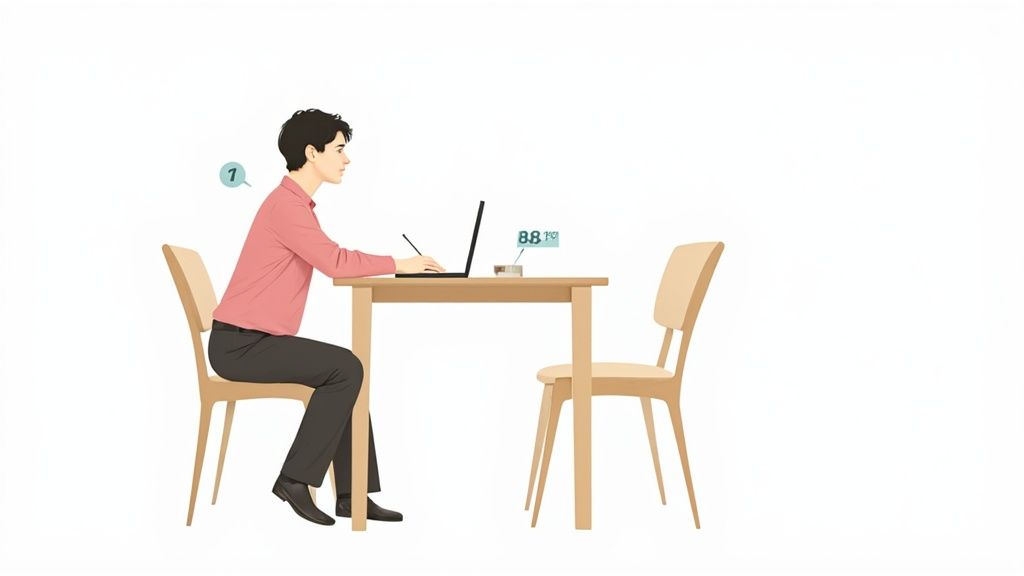
Sit upright on your office chair. Place both feet flat on the floor. Your knees should form an angle of approximately 90 degrees. There should be about three fingers' width of space between your knee hollow and the front edge of the seat.
This position is the basis for everything else. Only with a correctly adjusted chair can you sensibly adapt the desk height.
Step 2: Use Arms as a Measuring Tool
Let your shoulders hang loosely. Position your upper arms relaxed next to your body. Bend your forearms so that they form a 90-degree angle with your upper arms and are parallel to the floor.
The height of your elbows above the floor is the exact measurement for your optimal desk height when sitting.
Elbow height is the crucial factor for relaxed shoulder and neck muscles. If your forearms rest in a neutral position, you actively prevent tension.
Move the tabletop of your height-adjustable desk to exactly this height. Your forearms should rest flat on the tabletop or armrests without you having to raise your shoulders. Detailed instructions on how to correctly adjust your desk can be found in our guide.
This method ensures that the height of your desk is tailored to your individual body proportions. Repeat the process while standing to find your ideal standing height. Save both positions in your desk's memory function.
Individual Adjustments for Special Body Proportions
A desk height chart assumes average values. If your arms or legs are proportionally longer or shorter than your torso, fine-tuning is necessary.
Standard recommendations often don't fit exactly then. The table must adapt to your personal anatomy, not the other way around. With targeted corrections and the right aids, this is easy.
If Your Legs Are Disproportionately Long
Long legs with an average-length torso can lead to a dilemma. If you set the chair high enough for a 90-degree angle at the knees, the desk is too low for your arms.
The solution is simple:
Arms take priority: First, adjust the desk so that your forearms rest comfortably at a right angle on the tabletop.
A footrest takes care of the rest: If your feet are dangling, a footrest compensates for the distance to the floor. This ensures stability and good circulation.
This trick ensures the ideal posture in the upper body without compromising leg position.
If Your Arms Deviate from the Norm
Whether long or short arms, the elbow rule is crucial. It is more important than any table value.
Your elbow height dictates the table height. The standard table is a guide, your personal measurement is the decisive criterion.
Adjust the tabletop exactly to the height where your forearms rest at a 90-degree angle with relaxed shoulders. A height-adjustable desk allows for this millimeter-precise adjustment.
Additional aids further improve posture. Adjustable armrests on your office chair bridge the gap between your body and the table and relieve strain on your shoulders. A monitor arm allows you to adjust the screen to the perfect eye level regardless of the table height.
Optimally Utilize Height-Adjustable Desks
A height-adjustable desk is the core of a dynamic workstation. It gives you the freedom to organize your daily work flexibly.
With a Deskspace model, you can easily switch between sitting and standing at the touch of a button. The functions are designed to make everyday life uncomplicated.
Save your ideal sitting and standing height with the memory function.
Use the intuitive touch control for millimeter-precise adjustments.
The quiet dual-motor drive disturbs neither you nor your colleagues.
Structured alternation between postures prevents fatigue and can increase your productivity. Even small reminders help you stay in motion.
Set a 45-minute timer to remind you to stand up.
Set calendar alerts for your standing phases.
Use colored sticky notes on the monitor as a visual reminder.
The integrated anti-collision protection stops movement if there is an obstacle. Deskspace tables can support up to 200 kg and remain stable.
How the Memory Function Works
Setup is easy and done in a few seconds.
Find your optimal sitting position where your elbows rest at a right angle. Press and hold the "M" button and select Position 1 to save this height.
Then move the table to your perfect standing height and repeat the process by saving the height to Position 2.
A survey by the Techniker Krankenkasse shows that regularly switching between sitting and standing can reduce back pain by up to 30%.
The demand for height-adjustable desks in Germany increased by 700% in the last 20 years. While about 50,000 units were sold in 2005, over 400,000 were sold in 2020. Today, 62% of people working from home use or want such a desk.
Practical Examples for Dynamic Working
A marketing professional starts the day sitting for emails and switches to standing mode after two hours for creative brainstorming.
A developer uses the memory function specifically: sitting position for intensive programming phases, standing position for meetings.
A designer switches every 45 minutes to promote concentration and creativity.
Such routines help you utilize the advantages of both postures and avoid monotony.
Mistakes You Can Avoid
The most common mistake is not using the table and remaining in one position for hours.
Program the memory positions immediately after setup.
Do not change the height unprepared during an important conference.
Check occasionally whether your saved heights still fit.
With these tips, your Deskspace desk will become a tool for more well-being and productivity.
Around the correct desk height and perfect ergonomic adjustment, the same questions always arise. We have collected the most important ones for you and answered them briefly.
What Desk Height Is Ideal for Children?
Different rules apply to children, as they grow quickly. A height-adjustable desk that grows with them is the best solution. The tabletop should be at elbow height when the child is sitting and their forearms are at a 90-degree angle.
How Do I Find My Perfect Standing Height?
The correct height for working while standing is easy to find. Stand upright, with your shoulders relaxed. Your forearms should form a 90-degree angle to your upper arm and rest comfortably on the tabletop without raising your shoulders.
What If My Desk Is Not Adjustable?
A fixed desk is an ergonomic challenge. If the desk is too high, raise your office chair and use a footrest. If it is too low, you can prop it up with sturdy blocks. In the long term, a height-adjustable model is the best solution for your health. It adapts to you, not the other way around.
Your workspace should promote your health. Discover TÜV-certified, ergonomic desks from DESKSPACE and secure free delivery and a 100-day trial period. Find your perfect desk on deskspace.de now.