



Claiming home office expenses for maximum savings

You can deduct your home office from taxes. There are two ways to do this. Either you use the simple home office lump sum for each day you work from home. Or you deduct the actual costs for a home office. This is possible if your workspace meets the strict criteria of the tax office.
Which option brings you the greatest tax savings depends on your personal work situation.
The two ways to claim tax deductions for your home office
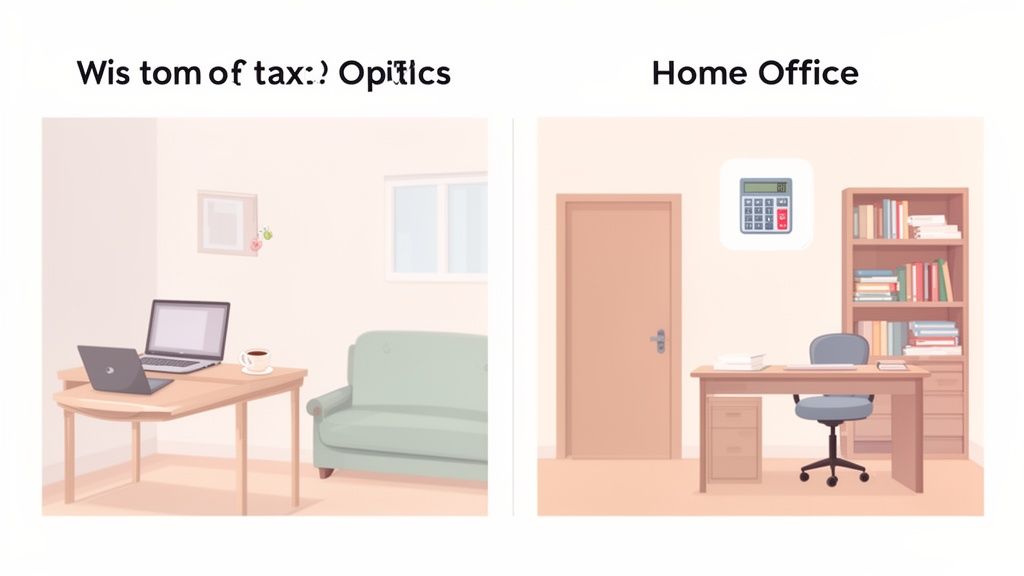
If you want to claim the costs for your home office for tax purposes, you must choose between two models. Each option has its own requirements and advantages.
The first method is the home office lump sum. This allows even those without a separate office to benefit from a tax relief. Even if you only use a corner of your living room to work, you can benefit from this deduction.
The second method is the home office. This option is only available if you use a separate, enclosed room almost exclusively for professional activities.
Legal changes since 2023
The regulations for the home office have been adapted to the changed world of work. Since 2023, the home office lump sum has been increased to a maximum of 1,260 euros annually. This corresponds to 6 euros per day for up to 210 working days. This increase is intended to offset the increased costs for electricity and heating.
At the same time, the hurdles for a home office are higher. You can only deduct it if it constitutes the focal point of your entire professional activity. More details on the requirements can be found, for example, in the guide from qonto.com.
To help you decide which method is right for you, here is a direct comparison.
Home Office Lump Sum vs. Home Office in Comparison
A direct comparison of the two deduction options helps you find the right choice for your situation.
| Feature | Home Office Lump Sum | Home Office |
|---|---|---|
| Requirement | No separate room needed, a workspace corner is sufficient | Separate, enclosed room |
| Usage | No requirement for intensity of use | Almost exclusive professional use (>90%) |
| Condition | Working predominantly from home on that day | Must be the focal point of the entire professional activity |
| Maximum Amount | 1,260 Euros per year (6 Euros x 210 days) | Actual costs (rent, electricity, etc.) or annual lump sum of 1,260 Euros |
| Proof | Simple documentation of work days | Extensive proof of costs and usage required |
The overview shows the fundamental differences. The lump sum is the more practical solution for most employees. The home office can be financially more advantageous for self-employed individuals or professional groups with a clear work center at home.
How to correctly use the home office lump sum

The home office lump sum is the easiest way to claim your work from home for tax purposes. It was created for cases where a full-fledged office is missing or the strict requirements cannot be met. Whether you work at the kitchen table or use a corner of the living room, you can use the lump sum.
The advantage lies in the low effort. Instead of collecting cost statements and receipts, you claim a fixed amount per workday. This saves time.
What are the conditions for the lump sum?
For you to be able to claim the home office lump sum, a few clear conditions must be met. The tax office checks whether the deduction is justified.
The crucial rule is that you must have predominantly worked from home on the respective day. Your working time at home must have been longer than at any other location, for example, in the company office.
At the same time, you may not claim travel expenses to your primary workplace for the same day. Combining both lump sums on one day is not allowed.
The home office lump sum is a simplified compensation for costs incurred through the professional use of your private premises, i.e., proportionate rent, electricity, and heating.
How to calculate your entitlement
The calculation is simple. For every day you meet the requirements, you can claim 6 euros. However, there is an upper limit.
You can claim the lump sum for a maximum of 210 days per calendar year.
This results in a maximum deductible amount of 1,260 euros per year (210 days × 6 euros). Even if you were in your home office for more than 210 days, this maximum amount still applies.
-
Example 1: Part-time Home Office
You work completely from home for 150 days a year. Your calculation is: 150 days × 6 euros = 900 euros. You can claim this amount as income-related expenses. -
Example 2: Full-time Home Office
You worked from home for 230 days. In this case, the upper limit applies. So you can only claim a maximum of 210 days, which corresponds to a deductible sum of 1,260 euros.
How to document your days for the tax office
A formal certificate from your employer is not necessary. Nevertheless, you must credibly demonstrate to the tax office, if requested, on which days you were in your home office. Clean documentation is therefore mandatory.
A simple record is sufficient for this. Keep a list or mark the days in your calendar. You should keep these notes in case the tax office asks for them.
The relevance of this regulation is shown by current figures. The home office rate in Germany has stabilized at just under a quarter. According to a study by the ifo Institute, in February 2025, 24.5 percent of employees worked at least partially from home. This underscores the importance of the lump sum for many employees. More about the development of home office use in Germany can be found here.
The lump sum in conjunction with income-related expenses
It is important to understand how the home office lump sum works in the overall context of income-related expenses. It is a building block and is not simply reimbursed additionally.
Every employee automatically receives the employee lump sum of 1,230 euros (as of 2024) from the tax office. This amount is deducted from your taxable income without you having to submit receipts.
You only achieve a real tax saving through your income-related expenses if their total amount exceeds this lump sum of 1,230 euros. The home office lump sum helps you overcome this hurdle. All other job-related expenses, such as for specialized literature, work equipment, or training, are added to it.
When you can deduct a home office
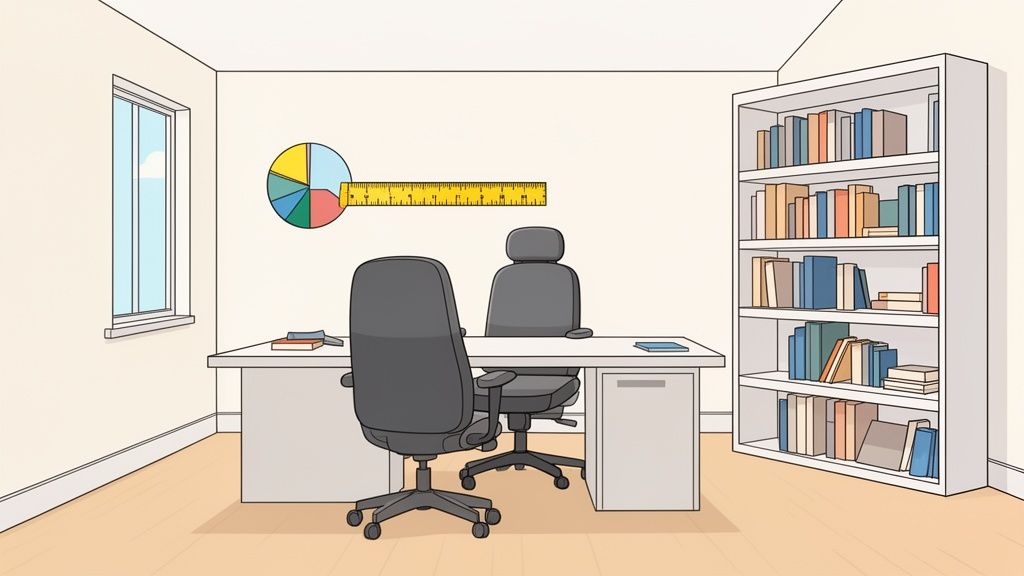
Deducting a home office from taxes is often more financially attractive than the home office lump sum. However, the tax office's hurdles are high here and the rules are clearly defined. A working corner in the living room, as is sufficient for the lump sum, is not enough here.
This option is only available if your entire professional life demonstrably takes place within your own four walls. This primarily affects self-employed individuals, freelancers, or employees in specific constellations. If you meet the criteria, you may claim a proportional share of the actual costs incurred.
The strict criteria for a home office
For the tax office to recognize your room as a home office, several conditions must be met. It must be a separate room, enclosed by a door, and clearly integrated into your private apartment or house. A walk-through room, an open gallery, or a niche in the hallway are not sufficient.
The biggest hurdle is the almost exclusive professional use. You must prove that the room is used for at least 90% for your professional or business activities. Any significant private co-use as a guest room, storage room, or hobby room is excluded.
The tax office may request evidence such as photos, a floor plan, or a detailed description of the room. A clear separation between professional and private life is essential.
The focal point of your entire professional activity
Since 2023, an even stricter regulation applies. Your home office must be the focal point of your entire professional and business activity. This is the key prerequisite for deducting actual costs.
The tax office examines where the qualitative focus of your work lies. It matters where you perform the activities that are essential and formative for your profession. Merely performing occasional administrative tasks from home is not enough. A comparison with the characteristics of professional office and practice spaces can help to understand the requirements.
- Example Teacher: A teacher teaches in school. Although they spend time at home preparing and following up, the qualitative focus of their activity is in the classroom. Their home office is therefore not the focal point. They must use the home office lump sum.
- Example Content Creator: A YouTuber who exclusively films, edits, and publishes their videos in their home studio has the focal point of their activity here. They can claim the full costs for their home office.
How to calculate deductible costs
If your home office meets all criteria, you can claim a proportional share of your apartment costs as income-related expenses or business expenses. The calculation is based on the proportion of your home office's area to the total living space.
The formula is:
(Home office area in m² / Total living area in m²) x 100 = percentage cost share
You apply this percentage to all apportionable costs.
The following costs can be claimed proportionally:
- Rent
- Utilities such as heating, water, garbage collection
- Electricity costs
- Renovation costs in the home office (100%)
- Interest on real estate loans
- Depreciation of the building (AfA)
You can find more details in our article on deducting costs for your home office.
A concrete calculation example
Your apartment has 100 m² and your home office measures 15 m². The share of the home office is therefore 15 %.
Your annual housing costs are as follows:
| Cost Type | Annual Total Costs | Share of Home Office (15 %) |
|---|---|---|
| Cold Rent | 12,000 € | 1,800 € |
| Utilities | 2,400 € | 360 € |
| Electricity | 1,200 € | 180 € |
| Total Proportional Costs | 15,600 € | 2,340 € |
In this case, you could claim 2,340 Euros for your home office in your tax return. This is significantly more than the maximum amount of the home office lump sum. You must carefully keep all receipts such as rental agreements and utility bills.
Correctly deducting work equipment and office furniture
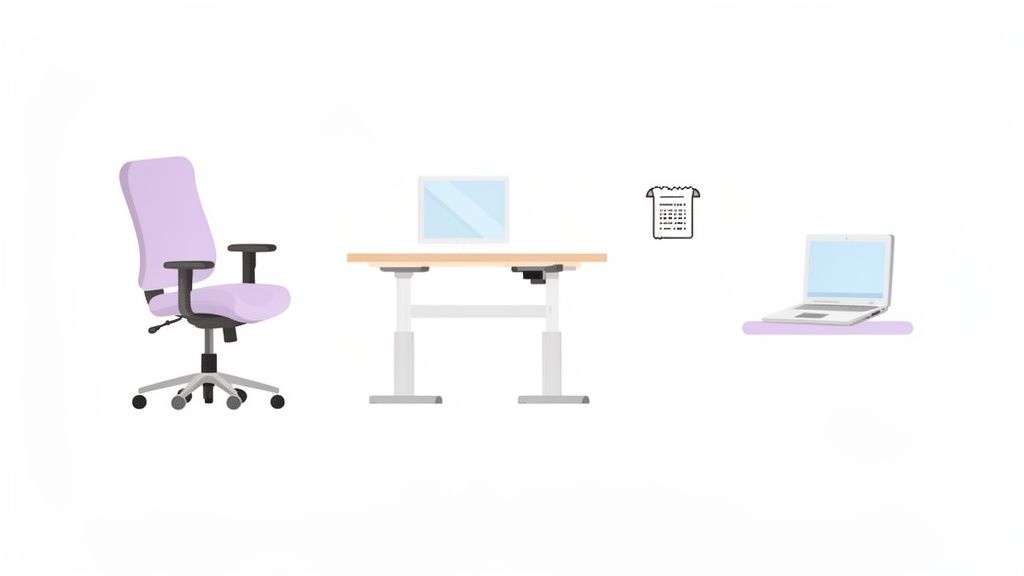
A decisive advantage is that you can always deduct work equipment in addition. This applies regardless of whether you use the home office lump sum or claim the costs for a home office. Every investment in your professional equipment reduces your tax burden.
This includes laptops, monitors, and furniture. A height-adjustable desk or an ergonomic office chair are classic work tools. They are deductible.
The tax office distinguishes between two methods: immediate deduction in the year of purchase or depreciation over several years.
Immediate deduction for low-value assets (GWG)
The simplest method is the immediate deduction for low-value assets (GWG). Here you can claim the acquisition costs immediately and in full in the year of purchase as income-related expenses.
The prerequisite is a price limit. An asset is considered a GWG if the purchase price is a maximum of 800 euros net. This corresponds to a gross price of 952 euros with 19% VAT.
The net amount is important. Check the invoice to see if the price without VAT is within the 800-euro limit. If it is higher, immediate deduction as a GWG is not possible.
Examples of typical GWG are:
- An office chair up to 952 euros gross.
- A monitor or printer in this price range.
- Specialized literature or an external hard drive.
Depreciation over the useful life (AfA)
If a work tool costs more than 800 euros net, you must spread the costs over several years. This process is called depreciation for wear and tear (AfA). You distribute the purchase price evenly over the useful life determined by the tax office.
The official AfA tables of the Federal Ministry of Finance specify over how many years an asset is depreciated. For office furniture such as desks, a useful life of 13 years applies.
An example of AfA:
You buy a height-adjustable desk for 1,300 Euros. Since the price is above the GWG limit, you must depreciate it over 13 years.
- Calculation: 1,300 Euros / 13 years = 100 Euros per year.
- Result: You can claim 100 Euros as income-related expenses each year for 13 years.
For digital assets such as computers, laptops, or software, a simplification has applied since 2021. The useful life has been set to one year across the board. You can fully depreciate such devices in the year of acquisition, regardless of the price. This practically acts like an immediate deduction.
A detailed overview can be found in our guide Tax Deduction for Office Furniture.
Overview of typical work equipment
The list of deductible work equipment is long. In principle, you can claim anything that you demonstrably need for your professional activity.
Here is an overview to help categorize the most common purchases.
Depreciation of Work Equipment in the Home Office
This table shows typical work equipment, their useful life according to the AfA table, and whether an immediate deduction is possible.
| Work Equipment | Useful Life (AfA) | Immediate Deduction Possible? | Example |
|---|---|---|---|
| Height-Adjustable Desk | 13 years | No, usually > 800 Euros net | A purchase price of 1,300 Euros is depreciated over 13 years (100 Euros/year). |
| Ergonomic Office Chair | 13 years | Yes, if under 800 Euros net | At a price of 700 Euros net, the amount can be deducted immediately. |
| Laptop / PC | 1 year | Indirectly, through 1-year AfA | A laptop for 1,500 Euros is fully depreciated in the year of purchase. |
| Monitor | 1 year (as peripheral device) | Indirectly, through 1-year AfA | A monitor for 600 Euros is fully depreciated in the year of purchase. |
| Printer | 1 year (as peripheral device) | Indirectly, through 1-year AfA | A printer for 300 Euros can be fully deducted in the same year. |
| Specialized Literature | No fixed duration | Yes, if under 800 Euros net | A specialized book for 80 Euros is immediately claimed as an income-related expense. |
The table shows how varied the rules can be. Especially with IT equipment, you benefit from the one-year depreciation.
Proof of professional use
For the tax office, it is crucial that you primarily use the work equipment professionally. For typical office items such as a desk or office chair, a professional reason in a home office is generally assumed.
For items that could also be used privately, you should credibly demonstrate the proportion of professional use. Private co-use of up to 10% is harmless.
Always collect all invoices and receipts. They are your proof of purchase price and acquisition date. Proper filing ensures that you fully exploit your investments for tax purposes.
How to include your home office costs in your tax return
You have all your deductible expenses together. Now comes the crucial part: entering them correctly into your tax return. Digital aids like ELSTER make the process easier, but care is needed. Here I will show you where to enter the costs for your home office and your work equipment.
For most employees, Schedule N for income from non-self-employment is important. All income-related expenses are listed here.
Entering the home office lump sum in Schedule N
The home office lump sum is quickly dealt with and goes directly into Schedule N.
- In your tax return, open Schedule N.
- Go to the "Income-related expenses" section.
- There is a dedicated line here for the "Home office lump sum".
- Enter the number of your home office days (maximum 210) there. The software calculates the total amount automatically.
An important note: For days on which you claim the lump sum, you may not claim the commuter allowance for travel to your workplace.
Correctly recording home office and work equipment
The costs for a recognized home office and your work equipment are also included as income-related expenses in Schedule N.
Look in Schedule N under the section "Other income-related expenses". This is where the total of all your expenses that have not already been claimed elsewhere goes, for example, the proportional rent for your home office or the depreciation for your desk.
Tip: Group your expenses into blocks. Write "Office supplies," "Specialized literature," or "Depreciation of office furniture." This provides clarity.
The screenshot from the ELSTER portal shows you where to find the fields for income-related expenses in Schedule N.
This is where you enter the calculated sums. Whether it's a lump sum or actual costs, this is the lever you use to reduce your tax burden.
Your checklist for a smooth tax return
Good preparation helps to avoid mistakes and not to forget any deductible items.
You should have the following documents and receipts at hand:
- Record of your home office days: A list or a calendar.
- Invoices for work equipment: All purchase receipts for desk, chair, laptop, etc.
- Cost breakdown for the home office: Detailed calculation of rent and utilities.
- Related documents: Rental agreement, utility bill.
Create a digital folder for this or collect everything in a binder. This way, you have everything ready if there are any queries. You do not have to send receipts directly, but the tax office can request them. You can find more information in our guide on the Home Office Lump Sum in the Tax Return.
Also check whether other expenses are deductible. If you had to move for professional reasons, you may be able to deduct moving costs. It is worthwhile to check all potential income-related expenses.
The most frequently asked questions about tax deductions for home offices
Here you will find answers to the most frequently asked questions about home office and taxes.
Can I use the home office lump sum and the commuter allowance on the same day?
No. The law prohibits you from claiming both the home office lump sum and the commuter allowance for the same workday. You must choose for each day.
On days when you commute to the office, you claim the commuter allowance. On days when you predominantly worked from home, you use the home office lump sum.
Do I need a certificate from my employer for my home office days?
No, an official certificate is not required. It is important that you can credibly substantiate your statements if requested.
Keep an informal list, for example in an Excel spreadsheet, or mark the days in your calendar. Keep these records carefully.
The principle of "credibility" means that your statements must be comprehensible to the tax office. Clean documentation avoids queries.
What happens if my income-related expenses are below the lump sum?
Every employee automatically receives the employee lump sum of 1,230 euros. This amount is deducted from your taxable income without you having to submit receipts.
You only achieve an additional tax saving if the sum of all your income-related expenses (home office lump sum, work equipment, etc.) exceeds this lump sum of 1,230 euros.
Can I deduct my desk even if I use the lump sum?
Yes. The costs for work equipment such as a desk, office chair, or laptop are separate income-related expenses. You can always claim these in addition to the home office lump sum.
The lump sum is only compensation for room-related costs such as rent, electricity, and heating. It does not cover the purchase of your office equipment.
Do I have to pay taxes on gifts or free products from companies?
In most cases, yes. Free products you receive as part of a collaboration are considered non-cash benefits for tax purposes. You must declare them at their market value in your tax return.
There are exceptions:
- Low-value products: Value under 10 euros.
- Loans: You return the product after testing.
- Flat-rate taxation: The company takes care of the taxation for you (ask!).
Keep all communication with the company as proof.
As a self-employed person, can I deduct energy costs for my office?
Yes, as a self-employed person, you can deduct energy costs as business expenses. If you use a recognized home office, you calculate the proportion of costs percentage-wise based on the area.
If you have an external office, the electricity and heating costs incurred there are fully deductible. A clear separation between private and business energy costs is important.
An ergonomic workstation is an investment in your health and tax deductible. At Deskspace, you will find TÜV-certified, height-adjustable desks and ergonomic chairs. Discover the right furniture for your home office now: https://deskspace.de


