

Back Workout Without Equipment for a Strong Back at Home

Anyone who spends a lot of time at a desk knows the feeling: back pain, tense shoulders, and declining concentration. Targeted back training without equipment is an effective solution. It helps you prevent back problems, improve your posture, and strengthen your core muscles with simple bodyweight exercises. You don't need a gym or expensive equipment for this.
Why a strong back is the foundation for productive work
Prolonged sitting puts a lot of strain on the spine. We often stay in the same position for hours, which can lead to muscular imbalances. The anterior muscle chain, i.e., chest and abdominal muscles, shortens. At the same time, the back muscles become overstretched and weaker.
You don't just feel this through tension after work. A weak back directly affects your concentration and productivity. Constant pain is a distraction and costs mental energy that you need for your tasks.
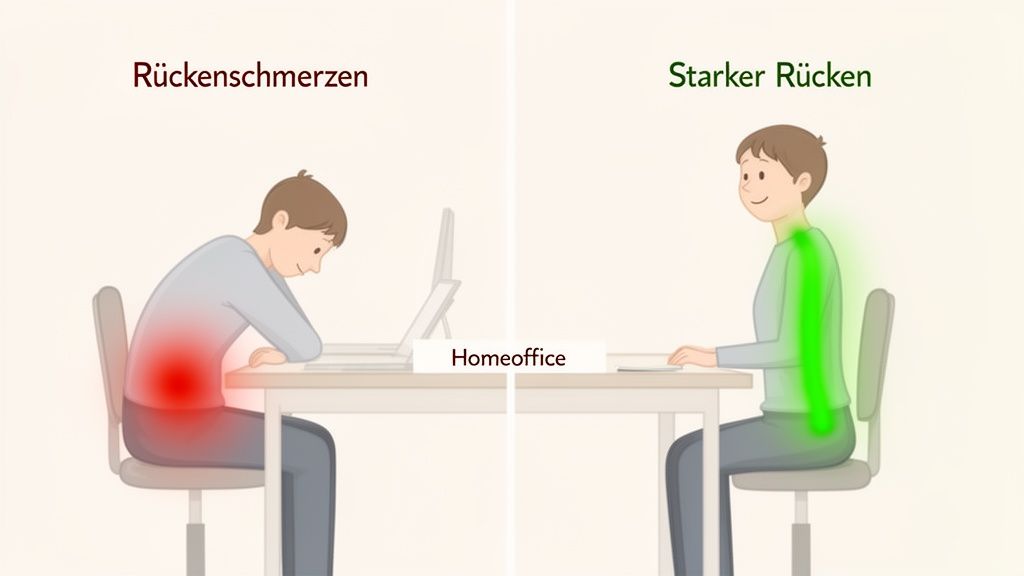
The invisible danger of sitting
Back pain is widespread and has become a common disease. The numbers are clear. In Germany alone, 26.2 million people were affected by medically documented back pain in 2021. That's almost a third of the population. The AOK Health Atlas provides further details on this data.
Targeted back training without equipment addresses precisely this. It reactivates and strengthens the muscles that are often neglected in everyday life.
A strong core is the foundation of the body. It stabilizes your spine with every movement and protects it from overload, especially during long periods of sitting.
The benefits go beyond pain prevention. Upright posture also improves oxygen intake, which in turn can promote your concentration.
The solution lies in simplicity
The biggest advantage of bodyweight exercises is their accessibility. You don't need expensive equipment or a gym membership. Your own body weight is the only training tool you need. It can be adapted to your individual fitness level.
You can flexibly incorporate the exercises into your daily routine:
- In the morning: Start the day with a short routine to activate your muscles.
- During breaks: Use short interruptions for mobilization exercises.
- In the evening: Release the day's tension with a targeted workout.
This flexibility allows you to become active anytime, anywhere and establish a sustainable routine for your back health. In combination with ergonomic adjustments at the workplace, this is a direct investment in your long-term performance. You can find additional tips in our article on back-friendly working.
Understanding the principles of an effective back workout
A strong back requires a structured approach. A good back training without equipment is more than a random sequence of exercises. It follows clear principles that strengthen your muscles without overstraining your body. The goal is a healthy balance between mobility, strength, and stability.
This foundation helps you not only to relieve tension in the short term but also to build robust back muscles in the long term. Each part of the workout has an important function.
Warm-up as an indispensable starting point
Before you start strengthening, your body needs to get up to operating temperature. A targeted warm-up promotes blood circulation in the muscles and makes the joints more flexible. This prepares your system for the upcoming strain.
A good warm-up for the back consists of dynamic movements, not static stretching. These include gentle torso rotations or the cat-cow exercise. Such movements mobilize the spine and activate the deep stabilizers. Often, five minutes are enough to reduce the risk of injury and increase the effectiveness of your training.
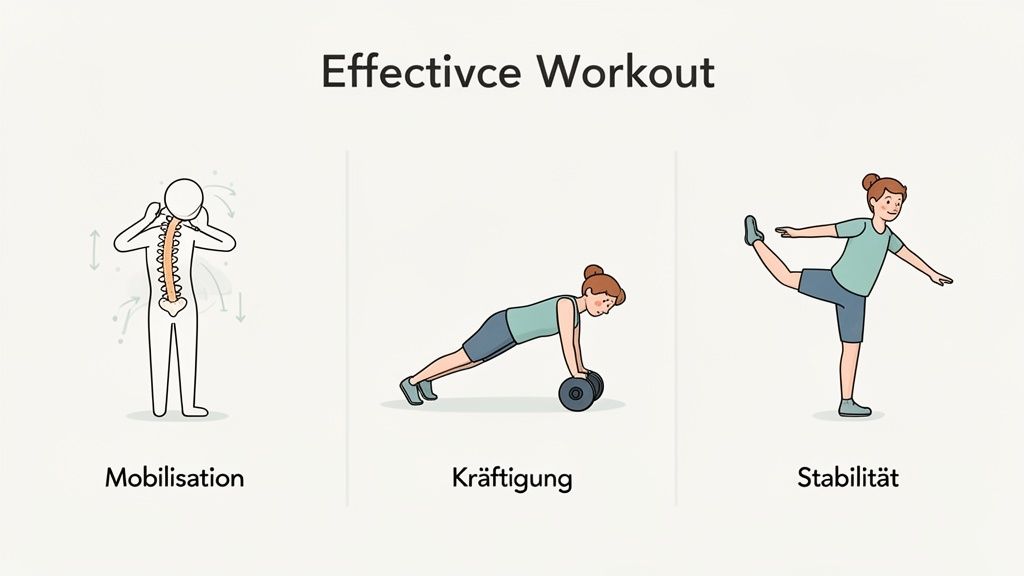
The three pillars of your training
A balanced back workout is based on three central pillars that work together. Each pillar is essential for a healthy back.
- Mobilization: This involves exercises that improve the mobility of your spine and adjacent joints like hips and shoulders. This counteracts the typical stiffness caused by prolonged sitting.
- Strengthening: This includes muscle building for the back and core. Strong muscles support your spine like a natural corset and relieve pressure on the intervertebral discs.
- Stability: With stability exercises, you train the coordination of your deep core muscles. They protect your spine during everyday movements such as lifting or turning.
Training that only considers one of these pillars is incomplete. Only the combination of mobility, strength, and control leads to a resilient back.
Knowledge of this is widespread. According to an AOK survey, 98 percent of respondents know that exercise is important for a healthy back. The problem: only 51 percent actively implement this knowledge. You can find more about this discrepancy in the summary analysis of the survey.
Cool-down: Allow your body to recover
After training, recovery begins. A short cool-down helps your body switch from exertion to recovery mode. It supports the removal of metabolic products from the muscles and can reduce muscle soreness.
Gentle stretching exercises that you hold for 20 to 30 seconds are ideal for this. Focus on the muscles you trained, such as the back extensors, glutes, and hip flexors. Conscious, calm breathing also helps calm the nervous system and promote the recovery process.
The 7 most effective exercises for your back workout
A strong back doesn't require a gym. With the right exercises that engage multiple muscle groups simultaneously, you can achieve a lot even without equipment. The following seven exercises form a complete workout that strengthens your entire back, from the lumbar spine to the shoulders.
Clean and controlled execution is important. Quality is more important than quantity.
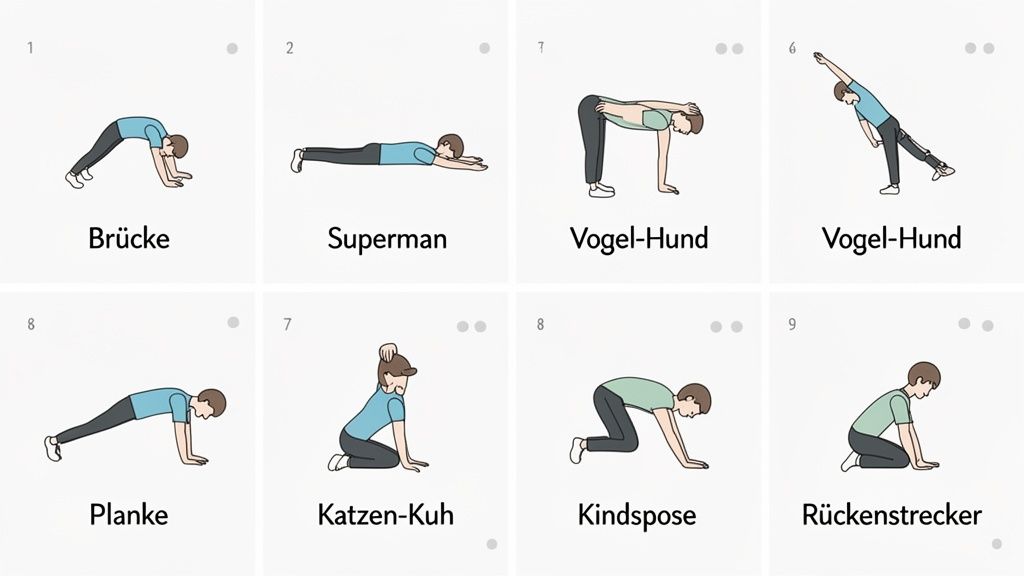
1. The Bridge (Glute Bridge)
This classic exercise is particularly effective if you sit a lot. The bridge strengthens the lower back and activates your glutes and hamstrings. It is ideal for activating shortened muscles after a long day at work.
- Starting position: Lie on your back with your feet hip-width apart. Your heels should be close enough that you can touch them with your fingertips. Your arms rest relaxed next to your body.
- Movement: Tighten your glutes and abs and slowly lift your hips. Your body should form a straight line from your knees to your shoulders.
- Repetitions: Hold the highest position for two to three seconds before slowly lowering your hips. A good guideline is 12 to 15 repetitions.
2. The Superman
This exercise, also called "swimmer," is excellent for your back extensors and core stability. It strengthens the upper and lower back simultaneously.
- Starting position: Lie flat on your stomach. Extend your arms forward and your legs backward. Your gaze is directed towards the floor to keep your neck relaxed.
- Movement: Simultaneously lift your right arm and left leg. Hold the tension for a brief moment and lower both again. Then switch sides.
- Repetitions: Perform the alternating movement until you have completed a total of 20 repetitions (10 per side).
3. Quadruped position with diagonal lifts
This exercise focuses on coordination and the activation of the deep core muscles. These muscles are crucial for stabilizing your spine in everyday life.
- Starting position: Get into the quadruped position. Place your hands directly under your shoulders and your knees under your hips. Your back remains straight.
- Movement: Slowly extend your right arm forward and your left leg backward simultaneously. Form a stable line and avoid arching your back.
- Repetitions: Hold the extended position for a few seconds and then return to the starting position in a controlled manner. Switch sides and perform the exercise 10 times per side.
Studies confirm the effectiveness of core training. Research at German universities shows that just two to three sessions of 30 minutes per week can bring significant improvements.
4. Standing Row (bent-over)
Rowing also works without weights. With this exercise, you simulate the classic rowing motion and specifically train the muscles in the upper back and between the shoulder blades. This is important for upright posture.
- Starting position: Stand hip-width apart, bend your knees slightly, and lean your upper body forward with a straight back.
- Movement: Let your arms hang loosely. Then pull your shoulder blades together and guide your elbows close to your body upwards and backward.
- Repetitions: Hold the tension at the highest point briefly and then slowly lower your arms again. 15 repetitions are ideal.
5. Pelvic Tilts while lying down
This is a subtle yet very effective exercise. It activates the deep abdominal muscles and gently mobilizes the lumbar spine. This helps with tension in the lower back.
- Starting position: Lie on your back with your knees bent. Normally, there is a small gap between your lower back and the floor.
- Movement: Tighten your abdominal muscles and tilt your pelvis backward so that your lower back presses firmly against the floor.
- Repetitions: Hold this tension for about five seconds and then relax. Repeat this 10 times. You can find more targeted exercises for the lower back in our separate guide.
6. Push-up with shoulder tap
This variation of the classic push-up additionally challenges your core stability and coordination. You strengthen not only your chest, shoulders, and arms but your entire core.
- Starting position: Start in the high plank position. Your hands are under your shoulders, and your body forms a straight line.
- Movement: Perform a clean push-up. When you are back up, lift one hand and briefly tap the opposite shoulder. Your hips should remain stable.
- Repetitions: Do the next push-up and then tap with the other hand. Alternate until you have completed 8 to 12 repetitions.
7. Side Plank
The lateral core muscles are often neglected but are very important for spinal stability. The side plank is the ideal exercise to strengthen this area.
- Starting position: Lie on your side and support yourself on your forearm. Your elbow is directly under your shoulder.
- Movement: Lift your hips off the floor until your body forms a straight line from head to toe. Tighten your core firmly and hold the position.
- Duration: Hold this position for 20 to 30 seconds before switching sides.
If you're looking for more variety in your training, you'll find comprehensive back exercises here.
Your practical weekly plan for a healthy back
The best exercises are only effective if they are performed regularly. The key to a strong back is a routine that fits into your daily life. This simple weekly plan helps you train consistently without overdoing it.
The plan starts with short sessions of only 15 to 20 minutes. It specifically alternates between strengthening and mobilization to ensure your back is comprehensively trained and to prevent overloads.
How to build a solid routine
Consistency is more important than intensity. Consider this plan a template that you can flexibly adapt. If a training day is missed, simply swap it with a rest day. The goal is to develop a habit, not to work through a rigid schedule.
Listen to your body. Slight muscle soreness after training is normal, but pain is not. Adjust the intensity to how you feel and pay attention to clean execution.
Regular, short, and targeted stimuli make the difference for a long-term strong back, not a single, strenuous session per week.
The rhythm is simple: three active days, two days for active recovery, and two complete rest days. This gives your muscles enough time to regenerate and grow.
Example weekly plan for your back training
This flexible plan combines strengthening and mobility units. This way, your back remains not only strong but also mobile.
| Day | Focus | Duration |
|---|---|---|
| Monday | Strengthening | 15-20 minutes |
| Tuesday | Active recovery | 10 minutes |
| Wednesday | Mobilization & Stability | 15 minutes |
| Thursday | Rest day | - |
| Friday | Strengthening | 15-20 minutes |
| Saturday | Active recovery | 10 minutes |
| Sunday | Rest day | - |
This structure offers a clear framework, but leaves enough room for adjustments.
How to structure your training days
Each training day has a clear focus to make the best use of time. Here's how you can specifically divide the exercises presented.
Monday & Friday: Strengthening
On these days, the focus is on muscle building. Do two to three sets of each exercise.
- Warm-up (3 minutes): Start with dynamic movements like arm circles or the cat-cow exercise to prepare the body.
- Bridge: 12–15 repetitions for the lower back and glutes.
- Superman: 10 repetitions per side to activate the back extensor muscles.
- Standing Row: 15 repetitions for the upper back and better posture.
- Side Plank: Hold for 20–30 seconds per side to strengthen the lateral core muscles.
- Cool-down (2 minutes): Finish with a gentle stretch, for example, in child's pose.
Wednesday: Mobilization & Stability
Today we focus on flexibility and deep-seated muscles. Perform movements slowly and in a controlled manner.
- Warm-up (3 minutes): Begin with gentle pelvic circles and standing spinal rotations.
- Quadruped position with diagonal lifts: 10 slow repetitions per side. Focus on balance and control.
- Pelvic Tilts while lying down: 10 repetitions, hold the tension at the end for about 5 seconds.
- Push-up with shoulder tap: 8–10 repetitions in total. Keep the torso stable.
- Cool-down (3 minutes): Stay a little longer in child's pose and gently stretch the lower back.
On days for active recovery (Tuesday & Saturday), light movement is sufficient. A short walk or some stretching exercises promote blood circulation and support regeneration.
Consider this weekly plan your starting point. Adapt it to your needs and find a routine that feels good.
How to integrate movement into your workday
Targeted back training without equipment is an excellent foundation. However, the key to a long-term healthy back is to establish movement as an integral part of your day. It's about regularly interrupting prolonged sitting and continuously giving your back breaks.
The combination of exercises and an ergonomic work environment is particularly effective. A height-adjustable desk is an important tool here. With it, you can easily switch between sitting and standing and prevent one-sided strain on your spine.
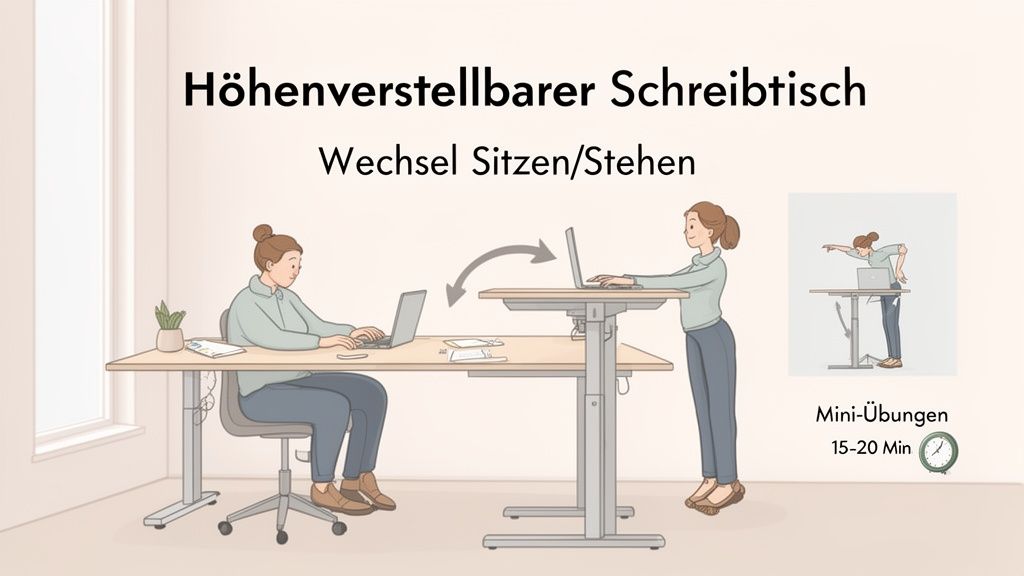
The change makes the difference
Our body is made for movement, not for hours of staying in one position. The dynamic alternation between sitting and standing promotes blood circulation, activates different muscle groups, and supplies your intervertebral discs with nutrients.
A simple rule of thumb is: 60% sitting, 30% standing, and 10% active movement. Use every opportunity to change your posture. A timer on your PC or phone can remind you.
Micro-workouts directly at your desk
You don't have to leave your workplace to do something for your health. Small exercise units, so-called micro-workouts, can be easily integrated into your daily routine. They are ideal for relieving acute tension and loosening muscles.
Here are some simple exercises:
- Shoulder circles: Sit upright with your arms relaxed. Circle your shoulders slowly 10 times backward and then 10 times forward. This relieves tension in the neck and shoulder area.
- Standing chest stretch: Stand in a doorway. Place your forearms left and right on the frame and take a small step forward until you feel a comfortable stretch in your chest. Hold this for 20 to 30 seconds.
- Calf raises: Stand behind your chair and hold onto the backrest. Slowly push yourself up onto your tiptoes, hold the tension briefly, and then lower your heels. Repeat this 15 times.
These small exercises break the monotony. For even more ideas, check out our article on gymnastics with a chair.
Movement breaks are not wasted work time. They are an investment in your concentration and productivity for the rest of the day.
Every movement counts and supports the effect of your back training. Take the stairs instead of the elevator or make phone calls while standing.
Frequently Asked Questions about Back Training
When you start back training without equipment, questions may arise. Here are the answers to the most common uncertainties, directly and factually.
How often per week should I do back training without equipment?
For noticeable results, two to three training sessions per week are ideal. However, regularity is more important than frequency. If you're just starting, two sessions are a good beginning. You can increase the frequency when you feel ready.
Additionally, short, daily movement breaks help. They are a good remedy for prolonged sitting and keep your back muscles active.
What to do in case of pain during exercises?
Pain is an important signal from your body. A slight pulling sensation or noticeable muscle strain is normal. However, a sharp, sudden pain is a clear stop signal.
If you feel such pain, you should do the following:
- Stop immediately. Do not try to ignore the pain.
- Check your technique. Often, incorrect execution is the reason.
- Choose an easier variation. Sometimes it helps to reduce the range of motion.
If the pain persists, give your back a few days of rest. If the discomfort continues, consult a doctor or physical therapist.
Safety comes first. Properly executed training prevents injuries and is the key to long-term success. It's about intelligently challenging the body, not enduring pain.
How long does it take until I see first results?
The first positive effects are often noticeable quickly. Many people notice a more upright posture and a reduction in minor tension after just two to four weeks of regular training.
Significant strength building and a noticeable relief of existing complaints take more time. Here you can expect solid results after about six to eight weeks. Patience and consistency are crucial.
Can I prevent a herniated disc with these exercises?
Yes, targeted core muscle training is an effective prevention against a herniated disc. By strengthening your back, abdominal, and lateral core muscles, you build a natural supportive corset.
This muscle corset relieves your spine in everyday life, whether lifting, carrying, or sitting. Regular mobilization also ensures that your intervertebral discs are better supplied with nutrients and remain elastic. Important: In case of pre-existing conditions or injuries, you should discuss your training program with a doctor beforehand.
A strong back is the basis for a productive and pain-free workday. The combination of targeted exercises and an ergonomic work environment is the most effective way. Discover high-quality, height-adjustable desks at Deskspace that help you seamlessly integrate movement into your day. Find the right model for your workplace now.


