

Setting up your desk in the bedroom optimally

A desk in the bedroom is often a necessity, not a design choice. If there's no separate office, the private retreat becomes a workspace. The key is to design this area so that it enables focused work and protects your night's sleep.
The Reality of a Bedroom Workspace

Working from home has become a part of everyday life for many. This brings flexibility but also spatial challenges. Few people have an unused room that can serve as an office.
Therefore, a desk in the bedroom is a common solution. Studies show that only about 56 percent of people working from home have a dedicated office. This means almost half use improvised solutions in the living room, dining room, or bedroom.
Integrating a workspace into the most private room is challenging. A table and chair in the corner are not enough. It's about creating an environment for two opposing demands: focus during work and relaxation afterward.
Challenges and Solutions
The biggest hurdle is the lack of separation. This is both spatial and mental. If your laptop is just a few feet from your pillow, it's hard for your brain to switch off. The workspace constantly reminds you of open tasks and can disturb your sleep.
A thoughtfully designed workspace in the bedroom is not a compromise. It's a conscious decision for your well-being and productivity. With the right strategy, you can prevent work and private life from blurring unhealthily.
To avoid these problems, clear structures are essential. Your goal is a functional and ergonomic workspace that doesn't detract from the calming atmosphere of your bedroom. Three points will help you with this:
- Visual separation: Use furniture, a room divider, or a rug to delineate the work area from the sleeping area.
- Clear rituals: Develop fixed routines for the beginning and end of your workday. This helps you mentally draw a line.
- Order: A tidy desk reduces visual stress and makes it easier to mentally let go after work.
This guide provides you with practical strategies for a functional workspace in the bedroom. Here you can also find 10 effective tips for working from home. You will create a solution that harmoniously integrates into your life.
Finding the Perfect Spot for Your Desk

The position of your workspace in the bedroom affects your concentration and recovery. It's not just about finding a free corner. The right location is a strategic decision.
Many people place their desk so that their back is to the door. Psychologically, this is not a good position. People feel safer when they have their surroundings in view. Sitting with your back to the entrance can unconsciously cause tension.
A direct view out the window is a distraction. There are always distractions outside. At the same time, your eyes have to adjust to the brightness differences between the outside and the monitor. This tires your eyes.
Ideal Positioning in the Room
The optimal position for a desk in the bedroom combines psychological and ergonomic aspects. Your goal is a setup that provides security and good working light.
Place the desk so that you can see the door. A lateral or diagonal position to the door is ideal. A solid wall behind you also provides protection and stability. This "command position" helps you concentrate better.
Light is also a crucial factor. Position your workspace sideways to the window. This way, you get natural daylight on the work surface without being blinded or having reflections on the screen.
Dealing with Difficult Room Situations
Not every bedroom is ideally designed. Narrow niches, sloping ceilings, or limited space require creativity in planning.
-
Utilize narrow niches A niche can visually separate the workspace from the rest of the room. Make sure it's deep enough for the ergonomically important distance to the monitor. Bright colors and good lighting prevent a cramped feeling.
-
Working under sloping ceilings Place the desk so that you don't hit your head when standing up. An adjustable-height desk may not be the best choice here. Instead, use the low area of the slope for storage and position your seating where you have enough headroom.
Especially in difficult room situations, the right furniture is crucial. Compact and thoughtful solutions create a functional workspace even in tricky corners. You can find more information in our guide on office furniture for small spaces.
Choosing the Right Desk for Your Bedroom
A desk in the bedroom must be an all-rounder. It is a work surface and part of your retreat. It must be functional and space-saving without disturbing the peace. Choosing the right model is crucial for work and relaxation to harmonize.
An adjustable-height desk has proven to be a good solution. It allows for easy switching between sitting and standing. This change prevents neck and back tension and can improve your concentration and circulation.
The Right Size for Your Space
The biggest problem in the bedroom is often limited space. A bulky desk would overload the room and disturb the atmosphere. Compact dimensions are therefore important.
For most bedrooms, tabletops with a width of 120 cm or 140 cm and a depth of 60 cm to 80 cm are ideal. This gives you enough space for a laptop, a second monitor, and important utensils without dominating the room.
A desk with a shallower depth, for example 60 cm, can make a big difference in narrow rooms. It protrudes less into the room and preserves important walkways without requiring major compromises on the work surface.
A smaller desk in the bedroom also forces you to be more organized. This helps you switch off after work and draw a clear line between work and leisure.
Don't Underestimate Load Capacity and Stability
Many underestimate the weight of a workstation setup. One or two monitors, a laptop, a docking station, a lamp, and books quickly add up to 20 to 30 kg. If you lean on it, the table must bear additional weight.
Therefore, ensure a load capacity of at least 80 kg. This way, you're on the safe side, and the table remains stable even in the highest position. Models like the DESKSPACE PRO offer even more reserves for any setup with up to 125 kg load capacity.
The Noise Factor
In the bedroom, quiet is important. A loud motor buzzing when adjusting the table is unacceptable. Especially if you start early or work late while your partner is sleeping, quiet operation is essential.
Modern adjustable-height desks use high-quality dual motors.
- Quiet operation: The motors in DESKSPACE desks operate at a volume of less than 50 dB. This is comparable to a quiet conversation.
- Smooth start: Soft-start and soft-stop functions ensure smooth movement without jolting.
- Reliability: Two motors distribute the load evenly. This ensures more stability and a longer lifespan.
These features ensure that you can adjust your table at any time without disturbing the peaceful atmosphere of your bedroom.
Find the Right Model for You
Which desk is right for you depends on your space, your setup, and your needs. This overview of our models should help you make a decision.
DESKSPACE Desk Models Compared for the Bedroom
This table helps you choose the right adjustable-height desk based on space, use, and technical requirements.
| Model | Ideal for | Tabletop Sizes | Special Feature |
|---|---|---|---|
| DESKSPACE PRO | The flexible home office | 120x80 cm to 200x80 cm | High stability and quiet dual motors. A versatile model for most setups. |
| DESKSPACE PRO PLUS | Demanding users & gamers | 140x80 cm to 200x80 cm | Increased lifting speed and stability, perfect for heavy setups and quick changes. |
| DESKSPACE CORNER | Optimal space utilization | L-shape, various leg dimensions | Perfectly utilizes corners and creates a generous work surface, ideal for clear separation. |
| DESKSPACE TITAN | Power users & creative professionals | 160x80 cm to 200x80 cm | Extreme load capacity of up to 200 kg thanks to 3-motor drive for professional and heavy equipment. |
There's a suitable model for every bedroom and every requirement. Whether you need a small space for your laptop or need to accommodate a full-fledged power setup.
Clearly Separating Work and Rest in the Bedroom

A desk in the bedroom presents the challenge of separating work and relaxation. Our brain associates places with activities. If the workspace is permanently in view, it's difficult to switch to rest mode in the evening.
You can actively influence this process. With targeted strategies, you create clear boundaries that signal to your brain when it's time for concentration and when for recovery. It's about building conscious barriers. These can be physical and mental.
Visual Barriers Create Clear Separation
The most effective way is to visibly separate the workspace from the rest of the room. Your brain perceives this visual boundary and can thus switch more easily between zones. Even small changes can make a big difference here.
The following elements are suitable as visual room dividers:
- Shelves as room dividers: An open, half-height shelf delimits the workspace without visually shrinking the room. At the same time, you gain storage space.
- Screens or mobile partitions: A light screen is the most flexible solution. After work, you place it in front of the desk and thus make the workspace disappear.
- Large houseplants: A strategically placed, large plant serves as a natural and air-purifying room divider.
- Rugs: A separate rug just for the area under the desk and chair clearly defines the work zone and creates a visual "island" in the room.
The separation of work and rest areas is more than a question of aesthetics. It is a fundamental measure for maintaining psychological health in order to remain permanently productive and balanced.
Rituals for a Conscious End to the Day
In addition to spatial separation, fixed routines are crucial for mentally concluding the workday. These rituals signal to your brain: work is over, now relaxation begins. A consistent tidying ritual at the end of the day is effective here.
Take five minutes and tidy your desk every evening. Close your laptop and put it away. Put loose papers in folders and ensure a clear work surface. This simple act helps you draw a clean line.
Additionally, turn off all work-related notifications on your devices. This way, no late email will disturb your peace. To maintain mental health and prevent exhaustion, it is essential to set boundaries. An article on learning to set boundaries offers valuable insights into this.
The Power of Light and Order
Visual stress from clutter can make it difficult to switch off. A cable mess under the desk is a constant, unconscious disturbance. Use simple cable channels that can be mounted under the tabletop, or cable ties for a tidy look.
Lighting also plays a crucial role. After work, consciously switch from bright, cool work light to warm, dimmed lighting. This subdued light signals to your body that it's time to rest and promotes the production of the sleep hormone melatonin.
Implementing Ergonomics and Organization in a Small Space

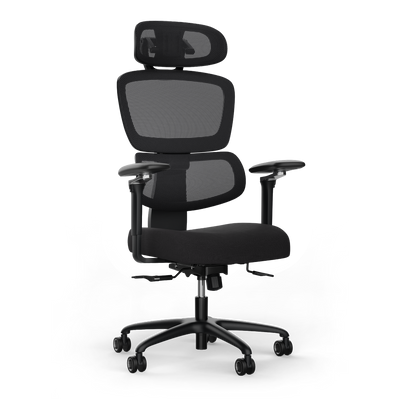
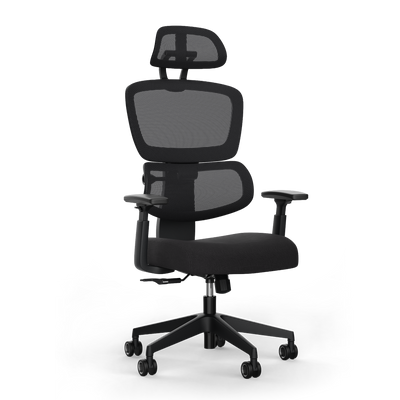
Even with limited space, you don't have to do without an ergonomic and organized workspace. The basis for healthy work is a high-quality, ergonomic chair and a suitable desk. This is a necessity to stay healthy and productive in the long term, especially if you use a desk in the bedroom.
A chair like the DESKSPACE MOVE is the foundation. It can be precisely adjusted to your body measurements. Make sure your feet are flat on the floor and your knees form an angle of about 90 degrees. The armrests are ideally adjusted when your forearms rest loosely and your shoulders remain relaxed.
Maximize Desk Space and Think Vertically
In a small bedroom, desk space is a precious commodity. To make optimal use of it, clever space management is required. An effective method is to use a monitor arm.
Such an arm brings your screen to the perfect viewing height and creates valuable space underneath. You can use this free space for a keyboard, notebooks, or other utensils.
A well-organized workspace is the result of strategic planning. Every tool that utilizes vertical space or makes clutter under the tabletop disappear contributes to a calmer and more productive environment.
The next step is to use the space above the desk. Think vertically. Narrow wall shelves offer space for folders, books, or personal items without blocking floor space.
In addition, these solutions help to create more structure:
- Magnet boards: Perfect for notes, to-do lists, or inspiration, without taking up desk space.
- Rolling containers: A flexible helper that can be pushed under the desk when needed and disappear into another corner after work.
Accessories That Create Order and Save Space
Organization in a small space lies in the details. There are accessories designed to minimize clutter and maximize functionality. Often, these small helpers make the biggest difference.
A drawer that can be mounted under the tabletop is a good solution. It offers invisible storage space for pens, notebooks, charging cables, and anything that shouldn't be constantly in view. Everything is quickly tidied up by the end of the day.
Other useful accessories include:
- Headphone holders: Attached to the edge of the table, they keep your headphones close at hand but out of the way.
- Laptop holders: A vertical holder allows you to position your laptop next to the monitor, saving space.
By combining these elements, you create a complete workstation that is ergonomically correct and seamlessly integrates into your bedroom. You can find many more ideas in our guide on keeping your desk tidy.
Frequently Asked Questions About the Bedroom Workspace
A desk in the bedroom is often a necessity. How do you ensure that work doesn't disturb sleep? We answer the most common questions and provide practical tips for focused work and restful nights.
How does a desk in the bedroom affect my sleep?
A constantly visible workspace can prevent your brain from switching to rest mode. The sight unconsciously reminds you of open tasks and can make it difficult to fall asleep.
The key lies in clear separation. Create a visual barrier with a screen, shelf, or plant to remove the workspace from view. More importantly, establish a fixed after-work ritual. Consistently tidy the desk in the bedroom, close your laptop, and turn off all work devices. This creates visual calm and prevents disturbing blue light emissions that affect your sleep cycle.
What lighting is useful at the workplace?
Lighting affects concentration and well-being. The general ceiling light is rarely sufficient. It is often too dim and casts shadows.
For working hours, use your own bright desk lamp. Ideally, a light intensity of about 500 lux with neutral white light (around 4,000 Kelvin), as this promotes concentration. After work, it is important to switch. Dim the light and use warm general lighting. This change signals to your body the end of the workday and promotes the production of the sleep hormone melatonin.
The right lighting strategy is a simple but effective trick to draw the line between work and relaxation. Bright light for focus, warm light for rest.
What to do with extremely little space in the bedroom?
When every inch counts, creative and compact solutions are needed. A bulky desk is unsuitable here.
For very small rooms, furniture that makes itself invisible after work is suitable:
- Secretary desks: These classics have a fold-down work surface and hide desk clutter.
- Foldable wall desks: They are mounted on the wall and take up hardly any space when folded.
- Compact adjustable-height desks: Models with a shallow depth (e.g., 60 cm) are a good alternative. They offer full ergonomics without protruding too far into the room.
In all space-saving variants, vertical organization is crucial. Use the wall space above the desk with narrow shelves or magnet boards. This keeps your work surface clear.
Are you ready to design your bedroom workspace ergonomically and stylishly? Discover Deskspace's high-quality and quiet adjustable-height desks and find the perfect solution for your space. Visit us at https://deskspace.de.


