



Deducting office furniture from your taxes: Your guide to depreciation

Yes, office furniture is tax deductible as long as you use it almost exclusively for professional purposes. The tax office assumes professional use if it is at least 90%. In that case, you can claim the full costs as income-related expenses or business expenses. This also applies even if you do not have a recognized home office.
When you can deduct office furniture
An investment in good office furniture, such as an ergonomic office chair, is an investment in your health and productivity. The state recognizes such purchases as necessary work equipment. You can claim the expenses in your tax return and thus reduce your tax burden.
The crucial point for the tax office is the distinction between professional and private use. Only what directly serves your work is deductible. The tax office examines this carefully for furniture in a private residence.
The 90-percent rule
To deduct your desk or office chair for tax purposes, you must prove almost exclusive professional use.
The 90-percent rule is the decisive benchmark. If you achieve this professional usage share, the tax office assumes negligible private co-use. You can claim the entire acquisition costs.
If professional use is below this, it becomes more complicated. A pro-rata allocation of costs is difficult to prove and is rarely accepted by the tax office. Focus on convincingly demonstrating professional use.
Do not confuse with home office flat rate
A common misunderstanding concerns the home office flat rate. Many believe that it covers all costs for working from home. This is not correct.
The home office flat rate compensates for your ongoing, increased costs such as electricity or heating. It does not cover the acquisition costs for work equipment such as furniture.
This means for you:
- Use home office flat rate: You can claim the flat rate for every day you primarily worked from home.
- Deduct office furniture additionally: You can claim the costs for desks and office chairs separately as income-related expenses.
You don't have to choose. You can combine both benefits to optimize your tax return. More details can be found in our article on deducting costs for your home office.
Who can deduct office furniture
In principle, almost anyone who needs office furniture for work can deduct it from tax. The method of claiming depends on whether you are employed or self-employed.
Deduction options for work equipment
| Who can deduct? | What can be deducted? | Important prerequisite | Typical examples |
|---|---|---|---|
| Employees | Necessary work equipment for professional activity. | Almost exclusively professional use (min. 90 %). | Desk, office chair, shelf for specialist literature, desk lamp. |
| Self-employed & freelancers | Business-used furnishings. | Almost exclusively business use (min. 90 %). | Complete office equipment, conference table, filing cabinets. |
| Companies (GmbH, UG etc.) | All furniture required for business operations. | Business necessity. | Office furniture for employees, reception desk, storage shelves. |
The process is similar for all groups. The decisive hurdle is credible proof of professional use.
The right depreciation method for your office furniture
You have purchased office furniture. Now the question is how you declare the expenses in your tax return. The tax office specifies two methods. Which one you have to use depends on the purchase price.
It's about whether you can deduct the costs immediately or have to spread them over several years.
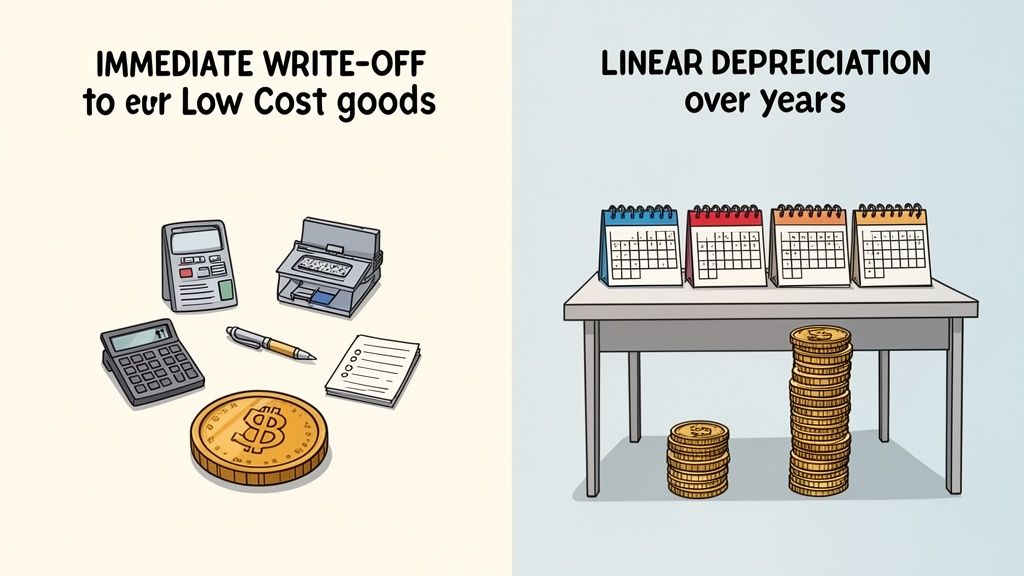
Method 1: Immediate depreciation for Low-Value Assets (GWG)
The fastest way is immediate depreciation. It works for low-value assets, or GWG for short. These are independently usable work equipment up to a certain price.
The limit is 800 euros net. The value of the goods without VAT is decisive. If your office chair or rolling container costs less, you can claim the full costs as income-related expenses or business expenses in the year of purchase.
Advantages of immediate depreciation:
- Full deduction in the same year: You feel the tax savings immediately.
- Less effort: Complicated calculations or long-term documentation are not necessary.
- Direct tax relief: This protects your liquidity.
An office chair for 750 euros net is a classic example. You can enter the full amount in your tax return for the year of purchase.
Important: The GWG rule only applies to independently usable items. A monitor is a GWG. A new hard drive for your PC is not, as it is useless without a computer.
Method 2: Straight-line depreciation over useful life (AfA)
If your purchase exceeds the GWG limit of 800 euros net, you use straight-line depreciation. The abbreviation for this is AfA, which stands for "Absetzung für Abnutzung" (depreciation for wear and tear). You spread the costs evenly over the official useful life of the piece of furniture.
For office furniture, the Federal Ministry of Finance has set a useful life of 13 years. This figure from the official AfA tables applies across the board to desks, cabinets, and chairs.
The calculation is simple. You take the net purchase price and divide it by 13. The result is the amount you can deduct each year.
Practical example: Straight-line AfA for a desk
You buy a height-adjustable desk for 1,200 euros net. Since the price is above the GWG limit, you must depreciate it linearly.
Here's how to calculate:
- Acquisition costs: 1,200 euros (net)
- Official useful life: 13 years
- Annual depreciation amount: 1,200 euros / 13 years = 92.31 euros
This means you can claim 92.31 euros as income-related expenses or business expenses for 13 years.
What happens if you buy in the middle of the year?
If you buy your desk in July, you must calculate the depreciation for the first year proportionally. You may only deduct the months in which you used the piece of furniture.
- Months of use in the first year: 6 (July to December)
- Pro-rata depreciation in the year of purchase: (92.31 euros / 12 months) * 6 months = 46.15 euros
In the following 12 years, you claim the full amount of 92.31 euros. The remaining amount is depreciated in the fourteenth year. Straight-line AfA requires you to keep track of depreciation over the years. It also allows you to claim larger investments for tax purposes.
Declining balance depreciation for businesses
For businesses, there is another method besides straight-line depreciation to deduct office furniture for tax purposes: declining balance depreciation. It allows significantly higher amounts to be deducted from tax in the first years after purchase.
This approach is ideal for self-employed individuals and companies that want to reduce their tax burden immediately after an investment. Liquidity is strengthened when it is most needed.
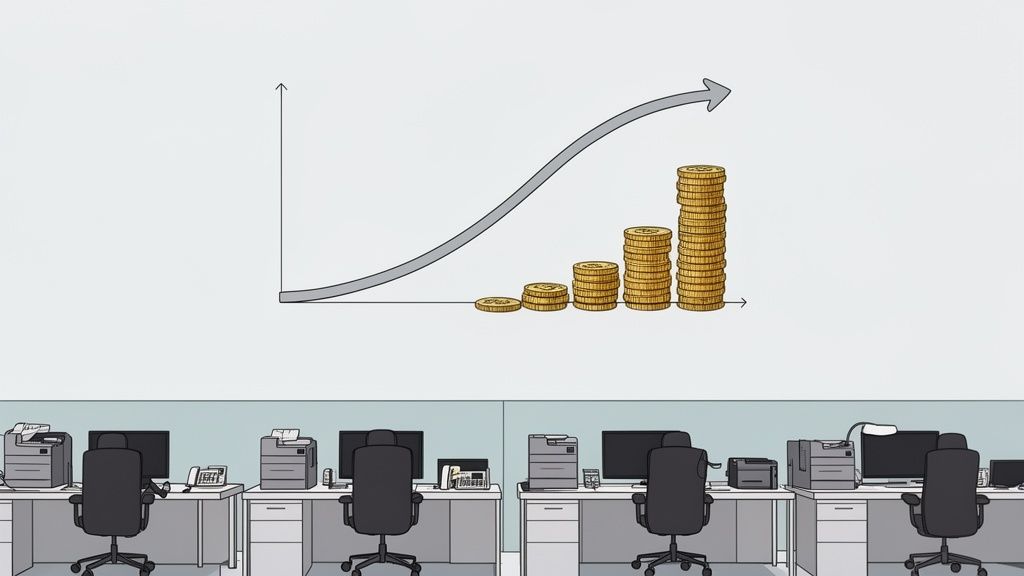
The difference to straight-line AfA
With the straight-line method, you depreciate the same amount each year. Declining balance depreciation is based on the current net book value. The depreciation amount decreases over time.
- In the first year, the depreciation amount is highest. You apply the percentage to the full acquisition costs.
- In subsequent years, you use the same percentage, but calculate it from the remaining net book value.
This approach allows you to claim a large portion of the costs for tax purposes more quickly.
Declining balance depreciation better reflects the real loss of value. New furniture loses value most significantly in the first few years. This method reflects exactly that.
The legislator has temporarily reintroduced this regulation to promote investments. Currently, companies can apply declining balance depreciation of up to 25 % for movable assets such as office furniture. This applies to purchases made between October 1, 2023, and December 31, 2024.
Practical example: The complete office equipment
Your startup is growing, and you are furnishing an office for three employees. You are investing in ergonomic equipment.
Your investment:
- 3 height-adjustable desks: 3,600 euros
- 3 ergonomic office chairs: 2,100 euros
- Filing cabinets and shelves: 2,300 euros
- Total investment (net): 8,000 euros
With declining balance AfA, you apply a rate of 25 %.
Comparison of depreciation methods
| Year | Declining balance AfA (25 %) | Straight-line AfA (13 years) |
|---|---|---|
| Year 1 | 2,000 euros (25 % of 8,000) | 615.38 euros (8,000 / 13) |
| Year 2 | 1,500 euros (25 % of 6,000) | 615.38 euros |
| Year 3 | 1,125 euros (25 % of 4,500) | 615.38 euros |
The difference is significant. In the first year, you deduct more than three times as much with the declining balance method. After three years, you have already claimed 4,625 euros (over 57%) of the costs. With straight-line AfA, it would be 1,846 euros (around 23%).
This difference relieves your finances immediately. For young companies, this is a decisive advantage. If you are planning larger purchases, you will find suitable solutions for companies with us.
Correctly entering office furniture in your tax return
You have found the right depreciation method. Now you enter your office furniture in your tax return. It is important to use the correct forms depending on your professional situation.
The difference lies in whether you claim income-related expenses as an employee or book business expenses as a self-employed person.
For employees: Annex N
As an employee, everything you purchase for your work belongs in Annex N of your income tax return. This is where income-related expenses are collected.
- Immediate depreciation (GWG): Did you buy an office chair for less than 800 euros net? Then you enter the full amount under "Further income-related expenses". Briefly describe the purchase, for example, as "office chair".
- Straight-line depreciation (AfA): More expensive furniture is depreciated over years. Here you only state the annual depreciation amount. You have already calculated this: purchase price divided by 13 years.
You can claim the costs for office furniture in addition to the home office flat rate. The flat rate only covers pro-rata room costs. You can find more information on this in our guide to the home office flat rate in the tax return.
For self-employed and freelancers: Annex EÜR
As a self-employed person, your office furniture is part of your business assets. The expenses reduce your profit as business expenses. Your point of contact is Annex EÜR (income surplus calculation).
- Immediate depreciation (GWG): Low-value assets up to 800 euros net belong in the line for "Expenses for low-value assets".
- Straight-line and declining balance depreciation (AfA): The annual depreciation amount for more expensive purchases goes into the line for "Depreciation for wear and tear (AfA)".
Important for self-employed: You must keep an asset register. List all assets above the GWG limit here. Note the acquisition date, purchase price, and annual depreciation.
Documentation is crucial
The tax office can request proof at any time. Clean documentation is your safeguard against inquiries.
Keep the following documents ready:
- Invoices and receipts: The original receipt is essential. Seller, purchase date, item, and price must be clearly identifiable.
- Proof of payment: A bank statement shows that payment has been made.
- Asset register (for AfA): A simple table is sufficient. List more expensive furniture with acquisition date, purchase price, useful life (13 years), and annual depreciation amount.
You do not have to submit these documents directly with your tax return. However, you should be able to present them upon request.
Where do I enter what in the tax return?
| Taxpayer | Form | Type of expense | Where to enter? |
|---|---|---|---|
| Employee | Annex N | Income-related expenses (GWG & AfA) | Under "Further income-related expenses" |
| Self-employed/Freelancer | Annex EÜR | Business expenses (GWG) | Line "Expenses for GWG" |
| Self-employed/Freelancer | Annex EÜR | Business expenses (AfA) | Line "Depreciation for wear and tear" |
With this information, you can deduct your office furniture for tax purposes and record everything correctly.
Practical examples and common mistakes
Theory is one thing, practice is another. Based on three typical scenarios, we will show you how you can deduct your office furniture for tax purposes and which mistakes you should avoid.
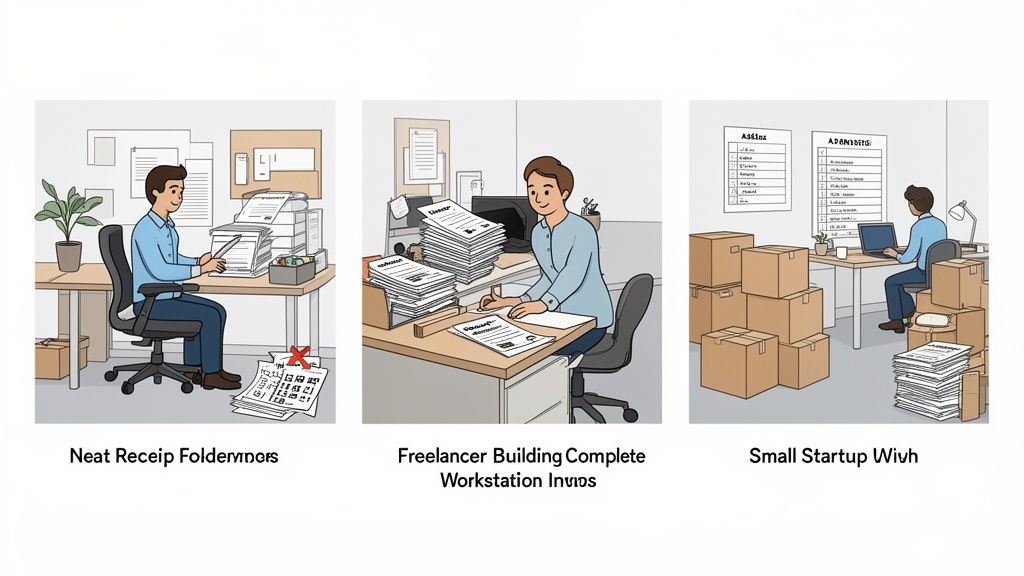
Scenario 1: The employee in a home office
Anna is a marketing manager and works 100% from her home office. She buys an ergonomic office chair for 650 euros net. Since she uses the chair exclusively for her work, the 90-percent rule is met.
The net price is below the GWG limit of 800 euros. Anna can claim the costs immediately and in full as income-related expenses in Annex N.
- Depreciation method: Immediate depreciation for Low-Value Assets (GWG).
- Tax effect: The 650 euros reduce her taxable income in the year of purchase.
- Common mistake: Anna does not keep the invoice. Without a receipt, the tax office will not recognize the expenses.
Scenario 2: The freelancer with complete equipment
Tom is a self-employed web designer. He invests in a height-adjustable desk for 1,100 euros net and shelves for 500 euros net.
He can immediately deduct the shelves as GWG. The desk is over 800 euros and must be depreciated over 13 years (AfA).
Tom calculates the annual depreciation for his desk:
1,100 euros / 13 years = 84.62 euros per year.
He claims this amount each year as a business expense in his Annex EÜR.
Tom must continue the ongoing depreciation. Only then will he claim the full amount.
Scenario 3: The startup sets up its first office
A startup hires five employees and needs office equipment for 15,000 euros net. The management decides on declining balance depreciation to save liquidity.
With a rate of 25 %, 3,750 euros (25 % of 15,000 euros) can be depreciated in the first year. This is significantly more than with straight-line AfA (approx. 1,154 euros) and provides faster relief.
The most common mistakes
Pay attention to these points so that your tax return runs smoothly.
1. Inaccurate usage allocation
The most common mistake is insufficient justification for 90% professional use. If a desk also serves as a dining table, the tax office will probably disallow the deduction.
2. Forgotten subsequent depreciations
If you choose straight-line AfA, you must continue it in subsequent years. Otherwise, you are throwing money away.
3. Incomplete documentation
No deduction without an invoice. Keep all purchase receipts and proofs of payment carefully. Digital copies protect against loss.
4. Incorrect calculation of depreciation
Always use the net amount as the basis for calculation. For purchases during the year, you must calculate the AfA for the first year on a monthly basis.
A look at common tax errors can help. An overview that shows basic principles of error avoidance are the 10 misconceptions about the taxation of influencer income.
The most frequently asked questions about deducting office furniture
There are recurring questions about office furniture and taxes. We answer the most important points clearly and directly.
Can I deduct my desk even without a separate home office?
Yes. A home office recognized by the tax office is not a prerequisite. A desk is a piece of work equipment. Its deductibility does not depend on the room.
The decisive factor is its use. The 90-percent rule applies. As long as you can prove that you use your desk at least 90% for professional purposes, you can claim the full costs. This also applies to a workspace in the living room.
Do I have to choose between the home office flat rate and furniture deduction?
No, you can claim both. The home office flat rate and the deduction for work equipment are not mutually exclusive.
The home office flat rate compensates for your pro-rata room costs such as rent or electricity. It does not cover the acquisition costs for your equipment. You can claim the flat rate AND additionally deduct the costs for your office chair or desk according to the known rules (GWG or AfA).
What happens if I buy a used office chair?
You can also deduct used office furniture for tax purposes. You need a purchase receipt. A simple receipt from a private individual with all relevant data is usually sufficient for the tax office.
The deduction depends on the purchase price:
- Under 800 euros net: You can immediately deduct the amount as GWG in the year of purchase.
- Over 800 euros net: You depreciate the chair over its estimated remaining useful life. Estimate this realistically.
Can students deduct their desk from tax?
Yes, this is possible if certain conditions are met. Your study expenses are either special expenses (initial training) or income-related expenses (further training).
A desk that you demonstrably use primarily for your studies is considered work equipment. The same rules apply: 90% usage rule and the limits for GWG or AfA.
Tip for students: A tax return is often worthwhile even without income. With a loss carryforward, you can accumulate your study costs. As soon as you get your first job, these losses are offset against your first salary and can reduce your tax burden.
What do I do if no VAT is shown on the invoice?
This is common for purchases from private individuals or small businesses. For you as an employee or as a self-employed person using the small business regulation, this is not a problem. You claim the full amount you paid (gross amount).
Companies that are entitled to deduct input tax cannot reclaim input tax. For depreciation, the final price paid is the basis for calculation.
An ergonomic workplace is an investment in your health and performance. At DESKSPACE, you will find TÜV-tested, height-adjustable desks and ergonomic chairs that you can claim for tax purposes according to the rules described here.


