

Find the Right Back Cushion for Your Chair and Prevent Back Pain

A back cushion for a chair is a simple aid that supports the natural S-shape of your spine while sitting. It fills the gap between your lower back and the chair's backrest, thereby stabilizing the lumbar spine and promoting a healthier posture. The result is less pressure on your intervertebral discs and a more relaxed feeling at the end of the day.
Why a back cushion for your chair is valuable
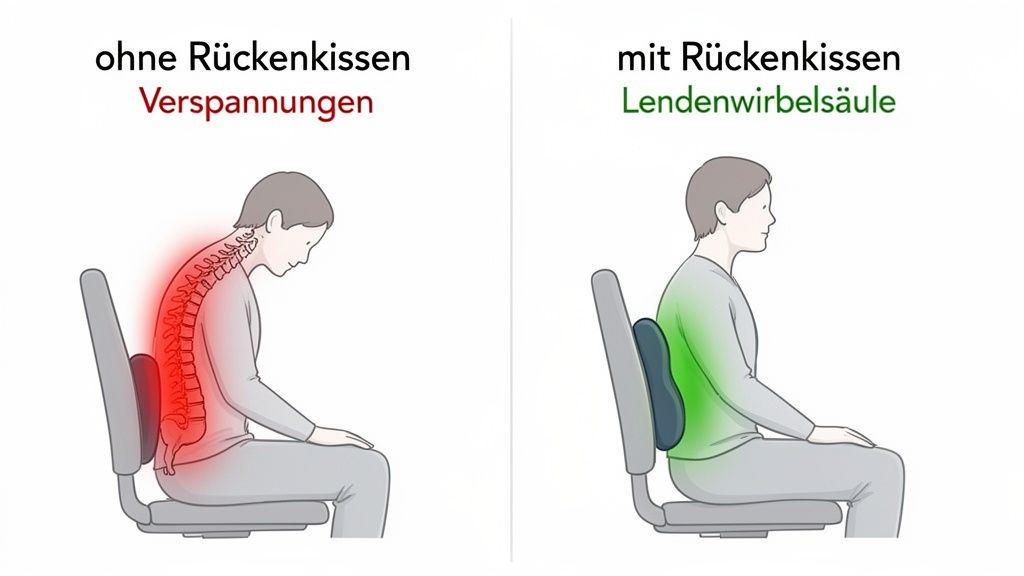
Anyone who spends a lot of time at a desk knows the problem. The back gets tired and posture collapses. Without proper support, this is almost inevitable. Shoulders roll forward and the lower back rounds. This poor posture unevenly stresses the spine and surrounding muscles. A good back cushion for a chair counteracts this process.
Our back is made for movement
The human spine is designed for movement, not for hours of sitting. Its natural S-shape acts like a shock absorber, distributing loads. When you sit for most of the day, the lumbar lordosis flattens out. This is the natural curve in the lower back. This increases pressure on the intervertebral discs and can cause pain.
A back cushion is an external support. It helps you maintain this important lordosis, even when your muscles tire. The cushion reminds your back of the correct position, preventing you from unknowingly falling back into a harmful posture.
Prevention is better than cure
Back pain is widespread. In Germany, according to statistics, many people suffer from it chronically. A back cushion is a simple but effective preventive measure. It addresses the causes of tension and pain before they become established.
A back cushion is more than a comfortable accessory. It is an active investment in your long-term back health and well-being at work.
Studies show that targeted support from a cushion can reduce pressure on the intervertebral discs by up to 40 percent. This is a big difference, as intervertebral discs are already more stressed when sitting than when standing or lying down. You can find more basics in our guide on proper sitting at a desk.
What happens if support is missing?
Without a back cushion, your back muscles have to do all the stabilizing work alone. Over an eight-hour workday, this often leads to fatigue and tension. The consequences are noticeable.
- Lower back pain: The lumbar spine bears the main load, often leading to localized pain.
- Neck and shoulder tension: Poor posture in the lower back extends upwards.
- Faster fatigue: Your body uses more energy to compensate for an unstable position, which reduces your concentration.
- Poor circulation: A hunched posture can impair blood circulation and even breathing.
A back cushion corrects the foundation of your sitting posture and relieves the entire system. It is an important tool for anyone who regularly sits at a desk.
What types and materials of back cushions exist
The effectiveness of a back cushion for a chair depends on its shape and material. Not every cushion suits every back. To make the right decision, you need to understand the fundamental differences.
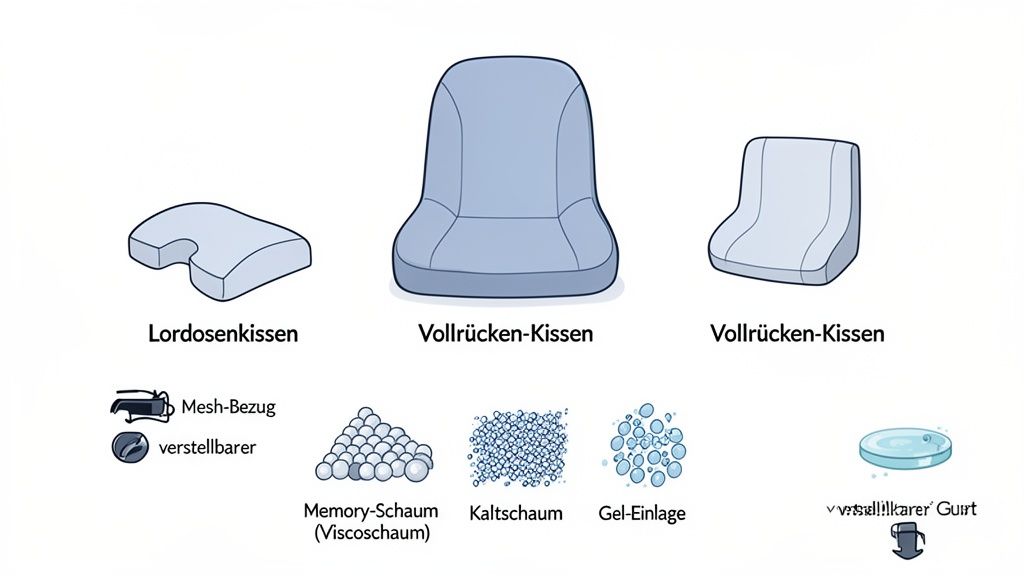
There are two main categories of back cushions, each with a different purpose.
Cushion types for targeted or comprehensive support
The shape of the cushion determines which area of your back is relieved. Two approaches have become established here.
1. Lumbar cushions
These cushions specialize in the lower back. They are designed to support the natural S-curve of the lumbar spine, the lordosis. They are usually smaller, crescent- or D-shaped, and specifically fill the gap between the lower back and the chair's backrest.
- Goal: Targeted relief of the lumbar vertebrae and prevention of a rounded back.
- Ideal for: People who specifically want to combat lower back pain or ergonomically upgrade an office chair.
2. Full-back cushions
These models cover a larger area. They support not only the lumbar region but extend into the middle or upper back.
- Goal: Comprehensive stabilization and holistic posture correction.
- Ideal for: Chairs with flat or poorly shaped backrests and for users who desire broader support.
The most common materials and their properties
The interior of your back cushion is crucial. It determines comfort, support, and durability. The choice should be based on your preferences and physical needs.
The material of a back cushion determines how it reacts to pressure and heat. It is the core of the ergonomic function and influences how well the cushion adapts to your body.
Memory foam (visco foam)
Memory foam reacts to body heat and weight. It precisely adapts to the contours of your back and distributes pressure evenly, preventing pressure points. When the pressure is released, the material slowly returns to its original shape.
- Advantages: Excellent adaptability and pressure relief.
- Disadvantages: Can retain heat and is often less breathable.
Cold foam
Cold foam is a highly elastic foam with an open-cell structure. It offers firm yet flexible support and immediately springs back into shape after pressure. You sink in less deeply.
- Advantages: Very breathable, dimensionally stable, and durable.
- Disadvantages: Does not adapt as precisely as memory foam.
Gel inserts
Modern cushions combine foam cores with gel pads or a gel layer. The gel provides better pressure distribution and has a cooling effect.
- Advantages: Additional pressure relief and a cooler sitting sensation.
- Disadvantages: Can make the cushion heavier.
Comparison of materials for back cushions
This table compares the properties, advantages, and ideal applications of the most common materials.
| Material | Adaptability | Support force | Breathability | Ideal for |
|---|---|---|---|---|
| Memory foam | Very high | Medium to firm | Low | Individual, pressure-free adaptation |
| Cold foam | Medium | Firm and stable | High | Users who prefer constant support and good ventilation |
| Gel inserts | High | Variable | Medium | Additional cooling comfort and pressure distribution |
The choice of material is a personal decision that depends on your comfort perception and needs.
Important functional details
Small details can make a big difference. Look for covers made of breathable mesh fabric. They ensure good air circulation and prevent heat buildup on your back.
Adjustable straps are also crucial. They ensure that the back cushion for the chair stays securely on the backrest and does not slip. A removable and washable cover is important for care and hygiene.
How to find the right back cushion for your chair
A back cushion for the chair is a personal investment in back health. Finding the right model depends on several factors. An unsuitable cushion is useless at best, and at worst, it forces you into an unhealthy posture.
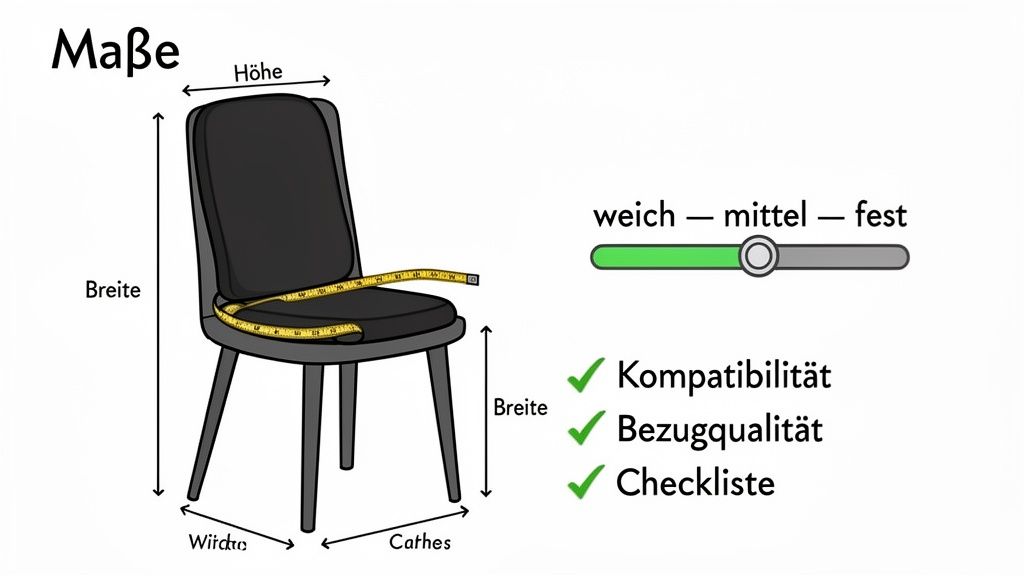
Make your choice consciously. Body size, chair, and your personal preferences are crucial.
First, measure: determine the correct dimensions
The size of the cushion is crucial. If it's too small, it won't support properly. If it's too large, it will push you forward on the seat.
- The height of the cushion: It should fill the natural curve of your lumbar spine. Sit upright and measure the distance from the bottom edge of your shoulder blades to the seat. The cushion must sit in this area.
- The width of the cushion: Orient yourself by the backrest of your chair. A cushion that is too wide will bulge and lose its supportive shape. A cushion that is too narrow will only support a small part of the back.
A matter of feeling: hardness level and support strength
How firm or soft a cushion should be depends on your body weight and your sensation. It's about the balance between comfort and support.
A good cushion actively supports your back, but without uncomfortable pressure. It should gently correct your posture, not deform it.
As a rule of thumb:
- Softer cushions: Suit lighter individuals or if you only want gentle support. Memory foam is often a good choice.
- Firmer cushions: Are ideal for heavier individuals or if you need noticeable, active support. Cold foam is often advantageous here because it remains dimensionally stable.
Does it really fit? Compatibility with your chair
Make sure you can attach the cushion to the chair so it doesn't slip.
- Adjustable straps: Most cushions have elastic straps with buckles. Check if they are long enough for your chair's backrest. Two straps are often better than one.
- Anti-slip coating: A rubberized back is a good extra, especially on smooth surfaces.
Only if the cushion is securely positioned can it ergonomically support you all day long.
Since the pandemic, many people regularly work from home. This has increased the demand for ergonomic office furniture. At the same time, studies show that many suffer from back pain, often caused by unsuitable chairs. A good back cushion can help here. Memory foam models that support the lumbar spine can reduce discomfort by up to 40 percent, according to IGR certifications.
More than just a cover: the quality of the cover
The cover is more than just aesthetics. It determines hygiene, comfort, and durability.
Look for these features:
- Breathability: Mesh fabric covers prevent you from sweating on your back.
- Washability: A removable, washable cover is a must for hygiene.
- Durability: The fabric should withstand daily use.
If you suspect that your chair is the cause of your pain, read our guide on choosing the right office chair for back pain. The combination of the right chair and the right cushion is often the best solution.
How to correctly position and use your back cushion
A back cushion for a chair is only a good tool if it is properly positioned. Incorrect placement can negate the relief or cause new tension. Correct application is simple if you observe a few basic rules.
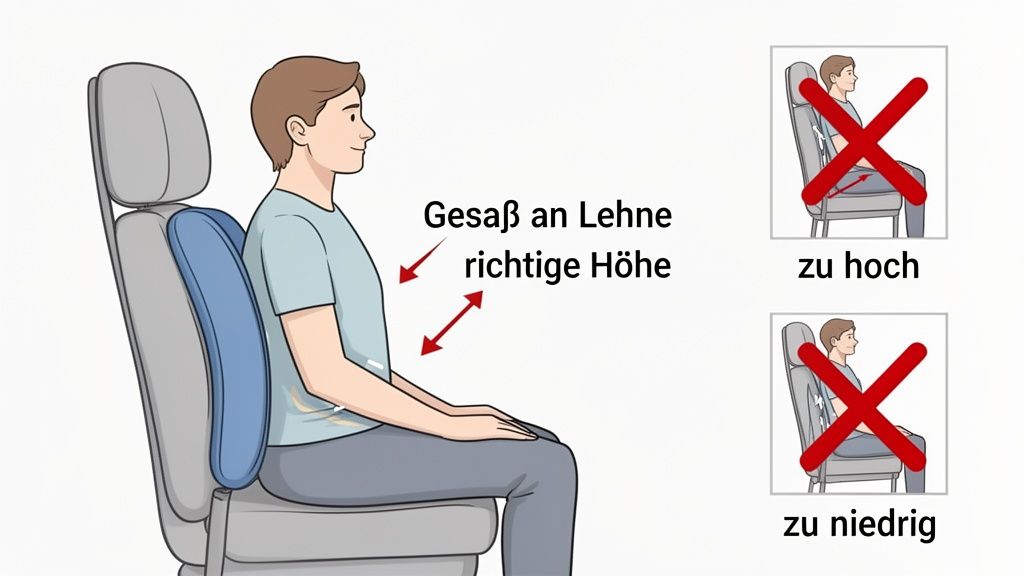
The cushion must fill the gap between your lower back and the chair's backrest. This way, it supports the natural S-curve of your spine. Your lumbar lordosis, the curve in your lower back, receives the necessary support.
Step-by-step to the optimal position
The perfect adjustment only takes a few moments, but makes a big difference over hours. Precise adjustment is the key to maximum relief.
Follow these steps:
-
Slide all the way back: Sit in your chair so that your buttocks touch the backrest. This is the base.
-
Place the cushion in the curve of your back: Position the back cushion directly in the curve of your lower back. The thickest part of the cushion should be where your spine is most curved.
-
Fine-tune the height: Slide the cushion slightly up or down. You'll notice when it's in the right spot. It should feel supportive without pressing uncomfortably.
-
Secure it: Use the fastening straps to fix the cushion to the backrest. This prevents it from slipping.
Common mistakes you should avoid
Even small errors in positioning can reduce the effectiveness of your cushion. Avoid these typical application mistakes.
- Placed too high: If the cushion is too high, it will press against your thoracic spine. This pushes the upper body unnaturally forward and can lead to tension.
- Placed too low: A cushion placed too low supports the tailbone instead of the lumbar spine. This causes your pelvis to tilt forward, which promotes a rounded back.
- Incorrect sitting posture: The best cushion is useless if you sit on the front edge of your chair. The contact between your back, the cushion, and the backrest must be maintained.
You have found the perfect position when you feel gentle yet noticeable support in your lower back. Your posture should feel upright and effortless.
Targeted support of the lumbar spine is a core principle of ergonomics. If you want to learn more, our article explains what a lumbar support is.
Getting used to a back cushion for a chair usually doesn't take long. In the first few days, the corrected posture may feel unfamiliar because new muscles are being activated. This is a good sign. It shows that the cushion is actively improving your posture.
How to properly care for and clean your back cushion
Your back cushion for your chair is in daily use. Proper care is important to keep it hygienic and to ensure it continues to support you optimally for a long time. Regular cleaning ensures cleanliness and extends the life of the material.
Care is straightforward. You only need to distinguish between the cover and the foam core.
Washing the cover gently to protect the material
The cover is constantly in contact with your body and clothing. It should be cleaned regularly.
For most cushions, the cover can be removed and machine washed. However, always check the manufacturer's care label first. There you will find precise information on washing temperature.
Follow these instructions:
- Remove the cover: Open the zipper and carefully pull the cover off the core.
- Select gentle cycle: Wash the cover at a low temperature, usually 30 or 40 degrees Celsius.
- Use mild detergent: Use a mild, bleach-free detergent.
- Air dry: Hang the cover to dry. Avoid the tumble dryer, as heat can damage the material.
For stubborn stains, professional textile cleaning can be a good solution.
Care of the foam core
The core of your back cushion should not be put in the washing machine. Water would destroy the foam's structure and impair its supportive effect.
The foam core is the heart of your cushion. Protect it from moisture so that it retains its shape and function.
If the core gets dirty, you can clean it carefully.
- Surface cleaning: Take a slightly damp cloth with mild soapy water and gently dab stains. Do not rub too hard.
- Thorough drying: Afterwards, the core must dry completely in the air. Make sure it is completely dry again before putting the cover back on.
- Regular airing: Occasionally remove the core from the cover and air it in a shady place. Avoid direct sun, as UV rays can make the material brittle.
When is it time for a new cushion?
Even the best back cushion for a chair eventually gives way. The foam fatigues from daily pressure and loses its elasticity.
Look for these signs that it's time for a replacement:
- Loss of shape: The cushion no longer springs back to its original shape.
- Visible indentations: Permanent dents have formed.
- Decreased support: You notice that the support is lacking.
- Crumbly material: The foam feels brittle or breaks apart easily.
With regular care and timely replacement, you ensure that your back receives the ergonomic support it deserves.
Everything you need to know about back cushions: FAQ
Still have questions before you decide on a back cushion? Here we answer the most common ambiguities concisely and directly.
How long does it take to get used to the back cushion?
This varies individually. In the first few days, the more upright sitting posture may feel unfamiliar. This is a good sign. It means that muscles are being activated that you previously neglected.
Allow an adjustment period of three days to two weeks. Initially, use the cushion for only one to two hours per day. This gives your body time to adapt to the new support. After that, you can gradually increase the usage time.
Does a back cushion also help with acute back pain?
Yes, a back cushion for a chair can often bring relief from acute pain. It takes pressure off the lumbar spine and promotes healthier posture. This prevents a compensatory posture that could worsen the pain.
However, a cushion is not a medical treatment. It serves for prevention and daily relief. For severe or prolonged pain, you should always consult a doctor or physical therapist.
Although a back cushion serves as a preventive measure, you should also be aware of serious warning signs of back pain if the discomfort exceeds the usual level.
Can I also use the cushion in the car or on the couch?
Yes. Many back cushions are designed as flexible all-rounders. On long car journeys, they stabilize your posture and prevent premature fatigue.
Even on the sofa, which is often not ergonomic, a back cushion does a good job. Just make sure it is well positioned and does not slip.
Think of the back cushion as a mobile tool for better sitting. Its area of application does not end at the office chair.
Does a back cushion replace a good ergonomic office chair?
No. A back cushion is a useful addition, but it cannot replace a full-fledged ergonomic office chair. A good chair is a complex system with many individual adjustment options.
This includes:
- Adjustable seat height and depth
- Adjustable armrests
- A dynamic backrest
However, a back cushion for a chair is ideal for ergonomically upgrading a simple chair. It can also help to more precisely adapt the built-in lumbar support of a good chair to your back. The best solution is often a combination of both: a fully adjustable chair and a suitable cushion.
Deskspace offers a wide range of ergonomic solutions to help you optimally adapt your workplace to your needs. Discover our products and invest in your back health: https://deskspace.de


