

Always tired after work? Strategies for more energy

If you're always tired after work, it often seems like a purely stress-related problem. In practice, it's usually more than that. Your mind is under strain, but your body often works all day in a posture that drains energy instead of supporting it.
According to a representative survey, 41% of employees in Germany feel so exhausted after work that they can no longer attend to private or family matters (Haufe). This is not an isolated phenomenon. It is a clear indication that many workdays are not just demanding, but systematically draining.
The point many overlook: exhaustion doesn't just come from meetings, deadlines, and pressure. It also arises from rigid sitting, poor screen height, too few changes in posture, and a daily routine without real recovery. If you approach this systematically, fatigue often improves significantly. For those who want to delve deeper into physical and mental causes, understanding and improving fatigue also provides helpful insights.
Why you are always tired after work

Ending up on the sofa after work with no energy left is a common reality for many. The problem isn't just that you're tired. The problem is that your private life is also affected.
If exhaustion looks the same every evening, it's worth taking a different perspective. Many only look for the cause in their minds. Too much pressure. Too many tasks. Too little sleep. This is often partly true. But it doesn't explain everything.
Fatigue is often also a posture problem
A static workday costs energy. This applies in the home office as much as in the office. If you sit almost motionless for hours, your body is constantly working against minor stresses. Shoulders tense up. The neck holds the head. The eyes fixate on a monitor that is too high or too low. This doesn't seem dramatic, but it adds up over hours.
Those who can only slump in the evening often lack not discipline, but physical changes during the workday.
This form of fatigue feels insidious. You're not necessarily sleepy. You're drained. That's why classic advice like "sleep more" or "drink another coffee" often falls short.
The workday drains energy in small portions
I see typical patterns again and again:
- Static sitting: You stay in the same position for too long.
- Lack of transitions: There is no clear separation between concentrated work, breaks, and quitting time.
- Constant tension: Even without physically strenuous work, your nervous system remains on alert.
- Poor workstation: Desk, chair, monitor, and lighting force you into compensatory postures.
If you don't change these factors, evening fatigue often persists, even if you are motivated and generally enjoy your job.
Analyzing the true causes of your exhaustion
Not all fatigue has the same cause. If you want to solve the problem, you need to cleanly separate the drivers. Otherwise, you'll be optimizing in the wrong place.
A survey shows that about 44% of full-time employees in Germany frequently feel mentally exhausted. The main reasons cited are performance pressure, time pressure, and an excessive workload, with the 30 to 49 age group being most affected (Statista). Mental strain is real. But it almost never acts alone.
Four typical causes in everyday work
Most cases can be traced back to four areas:
- Mental overload: Too many open tasks, constant interruptions, and permanent availability keep your brain in work mode.
- Insufficient recovery: You might sleep long enough, but you don't truly unwind in the evening.
- Weak basic care: Irregular eating and insufficient drinking worsen concentration and resilience.
- Physical inactivity: You sit for long periods, breathe shallower, tense muscles, and move too rarely.
How to recognize what dominates in your case
Pay less attention to the general feeling of "I'm done" and more to the underlying pattern.
| Observation | Probable driver | Practical significance |
|---|---|---|
| Head is full, even though the body is calm | Mental overload | You need fewer stimuli and clearer boundaries |
| You feel sluggish by early afternoon | Recovery or provision | Check sleep, food, and drink |
| Neck, back, or legs feel dull | Physical inactivity | More posture changes and better ergonomics |
| You can't switch off after work | Constant tension | Limit transition rituals and availability |
Checking question: Do you feel clearer after a short walk, but not necessarily more rested? Then fatigue is often not just a lack of sleep, but also a problem with movement and posture.
What often doesn't work in practice
Many react to exhaustion with short-term countermeasures. More coffee. Sugar. Pushing through quickly. This can help for the moment, but it doesn't solve the root cause. It only shifts it.
The thought "I just need to be more resilient" rarely helps either. If your daily routine is physically rigid and mentally fragmented, you don't need a tougher mindset. You need better conditions.
A simple self-test helps: for three workdays, note when your fatigue sets in, how you sit, whether you take breaks, and what your evening looks like. Afterward, it usually becomes clear whether your problem is caused more by pressure, lack of recovery, or an inactive workday.
Your workplace as an energy source instead of an energy drainer

Many guides talk about stress and sleep. Both are important. But they often overlook that your workplace itself can cause fatigue.
While stress and sleep deprivation are often discussed, many guides ignore ergonomic deficiencies. A DAK study shows that 42% of home office users complain about back pain and associated fatigue, often due to a lack of adjustable desks (Stuttgarter Zeitung).
A static setup slows you down
If your desk height, chair, and monitor don't fit you, your body compensates all day long. This costs concentration. It also costs energy, even though you hardly move.
Typical problems are quickly identified:
- Monitor too low or too high: The neck is constantly working.
- Desk too high: Shoulders are pulled up, forearms rest unsteadily.
- Chair incorrectly adjusted: Pelvis tilts, back loses support.
- Laptop without accessories: Gaze drops, hands work too closely.
If you also have many repetitive tasks, you should streamline processes. Not all fatigue is purely physical. Especially with administrative tasks, it can be useful to specifically consider replacing manual tasks with digital helpers so that not all energy is lost to friction.
What truly helps ergonomically
An ergonomic intervention with a fixed rhythm of sitting and standing can significantly reduce work-related fatigue. Studies show that users experience up to 78% less fatigue after three months, as blood circulation and oxygen supply to the brain increase by 15-20% (Maidesite).
The crucial factor is not just the height-adjustable desk itself. What matters is that you use it correctly and that the entire setup is appropriate.
The three most important adjustments
-
Adjust desk height appropriately
While sitting and standing, your forearms should be able to rest loosely. Shoulders remain down. Wrists do not bend. -
Align monitor correctly
The top edge of the screen should be approximately at eye level. This keeps your head above your torso instead of constantly pushed forward. -
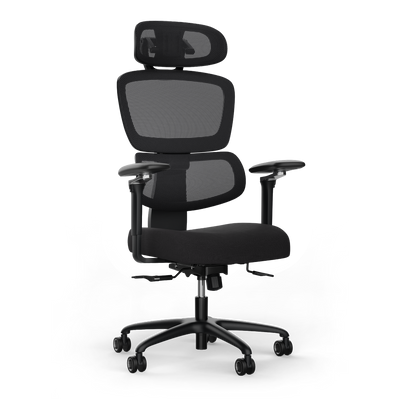
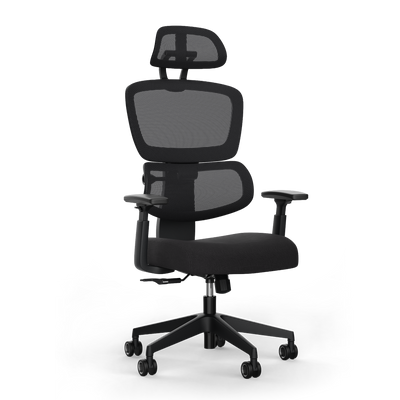
Use chair actively
A good chair doesn't replace movement. It should support you in changing postures, not force you into one position.
An ergonomic workstation is not a comfort issue. It plays a part in determining whether you still have energy reserves in the evening.
Lighting is also part of it. If you tire quickly, check your surroundings in addition to your desk and monitor. Poor brightness and harsh contrasts increase strain. You can find a compact guide on this at optimal lighting at the workplace.
Developing a dynamic routine for the workday
A good workstation is of little use if you use it statically. Many set up their desk once and then spend hours in the same posture again. This is exactly what keeps fatigue alive.
For practical purposes, a simple principle applies: changing postures beats perfect posture. You don't have to sit ideally. You have to change regularly.
The effective rhythm
An ergonomic intervention with a fixed rhythm of sitting and standing can significantly reduce work-related fatigue. Studies show that users experience up to 78% less fatigue after three months, as blood circulation and oxygen supply to the brain increase by 15-20%. This clearly argues for a planned change instead of spontaneous individual actions.
I don't recommend a rigid perfection plan. A repeatable work block that combines concentration, posture changes, and brief movement is useful.
Example of a dynamic work block
| Time | Activity | Focus |
|---|---|---|
| 0 to 30 minutes | Sitting, concentrated work | Deep tasks, writing, analysis |
| 30 to 50 minutes | Standing, continue working | Emails, coordination, review |
| 50 to 55 minutes | Short movement break | Release shoulders, walk, breathe deeply |
| 55 to 90 minutes | Sitting or standing depending on task | Second focus phase without rigid posture |
What you do concretely in everyday work
A fixed rhythm only works if the steps are small enough. These habits can be implemented directly:
- Set reminders: Use timers or calendar prompts for position changes.
- Link tasks to posture: Phone calls and brief consultations while standing. Complex thinking work while sitting or alternating.
- Move in mini-doses: Once to the printer, once to the window, once to get water. That's often enough to release tension.
- Really use breaks as breaks: Don't keep looking at the screen.
If you tend to forget to drink, a fixed coupling helps. With every change of posture, you take a few sips. Practical approaches can be found at drinking enough water in the office with these tips and tricks.
Short changes work better than the plan to fix everything with exercise in the evening.
What usually goes wrong
Many start too aggressively. Then good intentions quickly turn into back pain or frustration. Anyone who has mostly sat until now should build up standing phases slowly.
Common mistakes are:
- Standing for too long at a stretch: This also causes fatigue.
- Only standing, but not moving: Standing can also become static.
- Confusing breaks with scrolling: The eyes remain in stimulus mode.
- No adaptation to tasks: Not every activity requires the same posture.
The best routine is not the strictest. It's the one you reliably maintain on normal workdays.
Evening habits that bring back energy

Many underestimate the first hour after work. It's precisely then that it's often decided whether you recover or merely collapse passively. A good evening doesn't start on the sofa. It begins with a clear transition.
Sleep deprivation under eight hours can impair cognitive performance similarly to a blood alcohol level of 0.05% and increase the error rate by 40%. An effective evening routine to promote sleep quality is therefore crucial (Bimos).
The first hour after work
Anyone who immediately jumps back to screens, messages, and open to-dos after work often remains in internal work mode. The body is at home. The nervous system is not yet.
A fixed sequence works better:
-
Mark the end of work
Laptop closed. Briefly tidy the desk. No half-open tabs. -
Get moving briefly
A few minutes of walking, light stretching, or a small walk outside helps to switch gears. -
Reduce stimuli
Don't immediately turn to series, emails, or social feeds. First, something that calms your system down.
Practical rituals that often work
Not all recovery has to be active. But it should be conscious.
- Short walk: Good if your mind is still under tension.
- Light mobility: Shoulder circles, chest opening, hip stretching.
- Warm drink unrelated to work: This creates a clear transition.
- Reading instead of scrolling: Less stimulation, more calming.
- Elevate legs: Especially after long periods of sitting or standing, this can be pleasant. A simple guide can be found at elevating legs for health.
You don't need more input in the evening. You need less resistance between work and recovery.
What often sabotages the evening
I see three things especially often:
| Behavior | Consequence |
|---|---|
| Continuing to work directly or remaining reachable | The brain does not properly end the workday |
| Only scrolling on the sofa | Stimuli remain high, recovery remains shallow |
| Doing difficult tasks late in the evening | Sleep and winding down become more difficult |
If you're always tired after work, don't try ten new evening routines at once. Choose two. For example: a short walk followed by screen-free time. This is often enough to feel a difference after a few days.
When to consider medical help

Not all exhaustion can be resolved with better ergonomics, more exercise, and a clean evening routine. These measures are powerful. However, they are no substitute for a medical evaluation if symptoms persist or worsen.
The distinction is important: normal fatigue improves with rest. Problematic fatigue remains even if you sleep, take breaks, and adjust your daily routine.
Warning signs you should take seriously
Have symptoms checked by a doctor if one or more of these patterns occur:
- The fatigue remains constant for a long time: Even days off bring little improvement.
- You wake up exhausted: Not just in the evening, but even in the morning you lack energy.
- Physical complaints are added: For example, persistent pain, heart palpitations, or other unusual symptoms.
- Your mood significantly declines: Irritability, hopelessness, or severe withdrawal increase.
- Daily life clearly suffers: Work, family, or self-care become noticeably harder.
How to prepare effectively for your doctor's appointment
The more precisely you can describe what is happening, the better your condition can be assessed.
Notes on these points are helpful:
| Observation | Example |
|---|---|
| Timing | When is the fatigue strongest |
| Course | How long has the problem existed |
| Accompanying symptoms | Sleep problems, pain, inner restlessness |
| Relief | What helps short-term, what does not at all |
| Work patterns | Screen time, breaks, availability, shift work |
Medical help is not a last resort. It is a sensible step when self-help reaches its limits.
If you're unsure, don't wait for it to go away on its own. Especially with persistent exhaustion, early action is usually the better approach.
If you want to set up your workplace to save energy instead of draining it, you'll find ergonomic solutions for your home office and regular office at DESKSPACE. It's not just about a good desk or chair. It's about a setup that suits your workday and truly enables dynamic working.


