

Neck tension: what helps immediately and sustainably?

Heat, gentle stretching exercises, and workplace adjustments help with neck tension. These measures relax the muscles, promote blood circulation, and prevent new tension. A combination of immediate relief and targeted prevention is the most effective approach.
What causes neck tension?
Neck tension is usually not a sign of a serious illness. It results from daily habits. Knowing the causes allows for targeted countermeasures.

Poor posture at the desk
Long hours of sitting in front of the screen are a common cause of neck tension. The head unconsciously tilts forward, shoulders shrug, and the back rounds. This overloads the neck and shoulder muscles unilaterally. Every inch the head moves forward significantly increases the weight on the cervical spine. The muscles stiffen under this constant strain and become painful.
Stress as a cause
Psychological tension leads to physical reactions. In stressful phases, we unconsciously tense our shoulders and pull them up. This protective posture reduces blood circulation to the muscles. They no longer receive optimal oxygen supply, leading to stiffness and pain. The question "What helps with neck tension?" is thus also a question of effective stress management.
Neck tension is widespread. According to a representative study, around 46% of adults in Germany suffer from neck pain at least once a year. Working professionals are particularly affected. This underscores the importance of ergonomics and stress reduction. Further details can be found in the guideline on the prevalence of neck pain on degam.de.
What to do for acute pain?
For acute neck pain, quick relief is needed. There are proven methods to immediately loosen tense muscles.
Here is an overview of what you can do directly to relieve acute tension.
Effective immediate measures for acute neck pain
| Measure | Application | Effect |
|---|---|---|
| Targeted heat application | Place a heat pack, cherry pit pillow, or take a hot shower for 15 to 20 minutes on your neck. | Promotes blood circulation, relaxes muscles, and makes them more supple. |
| Gentle self-massage | Using your fingers, massage the painful areas on your neck and shoulders with light, circular pressure. | Specifically loosens muscle stiffness and stimulates metabolism in the tissue. |
| Conscious relaxation breathing | Sit upright, close your eyes. Inhale deeply and consciously drop your shoulders as you exhale. Repeat several times. | Breaks the cycle of pain and tension. It relaxes the nervous system. |
These measures can bring initial noticeable improvement and help control acute pain.
Effective exercises for loosening and strengthening
Immediate measures like heat or breaks provide initial relief. For a sustainable solution, targeted and regular exercises are necessary. Short, precise exercises can be easily integrated into daily life.

The combination of stretching and strengthening resolves acute blockages. It also builds up stabilizing muscles that support the neck, making you more resilient against new tension.
Targeted neck stretches
Shortened muscles are often the cause of pulling and pain. The following stretching exercises target these problem areas. They make the muscles in the neck and shoulder area supple again.
Perform each exercise slowly and deliberately. Only stretch until you feel a distinct but comfortable pull. Jerky movements are taboo.
-
Lateral Neck Stretch: Sit upright and relax your shoulders. Slowly tilt your head to the right side, as if your ear should touch your shoulder. To intensify the stretch, you can reach over your head with your right hand and gently pull it down. Hold the position for 20 to 30 seconds. Repeat the exercise on the other side.
-
Head Rotation to the Side: Remain seated upright. Slowly turn your head to the right, as if looking over your shoulder. Hold the endpoint for a few seconds, then slowly turn your head to the other side. Repeat this movement about five times per side.
-
Neck Flexion Forward: Slowly lower your chin towards your sternum. Interlace your hands behind your head. The weight of your arms intensifies the stretch in your neck. Hold this position for 20 to 30 seconds as well.
Practical Tip: Pay conscious attention to your breathing. Inhale deeply and calmly. As you exhale, try to relax your muscles even more. This enhances the relaxing effect.
Strengthening exercises for prevention
Strong neck muscles are the best prevention against tension. They support the head better and do not tire as quickly. These simple exercises strengthen the postural muscles without equipment.
-
Isometric Resistance: Place your right hand on your right temple. Now press your head against your hand, while your hand simultaneously resists, so that your head does not move. Hold this tension for about 10 seconds and then switch sides. Repeat this for your forehead (hand against forehead) and the back of your head.
-
Shoulder Rolls: Sit upright. Slowly pull your shoulders up to your ears. Then move them in a large, fluid motion backward and down, and then forward again. Do ten circles backward and ten forward.
These exercises are suitable for a short break at your desk. More comprehensive instructions can be found in our article on targeted neck exercises for neck pain.
Your 5-minute routine for the workday
Regularity is the decisive factor. Integrate the following exercises as a fixed routine into your day. For example, before your lunch break or at the end of the workday.
Your plan for the daily neck break:
- Shoulder Rolls (30 seconds): Loosen your shoulders by slowly rolling them backward and forward.
- Head Rotation (60 seconds): Slowly rotate your head alternately left and right.
- Lateral Neck Stretch (2 minutes): Stretch each side for 60 seconds to effectively target the lateral muscles.
- Isometric Resistance (90 seconds): Strengthen your postural muscles. Press each side (front, back, left, right) against the resistance of your hand for about 20 seconds.
This short sequence helps prevent tension before it sets in.
Ergonomically optimizing your workspace
Exercises and immediate measures are important. However, the cause often lies in the workplace itself. A suboptimally arranged desk forces you into an unhealthy posture for hours. The result is muscle stiffness.
By making targeted adjustments to your setup, you create the basis for a permanently healthy posture. An ergonomic environment supports your body instead of straining it.

The basics: Chair and sitting position
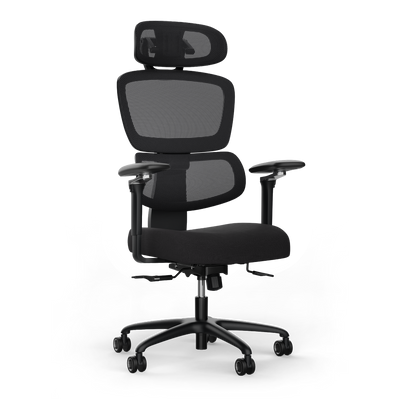
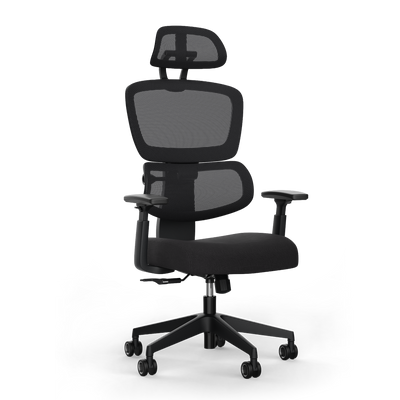
Your office chair is the foundation. An incorrect adjustment triggers a chain reaction that ends in the neck.
Adjust the seat height so that your feet are flat on the floor. Your knees should form an angle of about 90 degrees. Your thighs run parallel to the floor. There should be a hand's width of space between the back of your knee and the edge of the seat to avoid impeding blood circulation.
The backrest should actively support your lower back. Adjust the armrests so that your forearms rest loosely and your shoulders remain relaxed.
The right monitor position is crucial
An incorrectly positioned monitor overstrains the neck muscles. The top edge of your screen should be at or just below your eye level.
The ideal distance between your eyes and the screen is 50 to 70 centimeters. With multiple monitors, the main screen should be directly in front of you. Place other monitors as close as possible to avoid excessive head turning.
Rule of thumb: When sitting upright and looking straight ahead, your gaze should meet the upper third of the monitor. This keeps your head in a neutral, relaxed position.
Changed living and working habits, such as intensive smartphone use, more often lead to poor posture like "tech neck." Official data proves this: In 2018, 42% of all rehabilitation measures for adults were due to musculoskeletal diseases, which also include neck tension. You can find more about these developments on the RKI website.
The Game Changer: The height-adjustable desk
Alternating between sitting and standing is an effective method against one-sided strain. A height-adjustable desk allows for a dynamic work style. You interrupt rigid postures and keep your muscles moving.
- Muscle Activation: When standing, the core and leg muscles are engaged. This stabilizes the spine and relieves the neck.
- Better Circulation: Changing positions promotes blood circulation and better supplies muscles with oxygen.
- Prevention of Fatigue: Regular standing up counteracts the fatigue of the postural muscles and prevents tension.
Adjust the desk height while standing so that your forearms rest at a 90-degree angle on the tabletop with relaxed shoulders. Detailed instructions can be found in our guide on setting up an ergonomic workstation.
Checklist for your ergonomic workstation
Use this list to check and improve your setup.
- Chair: Feet flat on the floor, knees forming a 90-degree angle.
- Backrest: Supports the natural S-curve of the spine.
- Armrests: Shoulders relaxed, forearms resting horizontally.
- Monitor: Top edge at eye level, distance is an arm's length.
- Keyboard & Mouse: Positioned close to the body, wrists remain straight.
- Dynamics: Regular alternation between sitting and standing is essential.
With these adjustments, your workplace will become a place that promotes your health.
Making everyday life neck-friendly
An ergonomic workplace is fundamental. For lasting improvement in neck tension, daily routines are also crucial. Small habits add up and can either strain or relieve the neck. A conscious approach to these routines creates the foundation for a pain-free daily life.

Unconscious movement patterns are often the most harmful. By recognizing and changing them, you remove the basis for pain.
Conscious breaks and targeted stress management
Constant pressure makes us unconsciously shrug our shoulders. This permanent tension is harmful to the neck muscles and a major reason for stiffness. Regular interruptions are a necessity.
Plan short breaks of five to ten minutes throughout the day. Stand up, stretch, walk a few steps. These small impulses promote blood circulation and loosen muscles.
Additionally, simple breathing techniques can reduce stress levels:
- Conscious breathing: Sit upright. Inhale deeply through your nose for four seconds, hold your breath for four seconds, then slowly exhale through your mouth for six seconds. Five repetitions are often already effective.
- Progressive muscle relaxation: Consciously tense a muscle group, for example, your shoulders, for five seconds. Then suddenly release them. This trains body awareness and helps to actively release tension.
Using the night for regeneration
Your body regenerates during sleep. An unfavorable sleeping position can disrupt this process and lead to new tension. The correct position and a suitable pillow are crucial for the neck's nightly recovery.
The back and side sleeping positions are considered neck-friendly. In these positions, the spine can form a neutral, straight line. Avoid sleeping on your stomach, as the head is turned sharply to the side here. This overstretches the neck muscles and leads to strain.
A good pillow fills the hollow space between the head and shoulder without pushing the head upwards. The goal is to support the natural curvature of the cervical spine and maintain a straight line from head to pelvis.
Smartphone use and correct lifting
Two major neck traps are smartphone use and lifting heavy objects. "Tech neck" results from constantly tilting the head forward, which puts significant strain on the cervical spine.
Hold your smartphone at eye level as often as possible. Lower your gaze rather than your head. This small correction significantly reduces the strain on your neck muscles.
When lifting heavy objects, remember to bend your knees and use the strength from your legs, not your back. Keep the load as close to your body as possible. This protects your lower back and relieves strain on your neck and shoulder area.
When you should consider professional help
Most neck tension is harmless and can be resolved with exercises and ergonomic adjustments. However, sometimes self-treatment reaches its limits, and professional advice is necessary. Certain symptoms can indicate deeper underlying causes that require medical clarification.
It is important to recognize these warning signs. Ignoring such signs can lead to worsening symptoms or overlook a more serious problem.
Warning signs for a doctor's visit
Do not hesitate to see a doctor if one or more of the following apply. These symptoms go beyond ordinary muscle tension.
- Numbness or tingling: You feel numbness, tingling, or weakness in your arms or hands.
- Severe dizziness or headache: Sudden, severe dizziness or unusually severe headaches occur.
- Radiating pain: The pain radiates intensely into an arm or shoulder and feels burning or sharp.
- No improvement: Your neck pain does not improve or even worsens despite self-treatment for one to two weeks.
- After an accident: The symptoms are a result of an accident, such as a fall or rear-end collision.
Such symptoms may indicate that more than just a muscle is affected. Sometimes a pinched nerve is the cause. You can find more about this in our guide on what to do for a pinched nerve.
Who to contact
Your first point of contact is your family doctor. They can make an initial assessment and, if necessary, refer you to a specialist. This could be an orthopedist or a neurologist.
Professional treatments often include physiotherapy, manual therapy, or medication. An accurate diagnosis is key to effective relief of symptoms.
Neck tension: What you should know
Here we answer frequently asked questions about neck tension.
How long does it take for neck tension to go away?
The duration depends on the cause. Mild, acute tension from an awkward movement can improve within one to three days if you react immediately with heat and stretches.
Persistent complaints that have developed over weeks require more patience. A consistent combination of regular exercises and ergonomic adjustments is crucial here. In such cases, complete relief can take several weeks.
If your pain persists for more than a week without improvement or worsens, you should have it checked by a doctor.
Is heat or cold better for neck tension?
For muscular tension, heat is generally the better choice. It stimulates blood circulation, provides better oxygen to the muscles, and helps them relax. A heat pack, a warm bath, or a hot shower can loosen cramped muscles.
Cold is more often used for acute injuries or inflammation. It constricts blood vessels and can reduce swelling. For typical neck tension due to poor posture or stress, cold is usually counterproductive.
Can stress cause neck pain?
Yes. Stress is one of the most common triggers. Under tension, the body unconsciously adopts a protective posture. Many people shrug their shoulders or clench their teeth without realizing it.
This constant tension reduces blood flow to the muscles. They stiffen, become painful, and can trigger tension headaches. Stress management through breathing exercises or progressive muscle relaxation is therefore an important component in preventing neck tension.
What sleeping position is best for the neck?
The back or side sleeping position is best for a relaxed neck. In these positions, the spine can form a neutral line.
- For back sleepers: A flat pillow is ideal. It supports the neck without allowing the head to bend forward.
- For side sleepers: The pillow must fill the gap between the head and shoulder. This prevents the head from tilting sideways.
Avoid sleeping on your stomach. This forces the head to turn sharply to the side, putting the cervical spine and muscles in an unnatural, strained position. New tension is often pre-programmed.
An ergonomic workstation is key to a healthy back and neck. Discover certified height-adjustable desks and ergonomic chairs at Deskspace to actively prevent tension. Find the perfect solution for your setup now at https://deskspace.de.


