

Cervical Spine Syndrome Exercise: Quick Relief for Your Neck

Targeted exercises for cervical spine syndrome are often more effective than rest. They help to loosen tension, improve mobility, and strengthen the supporting neck muscles. The key is the right combination of mobilization, stretching, and targeted strength building.
Cervical Spine Syndrome: What's behind it?
Cervical spine syndrome is not a single disease. It is a collective term for complaints originating from the cervical spine. The triggers are diverse. A common cause in modern working life is the continuous strain at the desk.

Main triggers in modern working life
Hours of sitting, an incorrectly adjusted monitor, or stress lead to muscular imbalances. The anterior neck muscles shorten. The posterior neck muscles are under constant tension to hold the head. This creates permanent strain on vertebrae and intervertebral discs.
The consequences are often:
- Persistent muscle tension in the neck and shoulders.
- Dull, pulling, or stabbing neck pain.
- Tension headaches radiating from the neck.
- Restricted head movement.
These symptoms are warning signs from your body. Targeted exercises improve blood circulation, make stiff tissue more supple, and help correct posture. More information and immediate tips can be found in our guide on https://deskspace.de/blogs/ergonomie-am-arbeitsplatz/nackenverspannungen-was-hilft.
Common triggers and symptoms of cervical spine syndrome
This table shows typical causes and the resulting complaints.
| Cause | Typical Symptom |
|---|---|
| Long periods of sitting at a desk | Chronic neck tension, stiff neck |
| Incorrect monitor height | Pain in the upper neck area, headaches |
| Stress and psychological tension | Raised shoulders, pain in the shoulder girdle |
| Poor posture (e.g., "vulture neck") | Restricted head rotation, dizziness |
| Lack of exercise | General stiffness, recurrent blockages |
Many factors can lead to neck complaints. Therefore, it is important to identify the cause and take targeted countermeasures.
Why rest is often not the best solution
For neck problems, remaining still is usually the wrong approach. Lack of movement and protective postures can worsen the problem. Muscles atrophy, fascia stick together, and joints become less mobile. Being active is therefore almost always the better strategy.
Cervical spine syndrome is closely linked to professional life in Germany. An evaluation of sick leave in 2022 showed that people in sedentary professions have a 1.8 times higher risk of experiencing related complaints.
Sometimes the causes lie elsewhere. Problems with the temporomandibular joint or an incorrect bite can cause tension that radiates into the cervical spine. You can find more about the effects of an incorrect bite on the neck from specialists.
If you know the causes, you can perform each exercise more consciously and effectively. It's not about blindly copying movements. It's about understanding your body and improving your posture in the long term.
Gently mobilizing the cervical spine
Mobility is the basis for a pain-free neck. Before strengthening, the joints and tissues must be mobilized. Gentle mobilization stimulates blood circulation and improves nutrient supply to the intervertebral discs.
The following exercises are an ideal start. They are suitable for a short break at the desk or as a warm-up program. Perform each movement slowly and consciously.
Exercise 1: Slowly nodding your head
This simple movement mobilizes the upper head joints. It loosens the fine, deep-seated muscles responsible for head movements. Imagine you are slowly nodding "yes."
- Starting position: Sit upright. Your back is straight, and your shoulders are relaxed. Your gaze is straight ahead.
- Movement: Slowly lower your chin towards your sternum. Hold briefly at the endpoint and feel the gentle stretch in your neck. Then slowly raise your head back to the neutral starting position.
- Repetitions: Perform the movement 10 to 15 times slowly and smoothly.
Important: Do not hyperextend your head backward. The movement always ends in the neutral, straight position.
Exercise 2: Tilting your head sideways
This exercise targets the lateral neck muscles. It helps to relieve one-sided tension caused by staring at a monitor.
- Starting position: Remain sitting upright. Shoulders stay low and relaxed.
- Movement: Slowly tilt your head to the right side, as if you want to touch your shoulder with your ear. Make sure your left shoulder stays down. Slowly return to the center and repeat the movement to the left side.
- Repetitions: Alternate sides approximately 10 to 15 times per side.
Important note: Any exercise for cervical spine syndrome must only be performed within a pain-free range. A slight pulling sensation is acceptable. A stabbing pain is a clear stop signal. Always adapt the range of motion to your feeling.
Exercise 3: Gently turning your head
Rotation of the cervical spine is often neglected in everyday life. This exercise improves mobility and can relieve blockages. Imagine you are very slowly shaking your head.
- Starting position: Maintain your upright and stable posture.
- Movement: Slowly turn your head to the right, as if looking over your shoulder. Go only as far as feels comfortable. Hold briefly and slowly return to the center. Then it's the left side's turn.
- Repetitions: Perform the rotation 10 to 15 times per side alternately.
These mobilization exercises are the first important step. They prepare your cervical spine for more intensive stretches. Repeat this routine several times a day, especially when sitting for long periods.
Targeted stretching of tense neck muscles
Mobilization is followed by targeted stretching. Shortened muscles in the neck and shoulder area are often responsible for pain in cervical spine syndrome. They exert constant tension on the vertebrae and restrict freedom of movement.
The following stretching exercises target these problem areas. The goal is to relax muscle fibers, promote blood circulation, and relieve pressure on the cervical spine.

Stretching the lateral neck muscles
This exercise stretches the scalene muscle and the upper part of the trapezius muscle. These muscle groups are often affected if you sit a lot or unconsciously hunch your shoulders.
- Starting position: Sit upright on a chair. Your shoulders are low and relaxed. Both feet are firmly on the floor.
- Movement: Slowly tilt your head to the right side, as if you want to touch your right shoulder with your right ear.
- Intensification: To intensify the stretch, gently place your right hand on your head. The weight of the hand gently increases the pull. At the same time, actively pull your left shoulder downwards.
- Duration: Hold the stretch for 20 to 30 seconds. Breathe calmly and deeply. Then switch sides.
Perform two to three repetitions of this exercise for cervical spine syndrome per side.
Important: Never stretch into a stabbing pain. A noticeable pull is correct, but pain is a stop signal. If you feel it, reduce the stretch.
Stretching the upper trapezius and neck extensors
This stretch targets the trapezius muscle, a common trigger for tension headaches. Here, you stretch the muscles that run from the back of the head to the shoulders.
- Starting position: Start in an upright sitting position with relaxed shoulders.
- Execution: Turn your head approximately 45 degrees to the right. Lower your chin diagonally downwards, as if looking into your right armpit. You should feel a pull on the left, back side of your neck.
- Intensification: Place your right hand on the back of your head and gently increase the pull by guiding your head further down. Make sure your left shoulder remains low.
- Duration: Hold the position for 20 to 30 seconds, breathe calmly, and switch sides.
Repeat this stretch two to three times per side as well.
Regular stretching helps restore muscular balance. It breaks the cycle of tension and pain and is an important component in managing the symptoms of cervical spine syndrome.
Sustained strengthening of the neck muscles
After mobilization and stretching comes the crucial step for long-term improvement: strengthening. Strong postural muscles act like a natural corset for your cervical spine. They protect against recurring complaints and counteract typical desk posture.
This section focuses on isometric exercises. This means you build muscle tension without visible movement. This method is safe, gentle on the sensitive joints of the cervical spine, and specifically trains the deep stabilizers.
Activating the anterior neck muscles
This exercise for cervical spine syndrome strengthens the muscles that hold your head upright and prevent "vulture neck."
- Starting position: Sit upright. Your head is in a neutral position, gaze straight ahead.
- Hand position: Place a flat hand or both hands on your forehead.
- Build tension: Gently press your head against your hands while your hands resist. Your head does not move. The force comes from your neck.
- Duration and repetition: Hold the tension for 5 to 10 seconds. Breathe calmly. Slowly release the tension and repeat the exercise 5 to 10 times.
Stabilizing the lateral neck muscles
This variation strengthens the muscles that stabilize your head laterally. They are important for compensating for one-sided loads.
- Starting position: You remain sitting upright. Shoulders are relaxed.
- Hand position: Place your right hand on the side of your head, slightly above your ear.
- Build tension: Gently press your head against your right hand. Your hand does not give way, so no movement occurs. You should feel the tension in your lateral neck muscles.
- Duration and repetition: Hold the tension for 5 to 10 seconds. Release it slowly and repeat the entire exercise 5 to 10 times per side.
Clean execution is crucial. Build up and release pressure slowly. Avoid jerky movements and do not hold your breath. It's about controlled activation.
Strengthening the posterior neck chain
Finally, we train the neck extensors. These muscles often work against gravity and tend to be overloaded with poor posture.
- Starting position: Maintain the upright sitting posture.
- Hand position: Interlace your fingers and place both hands on the back of your head.
- Build tension: Gently press the back of your head backward into your hands. Your hands offer stable resistance.
- Duration and repetition: Again, hold the tension for 5 to 10 seconds. Slowly release and repeat the exercise 5 to 10 times.
These strengthening exercises can be discreetly integrated into your workday. By performing them regularly, you build resilient neck muscles. More tips on how to stay healthy and fit when working long hours at a desk can be found in our guide.
Ergonomically setting up your workspace
The best exercise for cervical spine syndrome is of little use if the cause lies at the desk. An ergonomic workspace is the foundation for permanently relieving the cervical spine and ensuring training success. The goal is to establish a healthy routine that prevents cervical spine syndrome.

Chronic cervical spine pain is a widespread problem. In 2022, according to data from statutory health insurance funds, there were over 1.2 million outpatient treatment cases with the main diagnosis of cervical spine syndrome. The average sick leave amounted to 18 days per case. More on this can be found in the annual report of the German Addiction Aid Statistics.
The correct height for monitor and chair
Monitor position is crucial. Incorrect height forces the head into an unnatural posture and leads to tension.
- Monitor height: The top edge of the screen should be at eye level or just below. This keeps the head in a neutral, upright position.
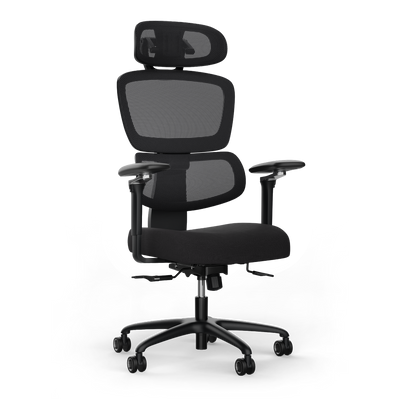
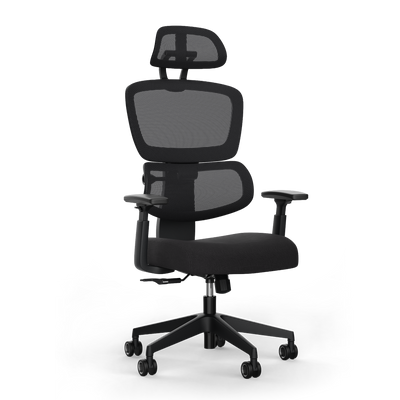
- Chair adjustment: Your feet should be flat on the floor, and your knees should form an angle of about 90 degrees. Armrests are correctly adjusted when your forearms rest loosely and your shoulders are relaxed.
Dynamic working as key
Hours of rigid sitting are harmful to the cervical spine. Switching between sitting and standing promotes blood circulation, loosens muscles, and relieves the spine. A height-adjustable desk is ideal for this.
An ergonomic workspace is not a one-time adjustment, but a dynamic system. Change your position regularly, integrate movement breaks, and pay attention to your posture.
With these adjustments, you create a work environment that supports your health. The goal is to reduce stress before it becomes chronic. Many more details on how to set up your workspace ergonomically can be found in our guide.
Small helpers with a big impact
In addition to the basic settings, small aids can also make a big difference.
A document holder next to the screen prevents constant head turning. An ergonomic mouse or keyboard can reduce tension in the arms and shoulders, which would otherwise extend into the neck. Consider your workspace as a whole, where each element can contribute to relief.
Frequently asked questions about cervical spine exercises
When actively combating neck pain, questions often arise. Here are the most important answers summarized.
How often should I do the exercises?
Consistency is key. Try to perform the stretching and mobilization exercises daily. Five to ten minutes a day, for example during a desk break, are sufficient.
You can initially plan the strengthening exercises three to four times a week. This gives the muscles time to recover. Once you become more confident, you can do them daily if it feels good.
What do I do if an exercise causes pain?
The golden rule is: it shouldn't hurt. A slight pulling or a noticeable stretch is normal. A stabbing, burning, or radiating pain is a clear stop signal.
If a movement causes pain, try the following:
- Reduce the range of motion: Only go as far into the movement as you feel a gentle pull without pain.
- Reduce the intensity: For strengthening exercises, 20 to 30% of your maximum strength is often enough.
- Adjust the exercise: Sometimes a small correction in posture helps to bypass the pain point.
If the pain persists, skip the exercise and talk to a doctor or physical therapist. Safety comes first.
When can I expect improvement?
This is individual and depends on the cause of your complaints. Many feel relief from acute tension through mobilization and stretching after just the first few days.
Sustainable improvement, based on muscle building and posture correction, requires more patience.
Don't expect miracles overnight. Generally, you should notice a noticeable improvement in your symptoms after two to four weeks of regular training.
Stay consistent. If there is no improvement after several weeks or if new symptoms such as severe dizziness or numbness occur, medical clarification is necessary.
An ergonomic workspace complements your training and ensures long-term success. At Deskspace, you will find height-adjustable desks and ergonomic chairs that actively relieve your cervical spine in everyday life. Find the right products for your healthy workday.


