

Releasing Full-Body Tension: A Practical Guide

Anyone who spends a lot of time at a desk knows the feeling. It often starts with a pull in the neck that spreads over the shoulders and down to the lower back throughout the day. These complaints are usually no coincidence. They are the result of a chain reaction triggered by sitting posture.
How tension spreads throughout the body and what helps immediately

Day after day, we spend hours in an almost unchanged position. The head is slightly bent forward, the back rounds. This posture unilaterally overloads certain muscle groups.
Your neck and shoulder muscles constantly perform heavy work to hold your head. At the same time, your core and leg muscles switch to standby mode. This imbalance is the breeding ground for the typical tension of office life.
The chain reaction of tension: From neck to hip
Your body is a finely tuned system. If one part gets out of balance, it has consequences for the rest.
- The "Vulture Neck": A slight forward inclination of the head increases the weight on your cervical spine many times over. The result is chronic tension in the neck and upper shoulders.
- The Rounded Back: The shoulders fall forward, the thoracic spine curves. This overstretches and weakens the back muscles, while the chest muscles shorten.
- The Blocked Lower Back: The typical pelvic tilt when sitting creates constant pressure on the lumbar spine. The muscles here harden and cause the classic lower back pain.
Interestingly, health data show a shift in the main pain points. Between 2020 and 2026, complaints increasingly moved from the lumbar to the cervical spine. This trend is directly linked to the increase in home office work and changing work patterns.
Problem areas and immediate measures at a glance
The good news is: you can actively break this chain reaction. Small, conscious counter-movements help to loosen muscles and stimulate blood circulation. The following table provides an overview of the most common problem areas and immediate measures.
| Problem Area | Typical Cause | Immediate Action |
|---|---|---|
| Neck | Incorrect monitor height, head tilted forward | Pull chin to chest and gently rotate left and right |
| Shoulders | Armrests too high or too low, "mouse arm" | Consciously raise shoulders, circle them backward, and let them drop |
| Upper back | Rounded back due to forward-leaning posture | Stretch arms forward, clasp hands, and round back |
| Lower back | Long sitting without lumbar support | Standing, place hands on hips, and lean back slightly |
| Hips/Legs | 90-degree angle in the knee for hours | Short walk or lunges to stretch hip flexors |
Movement is the most effective way to loosen hardened muscles. Even short breaks make a big difference and prevent acute tension from becoming chronic.
In addition to exercise, there are other aids. A warm shower or a cherry pit pillow can relax the muscles. Sufficient intake of magnesium for nerves can also support muscle function and counteract tension.
These immediate measures are your first-aid kit for everyday work. They help to quickly relieve acute complaints and break the spiral of tension.
How to set up your workplace ergonomically

Your workplace determines whether you remain relaxed and productive throughout the day or whether tension sets in. An unfavorable posture forces your muscles into unnatural compensatory movements permanently. This ultimately leads to pain.
With well-thought-out ergonomics, you create the basis for a neutral, relaxed posture. It's about aligning your three main contact points: chair, desk, and monitor.
The chair as the foundation for a healthy posture
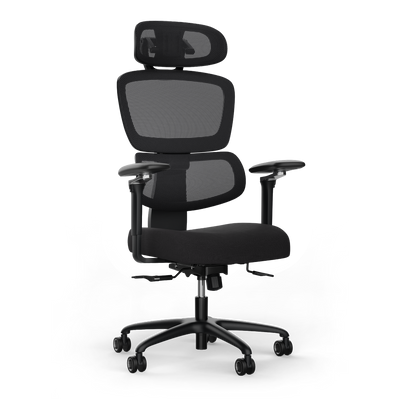
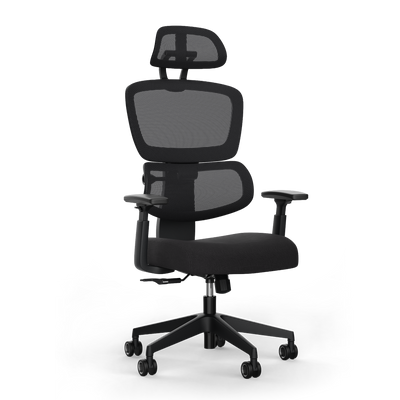
Your office chair is your most important tool for a healthy posture. The correct adjustment is simple if you consider a few points.
- Seat height: Sit down and place your feet flat on the floor. Your knees should be at an angle of 90 degrees or slightly more. Your thighs should be parallel to the floor or slope slightly downwards.
- Seat depth: Make sure there is about a hand's width of space between the edge of the chair and the back of your knees. This is important to avoid impeding blood circulation.
- Backrest: The backrest should support your spine in its natural S-shape. The curve in the lower back, the lumbar support, should be in your lumbar curve. This gently tilts the pelvis forward and prevents a rounded back.
- Armrests: Adjust the armrests so that your forearms rest loosely on them without you having to pull up your shoulders. Your elbows should also form an angle of about 90 degrees.
These basic settings are your foundation. They relieve the leg muscles and give your spine the necessary support.
A neutral posture is a necessity. It reduces the constant muscle tension required to maintain an unfavorable position. This actively prevents fatigue and pain.
The ideal desk height
Once your chair fits, it's time for the desk. The height of the tabletop should be based on the height of your armrests. The tabletop and forearms form a straight line when your arms rest loosely on the armrests.
With a fixed desk, this is often a compromise. A height-adjustable desk plays to its strengths here. You can set the perfect sitting height and dynamically switch between sitting and standing.
This change is key to preventing tension. Because even in the best sitting position, prolonged immobility leads to static muscle strain. Regular standing activates different muscle groups, stimulates blood circulation, and relieves the spine.
Forecasts show that the costs caused by back pain and tension in Germany will reach approximately 61.3 billion euros in 2026. A figure that underlines the importance of preventive measures.
Monitor, keyboard & mouse: The fine-tuning
The last step is to align your work equipment. An incorrectly positioned monitor is one of the most common causes of neck tension.
Checklist for correct positioning:
- Monitor: Place the screen directly in front of you. The top line should be at eye level or slightly below. This keeps your head in a neutral position. The distance to the screen should be about an arm's length, approximately 50-70 cm.
- Keyboard & Mouse: Place the keyboard and mouse close to the edge of the desk so that your forearms rest relaxed on the desk or armrests. Make sure your wrists remain straight and do not bend.
With this arrangement, you create a setup that supports you. If you want to delve deeper into the topic, you will find further tips on how to set up your workplace ergonomically in our guide. This way, you create the conditions to actively relieve tension.
Targeted exercises for neck, shoulders, and back

An ergonomic workplace is half the battle. But what do you do if it already hurts? Then it's time to take action.
A few minutes of targeted movement a day can loosen stiff muscles. The following exercises are tailored to the typical problem areas of office work. You don't need any equipment and can do them right at your desk. The only important thing is to perform each movement slowly and without jerking.
Loosening the neck area
Your neck has to balance your head for hours in a slightly forward-tilted position. This quickly leads to overload. These exercises help to mobilize the stressed muscles.
Lateral neck stretch: Sit upright. Let your shoulders relax down. Slowly tilt your head to the right, as if you wanted to touch your shoulder with your ear.
To intensify the stretch, you can gently place your right hand on the left side of your head. Only use the weight of your hand, do not pull. Hold this position for 20-30 seconds and then switch sides.
Chin to sternum: Interlace your fingers behind your head. Slowly lower your chin towards your chest. Your head will feel heavy. Your hands do not exert pressure, they only provide a slight weight.
You should feel a pull along your cervical spine down to between your shoulder blades. Hold this stretch for 20-30 seconds as well. This exercise helps against "vulture neck." You can find more about this in our article on what really helps with neck tension.
Always stretch only as far as you feel a gentle pull. Pain is a clear stop signal. Ignoring it will only irritate the muscles more.
Mobilizing shoulders and thoracic spine
The rounded back and forward-drawn shoulders are typical for office work. The following exercises counteract this. They open shortened chest muscles and get the thoracic spine moving.
Shoulder circles backward: Slowly pull your shoulders up to your ears, then consciously far back and let them sink down. Repeat this circular motion 10-15 times. This breaks the typical forward rotation of the shoulders and stimulates blood circulation.
Chest opener at the door frame: For this exercise, stand up.
- Stand in a door frame and place your forearms on the left and right sides of the frame. Your elbows should be slightly higher than your shoulders.
- Take a small step forward until you feel a comfortable stretch in your chest muscles.
- Hold this position for about 30 seconds and breathe deeply into the stretch.
This is the perfect balance to sitting. It feels like you are freeing your entire upper body.
Relieving the lower back
The lower back suffers greatly from prolonged sitting. The lumbar spine is often forced into an unnatural position, leading to pressure and pain. These exercises provide relief.
Cat-Cow while sitting: Sit on the front edge of your chair. Place your hands loosely on your knees.
- Cow position: As you inhale, tilt your pelvis forward, creating a gentle arch in your lower back. Your sternum pushes forward, your gaze is slightly upward.
- Cat position: As you exhale, round your back. Your navel pulls inward, your chin sinks to your chest.
Repeat this flowing change in the rhythm of your breath 10-15 times. This movement mobilizes the entire spine and can release blockages in the lower back.
Spinal rotation while sitting: Sit upright. Your feet are firm and parallel on the floor. Slowly rotate your upper body to the right. With your left hand, grasp the outside of your right knee to gently support the rotation. Support your right hand behind you on the seat. Hold the rotation for 20 seconds, breathe calmly, and then switch sides.
A simple routine for your workday
Regularity is more important than duration. Try to integrate this small routine into your day. It is more effective than a long session once a week.
| Exercise | Duration/Repetitions | Focus |
|---|---|---|
| Side neck stretch | 20-30 sec. per side | Relaxes the neck muscles |
| Shoulder circles | 10-15 repetitions | Loosens the shoulder girdle |
| Cat-Cow while sitting | 10-15 repetitions | Mobilizes the spine |
Do these three exercises two to three times a day, for example after lunch break. If you combine this with a height-adjustable desk, you create the conditions for a productive and pain-free workday.
Fascia techniques and self-massage for deep relaxation

Sometimes stretching exercises don't go deep enough to release stubborn tension. The pain runs deeper. Then your fascia are probably the problem.
Fascia are the connective tissue that envelops our muscles and organs like a net. Prolonged sitting, stress, or lack of movement can cause this tissue to stick together. The result is pain and immobility. This is where foam rollers and massage balls come in. With them, you can specifically apply pressure, release adhesions, and stimulate blood circulation.
Using a foam roller and massage ball correctly
Fascia training is about feeling, not force. Rolling too quickly or applying too much pressure can irritate the tissue and worsen tension.
Start with gentle pressure and gradually increase it to a noticeable but comfortable pain. Then roll very slowly over the muscle. If you find a particularly painful spot, a trigger point, stay there for 20 to 30 seconds. Breathe deeply in and out.
Important basic rules:
- Roll extremely slowly: Only a few centimeters per minute give the tissue a chance to yield.
- Avoid joints and bones: Always work only on muscle tissue. Skip the spine, knee pits, or elbows.
- Listen to your body: A stinging, sharp pain is a stop signal. Reduce pressure or stop the exercise.
Fascia training is like a deep tissue massage for your connective tissue. You help your body release adhesions and regain its elasticity. With regular use, you improve your mobility and get pain under control sustainably.
Targeted applications for typical problem areas
Every part of the body has its peculiarities. Here are proven instructions for the areas that suffer most in office everyday life.
Hamstrings: Sit on the floor and place the foam roller under your thighs. Support yourself with your hands behind your body, lift your buttocks, and slowly roll from just above the back of your knees to your glutes. For more pressure, you can cross one leg over the other.
Upper back and shoulder area: Lie on your back on the foam roller so that it is at the level of your shoulder blades. Place your feet on the floor and lift your pelvis. Hug yourself to spread your shoulder blades apart. Roll slowly from the base of your neck to the middle of your back.
Neck and shoulder blade (with massage ball): Use a small massage ball. Stand with your back against a wall and wedge the ball between the wall and your neck or shoulder muscles. Find a tense spot and lean against it with gentle pressure. Move minimally up and down or from side to side to work on the trigger point.
Self-massage without aids for in-between
You don't have a roller or ball at hand? You can also relieve acute tension at your desk with your own hands.
- Neck massage: Reach with your right hand over your head to the left side of your neck. Gently press into the muscles next to the spine with your fingertips. Hold the pressure for a few seconds and release. Repeat this and then switch sides.
- Forearm massage: Place your right forearm on the table. Use the thumb of your left hand to massage the muscles on the top and bottom of the arm with small, circular movements. This helps with complaints caused by typing or using a mouse.
These techniques complement stretching exercises and an ergonomic workplace. They give you the opportunity to specifically release tension where it arises.
Stress as a cause: Counteracting tension with breathing and mindfulness
Physical tension is often a sign of inner stress. Under pressure, your muscles unconsciously tense up. If this state persists, chronic tension can develop, which is difficult to relieve with mere stretching exercises.
Breathing and mindfulness techniques help here. They calm your autonomic nervous system and reduce the basic tension in your muscles.
Calming the nervous system with conscious breathing
Your breathing is a direct tool for stress management. Shallow, rapid breathing signals danger. Deep, calm breathing, on the other hand, activates the parasympathetic nervous system, which is responsible for rest and relaxation.
A simple and effective technique is box breathing.
- Breathe deeply in through your nose for four seconds.
- Hold your breath for four seconds.
- Breathe out slowly through your mouth for four seconds.
- Pause again for four seconds.
Repeat this cycle for one to two minutes. You will notice your pulse calm down and inner peace set in. This technique is valuable in stressful moments.
The power of a mindful short break
Mindfulness means perceiving the present moment consciously and without judgment. It's about regularly incorporating tiny breaks for mental clarity into your day.
A simple way to do this is the Body Scan.
- Sit upright in your chair and close your eyes.
- Direct your attention to different parts of your body, one after another. Start with your feet and feel how they touch the ground.
- Mentally move slowly upwards: to your calves, your thighs, your buttocks. Just perceive what you feel.
- Continue with your back, stomach, shoulders, and arms up to your face. Consciously relax your jaw and forehead.
This check-in only takes two to three minutes. It pulls you out of the thought carousel and helps to consciously release unnecessary muscle tension.
Stress management is a crucial building block for preventing tension. If you learn to recognize mental triggers and actively counteract them, you'll tackle the problem at its root.
The effect is particularly strong if you combine mental techniques with an ergonomic work environment. A height-adjustable desk not only gives you the opportunity to physically change your posture. Use the switch from sitting to standing for a short breathing exercise or a body scan.
By integrating such rituals into your daily life, you create a system that supports both body and mind. Would you like to delve deeper into the topic? In our article, you will find further tips for your mental health at work. This way, you relieve tension throughout your body before it settles in.
Tension: Your most important questions, our answers
When it comes to tension, the same questions keep coming up. Here we have collected the most frequent ones and provide clear, practice-proven answers.
How long does it take for an ergonomic workplace to take effect?
Deciding on an ergonomic workplace is the right step. The effect is not always immediate. For neck and shoulder tension, many people feel relief after just a few days. However, your body has often become accustomed to poor posture over months or years.
It needs time to adjust. A noticeable and sustainable improvement usually only occurs after two to four weeks of consistent use. The goal is to permanently improve your posture habits.
Be patient with yourself and your body. It is currently learning a new normal position. At first, the correct posture may feel strenuous because other muscles have to work. This is a good sign.
It is important that you stick with it. The combination of a well-adjusted chair, height-adjustable desk, and correctly positioned monitor is the basis for a pain-free workday.
What can I do immediately for acute pain attacks?
When pain suddenly strikes, quick help is needed. The most effective remedies are warmth and gentle movement. Do not fall into a protective posture, as this often makes it worse.
Proven immediate helpers:
- Heat: A hot water bottle, a cherry pit pillow, or a hot shower work. Heat stimulates blood circulation and signals the muscles to relax. Place the heat source on the painful area for 15 to 20 minutes.
- Gentle mobilization: Start with light movements. Gently nodding, slowly tilting your head from side to side, or circling your shoulders stimulates blood circulation and can release blockages. Listen to your body. It may pull, but it should not cause stabbing pain.
- Drinking: Dehydration makes muscles and fascia brittle. Make sure you drink enough to keep your tissue elastic.
If the pain is extremely strong, radiates into your arms or legs, or does not subside after a few days, you should have it checked by a doctor.
Are exercises alone enough to get rid of tension?
Regular stretching and mobilization exercises are a must. They are the active part with which you mobilize joints and loosen muscles. But they are often only half the battle.
To relieve tension sustainably, you have to approach the problem from all sides. Imagine it as a system with three pillars:
- The foundation: Your ergonomics Your workplace must promote a healthy posture. Without this foundation, you will always be fighting the cause with your exercises.
- Active maintenance: Your movement This is where targeted stretching exercises, mobility routines, and self-massages come into play. They are your toolbox for releasing tension.
- The mental level: Your stress level Stress causes unconscious tension. Breathing exercises or mindfulness breaks help to calm your nervous system and reduce this basic tension.
An effective concept combines all three areas. You create an ergonomic setup, integrate movement into your daily life, and learn to actively reduce stress. Only then can you build a system that frees you from pain and protects you in the long term.
Do massage chairs and the like really help?
Yes, massage chairs or portable massage devices can be a useful addition. They do not replace professional physical therapy treatment, but they offer advantages with regular use.
- Better circulation: Mechanical stimulation promotes blood circulation in the muscle. This helps to transport away metabolic waste products and supply the tissue with nutrients.
- Relaxation at the touch of a button: Targeted pressure on hardened muscles can reduce their basic tension. Many devices have a heat function that enhances this effect.
- Regularity is crucial: The biggest advantage is constant availability. Instead of waiting weeks for an appointment, you can treat yourself to a short break every day. This is very valuable for chronic complaints.
Whether neck massage cushions, massage guns, or chairs, these helpers are ideal for working on typical problem areas after a long day and promoting regeneration.
An ergonomic workplace is the first step to a pain-free daily life. With Deskspace, you create the foundation for healthy and productive work. Discover our TÜV-certified, height-adjustable desks and ergonomic chairs.


