

Electrically Height-Adjustable Table Legs: A Practical Guide

Electrically height-adjustable table legs are the foundation for a modern, ergonomic workspace. They allow you to adjust the height of your tabletop at the touch of a button and easily switch between sitting and standing. This flexibility improves your health and productivity.
What are electrically height-adjustable table legs?
Electrically height-adjustable table legs are an active system. They transform your rigid desk into a dynamic workspace. Integrated electric motors in the lifting columns, the table legs, enable movement.
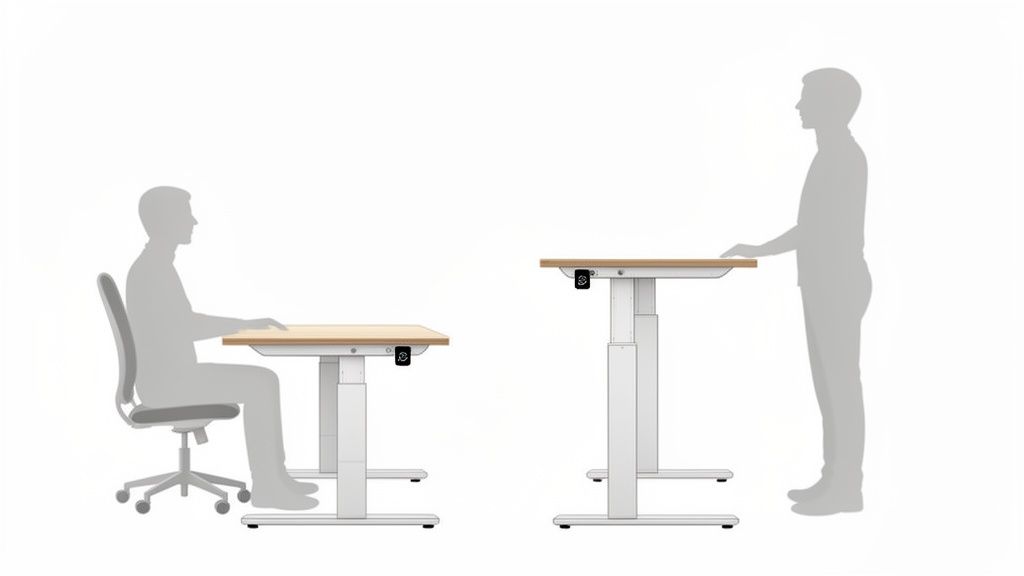
You give the command for height adjustment via a control unit under the tabletop. The motors move the legs precisely and smoothly to the desired height. The result is a smooth transition that encourages you to change your posture.
This technology breaks rigid postures that often lead to tension in the neck and back. By incorporating more movement into your workday, you increase your physical well-being, concentration, and energy levels.
The core components of a system
A system for electrically height-adjustable table legs consists of a few but crucial components. Knowing them helps in better assessing the quality and performance of different models.
- Lifting columns (table legs): They house the mechanics and motors. Their design is crucial for stability and adjustment range.
- Motors: They are the heart of the system. Their number and quality determine lifting capacity, speed, and noise development.
- Control unit: This is the "brain" of the desk. It processes inputs from the control panel and ensures synchronous movement of the motors.
- Control panel: This is the interface to the table. Simple models have up and down buttons. Better variants have memory functions for saving heights.
An electrically height-adjustable desk frame is an investment in your health. It allows you to adapt your workplace to your body. You don't have to force your body into a rigid environment.
From single-motor to three-motor solutions
The performance of a system depends on the number of motors. Inexpensive models often use only one motor, which transmits its power to both legs via a shaft. This usually means less lifting capacity and slower adjustment.
Modern systems rely on dual-motor technology. Each table leg has its own motor. This ensures faster, quieter, and more stable movement. For large L-shaped desks or heavy setups, there are three-motor solutions. They guarantee maximum stability and lifting capacity.
What is becoming standard today has a long history. In Scandinavia, such workplaces have been established for decades. In 2005, their share in offices was already over 90 percent. Thanks to technological advancements, powerful and quiet systems are now accessible to everyone. If you want to learn more, you can find more about the history of height-adjustable desks on office-roxx.de.
The technology behind electric table legs
To recognize a good electrically height-adjustable desk frame, it's important to look at the technology. It's an interplay of mechanics and electronics. This determines stability, speed, and longevity.
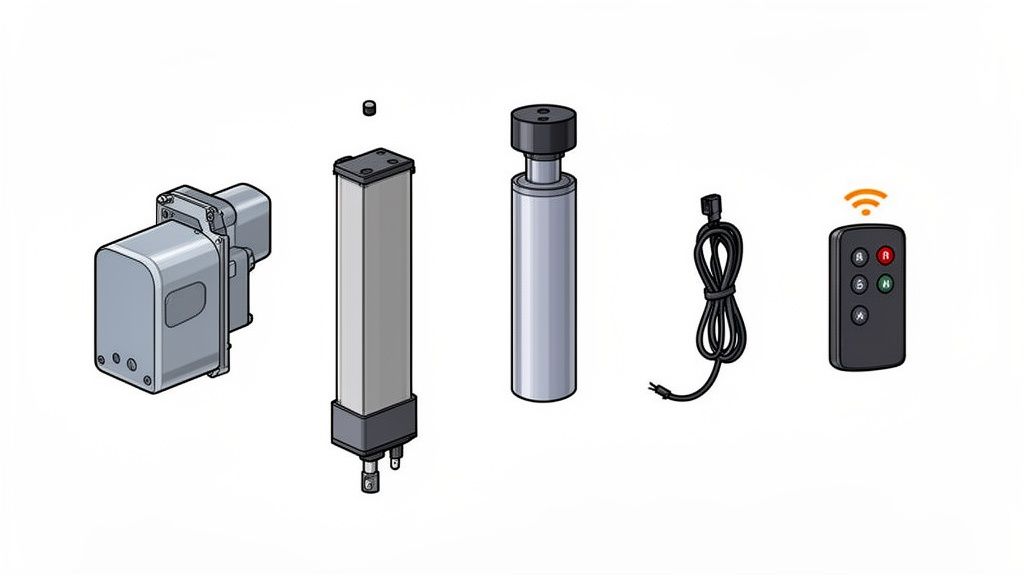
The foundation is formed by the lifting columns. They contain the drive technology. They usually consist of two or three segments that slide into each other. This construction allows for a large adjustment range. The quality of the steel and the precision of the telescopic mechanism are responsible for stability.
Inside each lifting column is the motor. It drives a spindle that moves the segments of the column. The quality of these motors determines the lifting capacity, speed, and noise level.
Everything is controlled by the control unit. This box receives commands from the control panel and ensures the synchronous operation of all motors. This synchronization is important so that the tabletop moves evenly.
The drive determines performance
The number of motors is an important technical feature. It influences how your desk feels in everyday use.
- Single-motor systems: A central motor drives both legs via a mechanical shaft. This design is cheaper but compromises on lifting capacity and speed.
- Dual-motor systems: Each table leg has its own motor. This is the standard for high-quality frames. Direct power transmission ensures more power, faster adjustment, and quieter operation.
- Three-motor systems: These systems are used for L-shaped corner desks. Each leg has its own motor. This guarantees maximum stability and lifting capacity for large work surfaces.
A good dual-motor system lifts loads from 120 kg to 160 kg. This is crucial for a demanding setup with a solid tabletop and multiple monitors. The higher power also ensures an adjustment speed of up to 40 millimeters per second. You can find more details in our guide on electrically height-adjustable desk frames.
Investing in a multi-motor system makes sense. You get more stability, quieter operation, and a longer lifespan. The smooth and fast operation encourages regular use.
Smart functions for safety and comfort
Modern electrically height-adjustable table legs offer more than just lifting and lowering. Smart features make everyday life safer and more comfortable.
An important function is anti-collision protection. Sensors detect when the table encounters an obstacle. The system immediately stops movement and retracts a bit. This prevents damage.
The memory function is also very practical. This allows you to save your sitting and standing heights. Instead of readjusting the height every time, you move the table to the desired position with a single button press. This makes regular changes easy.
Finding the right table legs for your needs
Choosing the right table legs is an important decision. It determines how stable, quiet, and powerful your desk will be. Analyze your needs to make the right choice. Find the balance of lifting capacity, height range, stability, and functions for your setup.
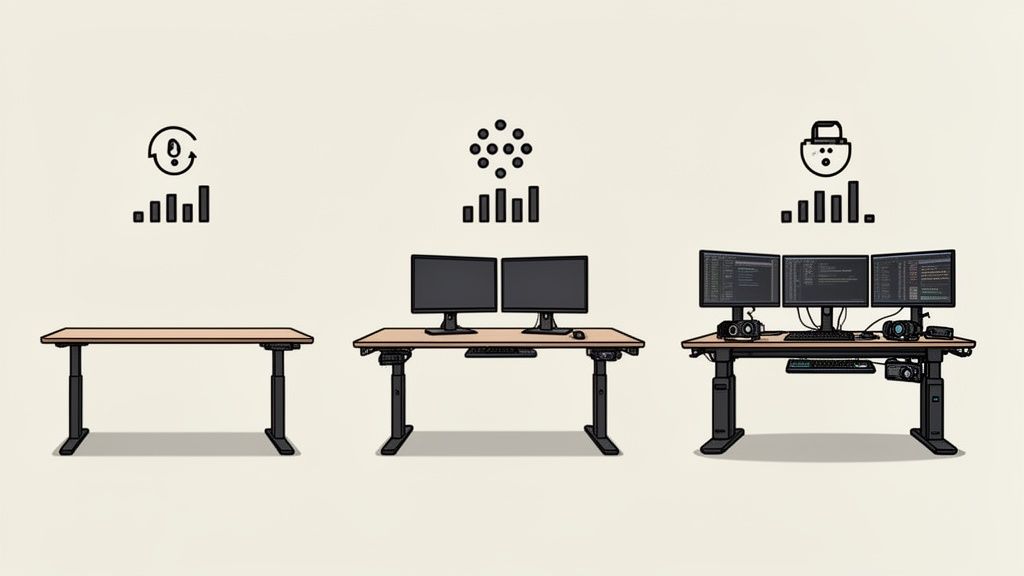
Take inventory of your equipment. What should go on the tabletop? A laptop has different requirements than a setup with two monitors and a heavy PC. Each part has a weight that the motors must lift.
Lifting capacity as a decisive factor
The lifting capacity, also known as load capacity, indicates how much weight the motors can lift. This value should not be too low. Insufficient lifting capacity makes adjustment slower and louder. In addition, the motors are overloaded, which shortens their lifespan.
To determine the necessary lifting capacity, add the weight of all components:
- Tabletop: A solid wood top weighs more than a chipboard. Plan for 15 to 40 kg.
- Computer and monitors: A PC and two 27-inch monitors together weigh 20 to 30 kg.
- Accessories: Consider monitor arms, speakers, and lamps.
- Additional load: Don't forget the weight of your arms and the pressure you apply while working.
Practical tip: Add the weights and plan a safety buffer of at least 30 %. For example, if your setup weighs 80 kg, choose a frame with a lifting capacity of at least 100 to 120 kg. This guarantees smooth operation and protects the technology.
Height adjustment range and stability
The height adjustment range is crucial for ergonomic adaptation. Make sure the table reaches the perfect height when sitting and standing. The sitting height is ideal when your feet are flat on the floor and your arms are at a 90-degree angle on the tabletop. The same rule applies when standing.
Good frames offer an adjustment range of approximately 62 cm to 128 cm. This covers the needs of most people.
Stability is particularly crucial in the highest position. Nobody wants to work at a wobbly table. Stability depends on several factors:
- Material quality: Thick-walled steel provides a solid base.
- Design of the lifting columns: 3-segment columns often offer more stability than 2-segment models.
- Workmanship: Precisely manufactured parts with low tolerances prevent wobbling.
Noise development and additional features
Noise development is an often underestimated point. A quiet motor is very important in a home office or quiet offices. High-quality dual-motor systems often operate at a volume of less than 50 dB. This is equivalent to a quiet conversation.
Also pay attention to useful additional functions. A memory function is practical for quickly switching between heights. Anti-collision protection protects your furniture and the frame.
Certifications and warranty as quality indicators
Independent certifications provide security. Seals such as the TÜV certificate confirm technical safety and tested load capacity. Certification by the IGR (Interessengemeinschaft der Rückenschullehrer/innen e.V.) shows that the product meets high ergonomic standards.
The warranty is a clear sign of the manufacturer's confidence in its product. A long warranty period of 5 to 10 years speaks for durable components. A 100-day trial period gives you the chance to test the frame in your work environment.
The following table helps you classify the most important features for your user profile.
Requirements for electrically height-adjustable table legs by user profile
This table compares the needs of different user groups with the relevant technical features.
| User profile | Most important feature | Recommended lifting capacity | Ideal height range | Additional features |
|---|---|---|---|---|
| Home Office Power User | Stability and noise level | 100 - 120 kg | 62 - 128 cm | Memory function, quiet motors (<50 dB) |
| SME & Startups | Durability and service | 120 - 160 kg | 60 - 125 cm | Long warranty, TÜV certification |
| Creator & Tech Pros | High lifting capacity and aesthetics | 160 kg or more | Wide range for various setups | 3-motor systems, good cable management |
Whether you're setting up a simple home office or require a complex setup, the technical data will give you a clear direction.
Assembly and Compatibility: How everything fits together
You've found the ideal desk frame. Now comes the combination with the right tabletop and the assembly. This step determines stability and longevity. Assembly is easy with preparation and instructions.
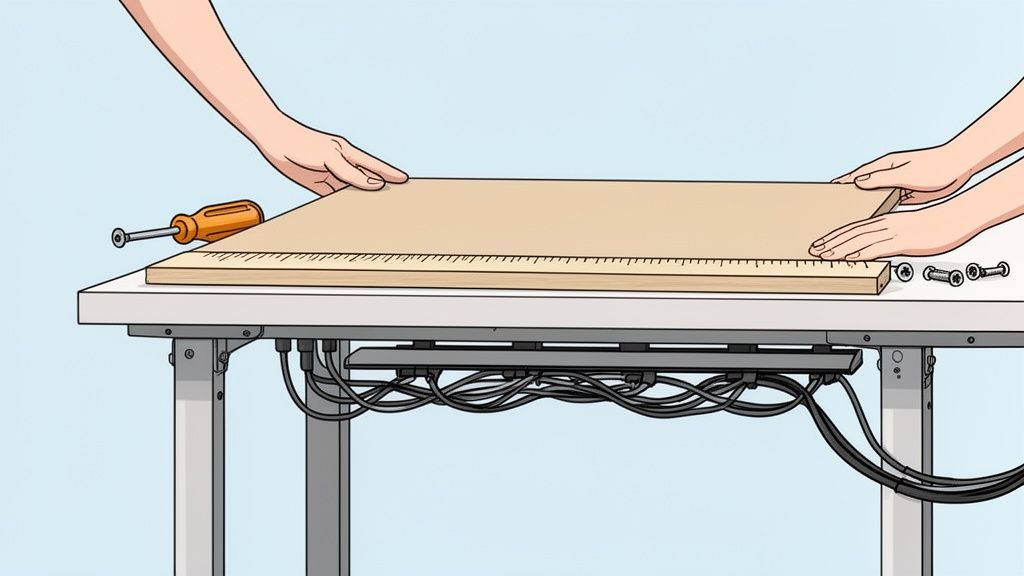
A good desk frame is flexible. Most models can be adjusted in width. This allows you to use them for different tabletop sizes. Check the manufacturer's specifications before buying. There you will find the recommended width and depth for the tabletop.
Choosing the right tabletop
The choice of tabletop is a matter of stability, not just aesthetics. Not every material and size fits every frame.
The thickness of the tabletop is a crucial factor. A thickness of at least 25 mm is ideal. This gives the screws enough grip and prevents the tabletop from bending. Thinner tops can become wobbly.
There are many options for material:
- Solid wood: Very stable, durable, and visually appealing. However, it is heavy, which you must consider for the lifting capacity of your frame.
- MDF or chipboard: An inexpensive and stable alternative. Look for a high-quality coating for a scratch-resistant surface.
- Bamboo: A sustainable and robust option with a natural look.
Pro tip: Consider the weight of the tabletop when checking the load capacity of your frame. Subtract the tabletop weight from the maximum lifting capacity. The result is the load capacity for your devices.
Step-by-step to successful assembly
You can assemble an electrically height-adjustable table yourself. Most manufacturers provide detailed instructions and often the appropriate tools.
- Prepare: Place the tabletop upside down on a soft surface to avoid scratches.
- Assemble frame: Assemble the frame according to the instructions and align it centrally on the tabletop.
- Mark position: Mark the drill holes with a pencil through the openings in the frame on the tabletop.
- Pre-drill (recommended): For hardwood tops, pre-drill the holes with a thin drill bit. This prevents the wood from splitting.
- Fasten frame: Screw the frame firmly to the tabletop. Tighten all screws securely.
- Attach components: Mount the control unit and the control panel in an easily accessible place under the tabletop.
- Wire: Connect the motors and the control panel to the control unit. The plugs usually only fit into the designated sockets.
Once everything is assembled, place the table on its feet and plug in the power cord. Perform a short calibration according to the instructions. This synchronizes the motors. For more details, you can find further tips in our article on electrically height-adjustable desk frames.
Cable management for a tidy workspace
A tidy setup looks better and is safer. Loose cables are tripping hazards. Good cable management is the last, but important step.
Here are some helpers:
- Cable trays: They are screwed under the tabletop and hide cables and power strips.
- Cable snakes: Flexible channels that lead cables from the table to the floor and adapt to any height.
- Cable ties or hook-and-loop fasteners: Use these to bundle cable strands.
Plan cable management from the beginning. This ensures all cables are long enough. A tidy workspace promotes concentration and completes your setup.
Why the investment is worth it for you
The decision for electrically height-adjustable table legs is a decision for your health, your focus, and your performance. The advantages are clearly identifiable.
The problem with classic desk work is the one-sided strain. Hours of sitting put pressure on the intervertebral discs and weaken the core muscles. This leads to tension and back pain.
A height-adjustable table breaks this cycle. The regular change between sitting and standing brings movement into the day without interrupting work. This dynamic way of working relieves the spine, activates the leg muscles, and gets the circulation going.
Concrete health improvements
The positive effects are measurable. Regular standing stimulates metabolism. Compared to sitting, you burn more calories, which can help with weight control.
More important is the effect on the back. Studies show that switching between sitting and standing reduces the strain on the lumbar spine. Many users report a relief of their neck and back pain. You can find more details in our article 7 good reasons why you need a height-adjustable desk.
- Less pressure: Changing posture redistributes pressure on the intervertebral discs.
- More active circulation: Slight muscle activity while standing promotes blood circulation and supplies the brain with oxygen.
- Better posture: You train your core muscles, which leads to a more upright posture.
More productivity and a clearer head
A fit circulatory system directly affects mental performance. Many users report more energy and better concentration, especially in the afternoon.
A change of position acts like a restart for the mind. It breaks monotony and helps to stay focused.
For creatives, programmers, and anyone who works concentrated for long periods, this is a great advantage. Instead of sitting tired in front of the screen, you can get new energy with the push of a button.
A wise economic decision for companies
For companies, investing in ergonomic workstations is economically sensible. Sickness-related absences, especially due to musculoskeletal disorders, cause high costs.
A 2022 survey by BAuA shows that the average sick leave in Germany is 21.3 days per employee. At a cost of 233 euros per day of absence, this adds up to almost 5,000 euros per employee per year. Studies prove that height-adjustable desks reduce back pain. The investment in prevention is often less than the cost of a single absence.
Frequently asked questions about electric table legs
You have an overview of the technology and benefits. Nevertheless, there are often detailed questions. We clarify these precisely and practically here.
How much weight can the table legs lift?
The load capacity, also called lifting capacity, depends on the model and the technology.
Simple frames with one motor start at 70 to 80 kg. This is sufficient for a minimalist setup.
For most workplaces, frames with two motors are standard. They lift up to 160 kg. This is ideal for multiple monitors and a heavy PC. Three-motor systems for large tabletops move loads up to 200 kg.
Practical tip: Calculate the total weight of your setup. Add a safety buffer of 20% to 30%. A generously sized lifting capacity ensures safety, smooth operation, and a longer lifespan for the motors.
Can I continue to use my old tabletop?
Yes, this is usually not a problem and a sustainable solution. Most electrically height-adjustable table legs can be flexibly adjusted in width.
Check the technical specifications of the frame. There you will find information on the recommended tabletop size.
Your tabletop should be sturdy enough, at least 25 mm thick. This gives the screws a firm hold. Materials such as solid wood, MDF, or chipboard are ideal. Make sure the weight of the tabletop does not exceed the lifting capacity. Assembly is simple: You screw the frame to the tabletop from below.
How high is the power consumption?
Power consumption is very low. Modern systems are energy-efficient. The motors only consume power when you move the table.
In standby mode, consumption is often below 0.1 watts. The annual electricity costs amount to only a few euros. You don't have to worry about a higher electricity bill.
What makes an expensive desk frame better than a cheap one?
Price differences are based on differences in construction, quality, and technology. These factors determine performance, stability, and lifespan.
1. The motor technology Inexpensive models often only have one motor. This is usually louder and weaker. More expensive frames use two or three separate motors. Each leg has its own drive. This leads to more power, faster adjustment, and more stable movement.
2. Material and workmanship High-quality frames are made of thicker steel and are more precisely manufactured. The table wobbles less, especially when extended. The telescopic segments have less play.
3. The range of functions Premium models offer smart features. This includes more sensitive anti-collision protection, more memory slots for heights, or a high-quality control element.
4. Warranty and certificates A long warranty of five to ten years is a sign of quality. Certificates from institutes such as TÜV (for technical safety) or IGR (for ergonomics) confirm high standards that are often missing in cheaper models.
A higher investment pays off with more performance, better stability, and a longer lifespan.
Ready for a better workplace? Discover our variety of TÜV-certified desk frames at Deskspace. Find the perfect base for your ergonomic desk. Test everything with our 100-day trial period and benefit from up to 10 years warranty.


