

Workplace Lighting Regulations Explained

The regulations for workplace lighting ensure that you can work healthily and productively. They define clear minimum requirements for brightness, glare-free conditions, and light quality. These requirements protect your eyes from strain in the office and home office.
The most important lighting regulations explained directly
Good lighting at the workplace is regulated by law. The regulations serve to protect your health and safety. This has a practical background: they are intended to prevent eye strain, fatigue, and accidents due to poor visibility. Correct lighting demonstrably promotes concentration and general well-being.
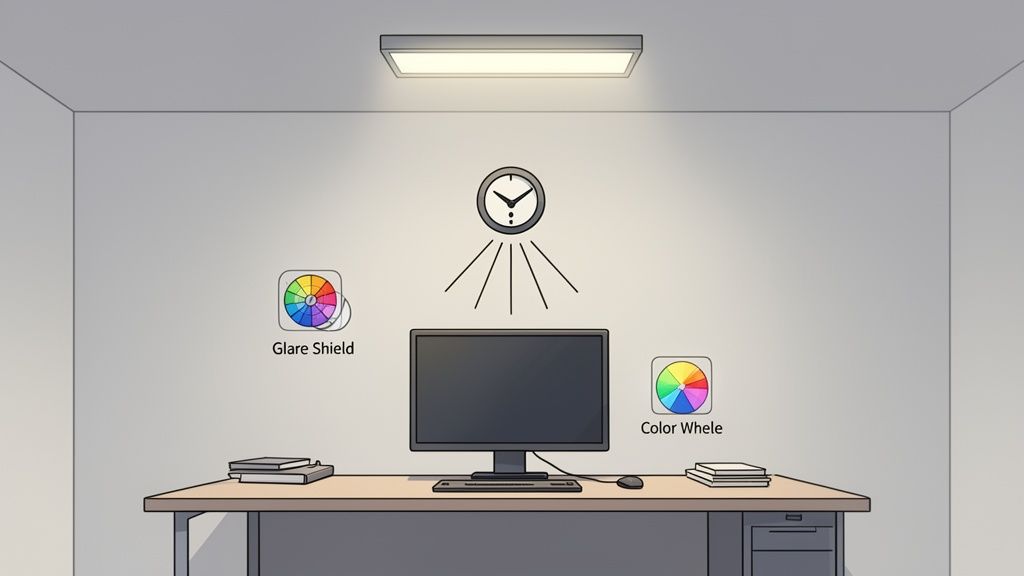
The legal framework for this is clearly structured. It provides employers with concrete specifications. These rules are not recommendations, but binding requirements. They create a safe and ergonomic working environment.
Legal Basis in Germany
The central regulations in Germany are the Workplace Ordinance (ArbStättV) and the Technical Rule for Workplaces (ASR A3.4). They form the foundation for all lighting requirements. The ArbStättV defines the general protection goals. The ASR A3.4 underpins these goals with concrete values and measures.
These regulations define exact metrics to ensure that the lighting matches the respective activity. For typical VDU workstations, the illuminance on the work surface must be at least 500 lux. In the immediate vicinity, 300 lux is sufficient. For demanding visual tasks such as technical drawings, the requirements increase to 750 to 1,000 lux. More details on the regulations for workplace lighting can be found here at LED2WORK.
Key Requirements at a Glance
The following table summarizes the most important key data. These values are crucial if you want to assess the lighting at your workplace. It's not just about brightness. Uniformity, glare prevention, and good color rendering are equally important for your visual comfort and performance.
The table shows the most important limit and guideline values according to ASR A3.4 for typical office workplaces. It helps you quickly categorize technical terms.
| Requirement | Specification for Office & VDU Work | Meaning for you |
|---|---|---|
| Illuminance | Minimum 500 lux on the work surface | Ensures sufficient brightness so that you can effortlessly recognize details on the screen and documents. |
| Glare limitation (UGR) | UGR value ≤ 19 | Prevents disturbing reflections and direct glare from lamps. This reduces headaches and tired eyes. |
| Color Rendering Index (Ra) | Ra ≥ 80 | Ensures that colors look natural and unadulterated. Important when evaluating graphics or designs. |
| Uniformity | Minimum 0.6 (E_min / E_mean) | Guarantees a balanced light distribution without strong light-dark contrasts, which noticeably relieves your eyes. |
These values are the benchmark for good workplace lighting. They help create an environment where you can concentrate without unnecessarily straining your eyes.
Overview of the Most Important Regulations and Standards
The regulations for workplace lighting can seem complex. But the system behind it is logical. The goal is always to protect your health and provide you with the best conditions for concentrated work.
Three sets of regulations are crucial: the Workplace Ordinance (ArbStättV), the Technical Rule for Workplaces (ASR A3.4), and the European standard DIN EN 12464-1. They interlock like gears. The ArbStättV sets the direction, while ASR and the DIN standard define the technical details. If you understand their roles, it becomes clear what matters for your work lighting.
The Workplace Ordinance (ArbStättV) – the Foundation
The Workplace Ordinance (ArbStättV) is the fundamental law for safety and health protection at the workplace. It sets overarching goals. Appendix point 3.4 states the central requirement: workplaces must receive as much daylight as possible and additionally be equipped with appropriate artificial lighting.
What "sufficient" or "appropriate" means in numbers is left open by the ArbStättV. It states that the lighting must be safe and healthy, which is mandatory. How this is to be implemented in detail is left to specialized regulations. The ArbStättV defines general rights and obligations without regulating every detail itself.
ASR A3.4 – the Concrete Guide for Germany
The Technical Rule for Workplaces ASR A3.4 "Lighting" is the practical implementation of the ArbStättV for Germany. It is the most important guide for employers and contains binding requirements. If a company adheres to ASR A3.4, it is legally on the safe side.
ASR A3.4 provides clear facts and figures. It defines precise quality criteria for good light:
- Minimum illuminance: For an office workstation, at least 500 lux on the desk surface is prescribed.
- Glare limitation: The UGR value at the workplace must not exceed 19 to prevent reflections on the screen from being distracting.
- Color rendering: The color rendering index (Ra) must be at least 80 so that colors do not appear distorted.
- Daylight first: The ASR emphasizes that daylight takes precedence. Good provision and a visual connection to the outside are clear requirements.
This rule makes the abstract goals of the ArbStättV measurable and tangible. It is the decisive document for the practical implementation of the workplace lighting regulations.
DIN EN 12464-1 – the European Standard
DIN EN 12464-1 "Lighting of Indoor Workplaces" is a European standard. It describes the current state of the art for professional lighting design. Its recommendations are often more detailed than those of ASR A3.4. For example, it also provides information on the correct lighting of ceilings and walls to create a pleasant lighting atmosphere.
Although ASR A3.4 sets the legal tone in Germany, it is heavily based on this DIN standard. Many limit values are identical. For lighting designers, architects, and luminaire manufacturers, DIN EN 12464-1 is the basis for developing high-quality lighting solutions.
In summary: The ArbStättV requires good lighting. ASR A3.4 sets the minimum standards for Germany. DIN EN 12464-1 shows the optimal implementation according to the European state of the art.
Daylight First, Then Technology
The regulations for workplace lighting prioritize daylight. It is the primary light source for every workplace. Natural light is crucial for health, well-being, and performance.

Daylight has a dynamic quality. The changing intensity and color temperature synchronize our internal clock, the circadian rhythm. This rhythm controls important bodily functions such as the sleep-wake cycle, hormone production, and concentration.
Good daylight exposure helps maintain this rhythm. This makes us feel more alert during the day and sleep better at night. If this natural light stimulation is missing, the rhythm can be disturbed. This leads to fatigue, concentration problems, and reduced productivity.
Why ASR A3.4 Places So Much Value on Daylight
The Technical Rule for Workplaces (ASR A3.4) formulates concrete requirements. It ensures that daylight is used effectively. Artificial light should only be used when natural light is insufficient.
This prioritization is a core element of German regulations. Workrooms must either achieve a daylight factor of over 2% at the workplace or have a window area to room floor area ratio of at least 1:10. Places near windows are to be preferred, as they ensure an unobstructed view outside. Studies show that daylight can reduce fatigue and increase productivity by up to 15–20%. Learn more about the scientific background from BAuA.
These requirements pursue two goals:
- Health protection: Looking outside is psychologically important. It relaxes the eyes when looking into the distance and reduces the feeling of being enclosed.
- Visual ergonomics: Sufficient daylight ensures high illuminance and excellent color rendering. This improves visual performance and relieves eye strain.
How to Optimize Your Workspace Layout
The correct positioning of your workspace is important to maximize the benefits of daylight. The orientation of your desk and screen is crucial. The best position for your desk is sideways to the window. This way, light falls onto your work surface from the side. You avoid glare and reflections on the monitor.
Avoid placing your desk directly in front of the window. The high contrast between the dark screen and the bright outdoor area overstrains your eyes. Sitting with your back to the window is equally unfavorable. Then the sun shines directly onto the monitor and causes strong glare.
Practical Tips for Using Daylight
With simple adjustments, you can improve daylight provision and meet legal requirements.
- Position your desk sideways to the window: Place your desk at a 90-degree angle to the window front. This gives you optimal side light.
- Use glare and sun protection: Use blinds, roller blinds, or pleated blinds to regulate direct sunlight. Ideally, these direct the light to the ceiling, from where it is distributed glare-free throughout the room.
- Prefer light room design: Light walls, ceilings, and furniture reflect daylight. This increases general brightness and ensures more uniformity.
- Remove obstacles: Make sure that no large pieces of furniture or plants block the light flowing into the room from the windows.
By consciously incorporating daylight into your workplace design, you create a standard-compliant, healthy, and motivating work environment.
Targeted Planning and Implementation of Artificial Lighting
When daylight is insufficient, artificial lighting becomes crucial for your productivity. With targeted planning, you not only meet legal requirements but also create an environment that promotes concentration and protects your eyes.
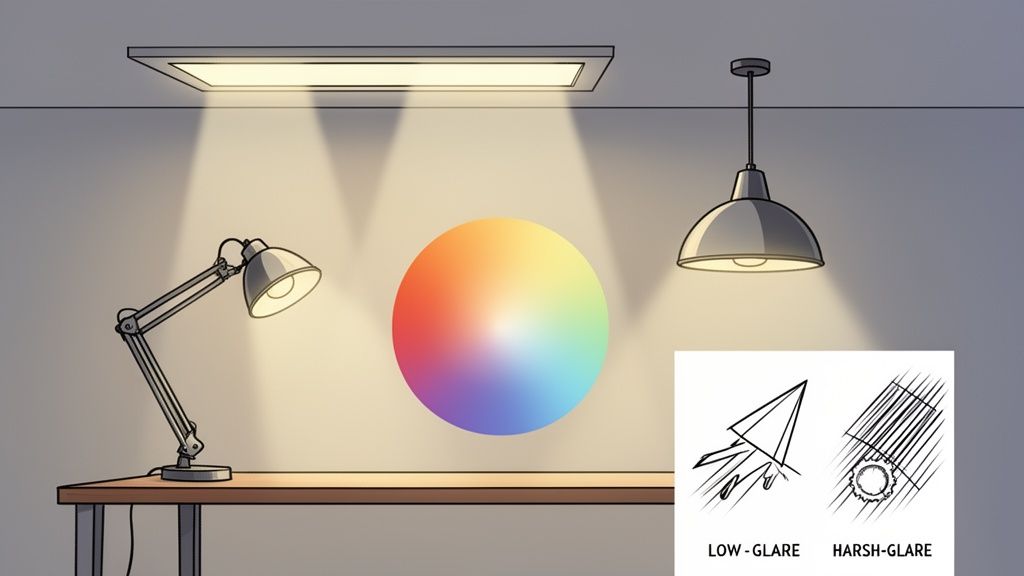
The right artificial lighting is a mixture of good general lighting and a direct workstation light. To optimize this combination, you should be familiar with the most important photometric parameters.
Understanding the Four Pillars of Lighting Design
Four central metrics determine the quality of your artificial light. If you know these values and use them correctly, you create lighting that complies with regulations and is ergonomic.
- Illuminance (Lux): This value indicates how much light falls on a surface. It is the most important parameter for assessing brightness.
- Color temperature (Kelvin): It describes the light color from warm white to daylight white.
- Color Rendering Index (CRI or Ra): The CRI indicates how naturally colors appear under a lamp.
- Glare limitation (UGR): The Unified Glare Rating is a measure of how much a luminaire causes glare. A low UGR value is important for VDU work.
These four factors interact and influence how you perceive light and how it affects your body.
Illuminance: The Right Brightness for Every Task
The most important requirement of the workplace lighting regulations concerns illuminance. It is measured in lux (lx). The necessary value depends on your activity.
ASR A3.4 specifies clear minimum values. For most office workstations, a value of 500 lux directly on the work surface is standard. The area around it should be illuminated with at least 300 lux to avoid harsh contrasts.
Recommended Illuminance by Activity (ASR A3.4)
| Activity Area | Minimum Illuminance (in Lux) | Practical Example |
|---|---|---|
| General office work | 500 Lux | Answering emails, writing texts, normal VDU work |
| Technical drawing | 750 Lux | Detailed manual drawings or CAD work with high precision requirements |
| Assembly of fine parts | 1,000 Lux | Filigree manual activities, quality control of small parts |
| Surrounding areas | 300 Lux | Areas directly around the workplace to minimize contrasts |
| Traffic routes, corridors | 100 Lux | Passages and areas without permanent workstations |
These values are the minimum. Depending on the visual task and individual perception, more light can be more pleasant.
Color Temperature and Color Rendering: For Mood and Accuracy
In addition to brightness, light color and color rendering are also crucial. Color temperature, measured in Kelvin (K), has a direct impact on your mood and concentration.
- Warm white (< 3,300 K): Creates a relaxed atmosphere. Rather unsuitable for concentrated work.
- Neutral white (3,300–5,300 K): Is considered objective and promotes concentration. Ideal for most office activities.
- Daylight white (> 5,300 K): Has a strong activating effect and is closest to natural daylight. Perfect for attention-intensive tasks.
The color rendering index (CRI or Ra) must be at least Ra 80 according to the regulations. This ensures that colors look natural. If you work as a graphic designer or artist, you should aim for a value of Ra 90 or higher.
Good lighting is one that you barely notice. It should feel natural and support you in your work. If you want to learn more about how to find the right light at the workplace for optimal lighting against fatigue, read our detailed guide.
Employer's Duties and Your Rights in the Home Office
The responsibility for compliant lighting lies with the employer. This is a core element of their statutory duty of care under the Occupational Safety and Health Act (ArbSchG). Companies are obliged to actively protect the health of their employees. Proper lighting plays a crucial role in this.
How the Employer Ensures Proper Lighting
Everything begins with a risk assessment. The employer must systematically check whether the lighting at all workplaces complies with the requirements of ASR A3.4. Are there risks to the eyes? Is there a risk of tripping? If deficiencies are identified, the employer must act.
This duty is important. If an accident occurs due to poor lighting, it can be costly for the company. Fines or criminal consequences may result. Occupational insurance associations also pay close attention.
What Applies in the Home Office?
The employer's responsibility does not end at the office door. Conditions must also be right in the home office. This applies particularly to permanently established teleworkplaces.
A risk assessment must also be carried out for your home office. This is often done using checklists, questionnaires, or photos. The employer must support you in making your workplace safe and healthy. Lighting is an important aspect here.
You have freedom in furnishing your home, but the protective objectives of the Occupational Safety and Health Act still apply. Your employer is obliged to inform you about the requirements and to help.
At the same time, as an employee, you have a duty to cooperate. You must apply the information provided and inform your employer of any problems. If the light is insufficient, discuss this with your supervisor.
Concrete Requirements and Support
The known quality characteristics for good light apply to your home workplace. An illuminance of 500 lux on the desk is a solid guideline. It is equally important to avoid glare and ensure uniform illumination.
Employer support can take various forms:
- Consultation: Many companies provide guidelines.
- Financial subsidies: Some employers contribute to the cost of a good desk lamp.
- Provision of equipment: In some cases, the employer provides the appropriate lighting.
A well-equipped workplace is the basis for healthy work. In our guide, you will find tips on how to set up your home office workplace correctly.
Proper lighting in the home office is a shared responsibility. The employer creates the framework, and you ensure implementation on site. If you are interested in different work models, check out our guide to remote work. Open communication is the best way to a healthy working environment.
Checklist for Optimizing Your Workplace Lighting
This checklist helps you systematically check and improve the lighting at your workplace. Go through the points step by step to uncover weaknesses. This way, you create an environment that complies with the workplace lighting regulations and promotes your concentration.
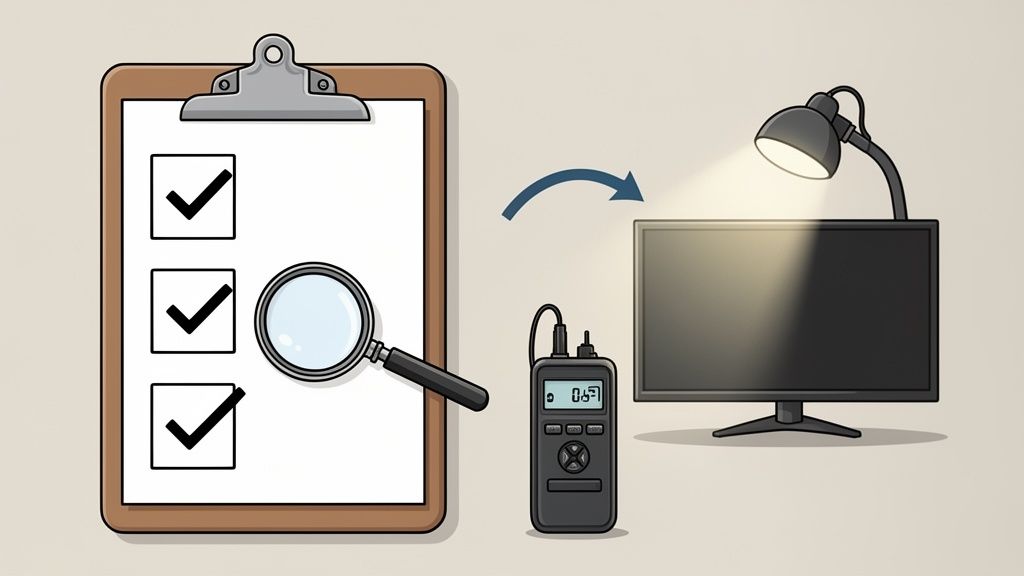
Each point is formulated as a simple question. An honest answer will show you where you need to start.
Part 1: Evaluating Daylight Use
The correct use of daylight is the first and most important step.
-
Question 1: Is your desk positioned sideways to the window? Your desk should be at a 90-degree angle to the window. This prevents glare and reflections on the screen. What to do? If not, reposition your desk. A small change can reduce glare.
-
Question 2: Do you have an unobstructed view outside? Regulations require a visual connection to the outside. This relaxes the eyes. What to do? Remove anything that blocks the view. Tall cabinets or large plants do not belong directly by the window.
-
Question 3: Can you control direct sunlight? Direct sun causes glare and harsh contrasts. Effective sun protection is a must. What to do? Use blinds, pleated blinds, or roller blinds. Ideally, direct the light to the ceiling, from where it is indirectly distributed throughout the room without glare.
Part 2: Checking Artificial Lighting
When daylight is insufficient, artificial lighting must take over. Good lighting consists of three components: uniform general lighting, a flexible workstation light, and, if necessary, accent lighting.
-
Question 4: Are there distracting glares or reflections on your screen? Sit in your normal working position and look at your monitor. Do you see reflections? Direct glare is a primary cause of tired eyes. What to do? Reposition luminaires or use lamps with a low UGR value (UGR ≤ 19). Often, slightly tilting the screen downwards helps.
-
Question 5: Does your hand or body cast shadows on your work surface? Shadows while writing force your eyes to constantly adjust. This causes fatigue. What to do? Position your desk lamp so that the light comes from the side. For right-handers, this means light from the left. For left-handers, light from the right. In our guide, you can learn more about how to find the right desk lamp and use it optimally.
-
Question 6: Is the lighting on your work surface uniform? Strong light-dark contrasts are strenuous for the eyes. Your work area should be illuminated homogeneously. What to do? Combine a central ceiling light for basic brightness with a flexible desk lamp for targeted light.
Part 3: Controlling Light Quality
Not only brightness counts; light quality is also crucial for your visual comfort.
-
Question 7: Does your light flicker or appear restless? Flickering light can cause headaches and concentration problems. What to do? Invest in high-quality, flicker-free LED light sources. Old fluorescent tubes should be replaced.
-
Question 8: Do colors appear natural under your artificial light? A low color rendering index (CRI) makes colors look pale. Regulations require at least Ra 80. What to do? When buying, look for a CRI value of 80 or better. If you work creatively, Ra 90 is mandatory.
Frequently Asked Questions About Workplace Lighting
Here you will find answers to the most common questions about lighting regulations.
What is the mandatory lux level for an office workstation?
For a VDU workstation, regulations stipulate at least 500 lux. This value applies directly to the work surface. For the area around your desk, at least 300 lux is required. This ensures soft transitions and relieves eye strain.
Does the Workplace Ordinance also apply to home offices?
Yes, the protective objectives of the Occupational Safety and Health Act and the Workplace Ordinance also apply to home offices. This is particularly true for permanently established teleworkplaces. Your employer has a duty of care and must ensure that your workplace meets the ergonomic minimum requirements.
Who is responsible for correct lighting in the home office?
Employer and employee share responsibility. The employer must inform and advise you. As an employee, you have a duty to cooperate and are responsible for implementing the measures at your workplace.
What does the UGR value mean and why is it important?
The UGR value (Unified Glare Rating) indicates how much a luminaire causes glare. The lower the value, the more comfortable the light. For VDU workstations, a UGR value of ≤ 19 is prescribed. This value avoids reflections and direct glare.
Do I need daylight at my workplace?
Yes. Regulations give daylight the highest priority. ASR A3.4 requires sufficient daylight and a visual connection to the outside. Artificial light is intended as a supplement.
Is a single ceiling light sufficient for my workplace?
In most cases, no. A single ceiling light rarely achieves the required 500 lux glare-free on the desk surface. The ideal solution is a combination of good general lighting from a ceiling light and a flexible desk lamp.
Which color temperature is best suited for the office?
For concentrated work, neutral white (around 4,000 Kelvin) has proven effective. This light color promotes attention without appearing cold. Warm white light (< 3,300 K) has a relaxing effect, while daylight white light (> 5,300 K) is strongly activating.
An ergonomic workplace is more than just good lighting. The perfect foundation is a height-adjustable desk from Deskspace. Discover our TÜV-certified models now and design your workplace the way you need it.


