

Release Psoas Tension with Simple Exercises

Do you want to release a stubborn psoas tension? The key often lies in understanding the deeper causes. A combination of targeted stretching, strengthening antagonist muscles, and conscious relaxation helps to sustainably release tension and alleviate lower back pain.
Why your psoas muscle is often the cause
The psoas muscle is more than just a simple hip flexor. It is the only muscle that directly connects your upper body to your legs. This makes it a key player for posture, stability, and mobility.

If this muscle is tense or shortened, it can trigger a chain reaction. It pulls on the lumbar vertebrae and tilts the pelvis forward, forcing you into an exaggerated lordosis (hollow back). This poor posture puts pressure on intervertebral discs and facet joints.
The consequences are diverse and often not associated with the psoas.
The combination: sitting, stress, and pain
Prolonged sitting at a desk harms the psoas. It is forced into a shortened position for hours. Over time, the surrounding fascial tissue becomes matted, making the tension chronic. When you then stand up, the shortened muscle cannot properly straighten the pelvis. This causes the pulling sensation in the lower back after a long day at work.
Additionally, the psoas reacts sensitively to emotional stress. It is part of the "fight-or-flight" response and instinctively tenses up under strain. In the past, the reaction was flight or fight. Today, we remain stressed while sitting at our desks. The tension remains trapped in the muscle.
A chronically tense psoas constantly sends alarm signals to the body. This leads to physical pain and can, in the long run, burden the nervous system.
Typical consequences of psoas tension
The problems rarely remain confined to the back. A tense psoas can cause symptoms that one would not initially associate with it:
- Lower back pain: This is the classic. The muscle attaches directly to the lumbar spine.
- Restricted hip mobility: Stride length feels shortened or there is a sensation of a blockage in the hip.
- Groin pull: The muscle runs directly through the groin area.
- Digestive problems: Due to its proximity to the abdominal organs, a tense psoas can exert pressure and disrupt their function.
This list shows why isolated back exercises often don't help. If the psoas is the cause, you need to address it directly. According to an RKI study, 61.3% of adults in Germany reported having back pain in the last year. Lower back pain was twice as common as upper back pain.
Because the psoas as a cause is often overlooked, targeted approaches such as specific yoga exercises specifically for back pain can be helpful. In our guide, you will find more tips on how you can manage lower back pain yourself.
Recognizing typical symptoms of psoas tension
When the psoas is tense, the body often sends signals that are difficult to pinpoint. The discomfort ranges from a deep pull in the groin to pain in areas not associated with the hip.

Correctly interpreting the body's signals is the first step to being able to release psoas tension. Pay conscious attention to recurring patterns. These occur especially after prolonged sitting, upon waking, or when getting out of the car.
Direct pain and a feeling of blockage
The most obvious signs are felt directly in the hip and lumbar spine area. These symptoms are often a clear indication that the muscle is too short or under constant tension.
Typical direct symptoms include:
- Lower back pain: A dull ache in the lumbar spine that worsens with standing or walking.
- Groin pull: A deep-seated pain that makes leg movements uncomfortable.
- Feeling of blockage in the hip: The hip feels stiff and immobile, especially when trying to move the leg backward.
- Difficulty straightening up: After standing up, it takes a moment to fully straighten.
These direct signs usually result from the mechanical pull that the tense psoas exerts on your lumbar spine and pelvis.
Indirect symptoms and radiating pain
A chronically tense psoas rarely remains a local problem. It forces other body areas to compensate. These compensation patterns lead to discomfort in places not associated with the hip flexor.
These include radiating pain into the front of the thigh or down to the sacrum. A changed gait with a shorter stride length on one side can also be an indirect sign. The body tries to avoid the painful stretching of the psoas, leading to uneven loading.
The following table helps you better classify your body's signals.
Symptom check for psoas tension
| Symptom | Possible cause by the psoas | Typical occurrence |
|---|---|---|
| Lower back pain | The shortened muscle pulls on the lumbar vertebrae and increases the lordosis. | Especially after prolonged sitting, in the morning after waking up. |
| Pulling in the groin/hip | Direct overuse of the muscle and its tendon attachments. | When lifting the leg, walking, or climbing stairs. |
| Thigh pain | Radiating pain along the nerve pathways that pass by the psoas. | Often a dull, hard-to-localize pain in the front of the leg. |
| Digestive problems/abdominal pressure | The psoas is located near organs such as the kidneys and intestines. Tension can exert pressure. | Nonspecific discomfort in the abdominal area without obvious reason. |
| Morning stiffness | The muscle shortens overnight in the sleeping position. | Difficulty straightening up immediately in the morning. |
| Short/shallow breathing | The psoas is connected to the diaphragm. Tension can hinder breathing. | The feeling of not being able to breathe deeply enough, especially under stress. |
The overview shows how far-reaching the effects can be. If you recognize yourself in several points, you should take a closer look.
A simple self-test can provide an initial assessment. The Thomas test from physiotherapy helps to detect a possible shortening of the psoas muscle.
Your self-test: The Thomas Test
With this test, you can check for yourself whether your psoas is shortened. Perform it slowly and in a controlled manner on a stable, flat surface. The floor or a firm bed edge are suitable.
Step 1: Starting position
Lie flat on your back. Pull both knees to your chest so that your lower back lies flat. This compensates for any lordosis.
Step 2: Execution
Hold one knee firmly to your chest with both hands. Your lower back must remain on the floor. Slowly and in a controlled manner, extend the other leg. Try to rest it relaxed on the floor.
Step 3: Read the result
Observe your extended leg. Can you place the back of your thigh completely on the floor without your lower back losing contact with the floor or tilting into an exaggerated lordosis?
If your extended leg lifts off the floor or you have to form a strong lordosis, this is a clear sign of a shortened psoas on that side. Repeat the test for the other leg.
Three stretching exercises for immediate relief
If your psoas is chronically tense, you need targeted and safe exercises to release the tension. We will focus on three effective stretches. Correct execution is important to avoid improper strain on the lower back.

Each exercise aims to gently lengthen the hip flexor. Perform the movements slowly and in a controlled manner. A stretch should feel like a pleasant pull, never a stabbing pain.
Listen to your body and don't force anything. Regularity is more important than maximum intensity. Even a few minutes daily can make a big difference.
1. Kneeling Hip Flexor Stretch
This exercise specifically isolates the psoas and stabilizes the spine. The key to success lies in the precise alignment of your pelvis.
How to perform the exercise correctly:
- Starting position: Begin in a kneeling position. Place a blanket under your knee if needed. Take a large lunge step with your front leg. Your front knee should be directly above your ankle.
- Align the pelvis: This is the most important step. Consciously tilt your pelvis backward instead of falling into an exaggerated lordosis. Tighten the gluteal muscles of the back leg. Gently pull your pubic bone towards your navel.
- Build the stretch: Maintain this pelvic tilt and slowly push your hip forward. You should feel a pull in the front of your hip and thigh of the back leg.
- Hold duration: Hold the stretch for 30 to 45 seconds. Breathe calmly and deeply into your abdomen. Then switch sides.
Make sure your upper body remains upright. If you don't feel the stretch, your pelvis is probably not tilted correctly.
2. Lying Psoas Stretch at an Edge
This passive variation uses gravity for a deep stretch. It is gentle on the back and ideal for relaxation after a long day.
You need a stable edge for this, for example, from a bed or a workout bench.
This passive stretch helps the muscle and calms the nervous system. By gently opening the hip, you signal relaxation to your body.
Here's how:
- Lie on your back. Your hip is exactly at the edge, your lower back is fully on the surface.
- Grasp one knee with both hands and pull it firmly to your chest. This stabilizes your pelvis.
- Slowly and relaxed, let the other leg sink towards the floor. Let gravity do the work.
- Breathe deeply in and out. Feel the stretch intensify with each exhalation.
- Hold this position for 45 to 60 seconds per side.
This exercise complements active stretches and works well for stress-related tension.
3. Constructive Rest Position
This posture seems unspectacular, but it is very effective in being able to release deep-seated psoas tension. It brings the muscle into a neutral position where it can completely let go.
The position relieves the lumbar spine. It is perfect as a conclusion to your routine or as a short relaxation break.
The simple execution:
- Lie flat on your back on a mat.
- Place your feet hip-width apart, so that your knees are bent. Your lower back should lie flat on the floor without effort.
- Let your knees fall loosely towards each other, so that they support each other.
- Place your arms relaxed next to your body, palms facing up.
- Close your eyes and concentrate on your breathing. Breathe deeply into your abdomen.
- Stay here for at least 5 minutes.
Since psoas tension is often associated with lower back pain, a holistic approach is sensible. In our guide, you will find further exercises for the lower back that complement your routine.
Strengthening the psoas sustainably
Anyone who wants to release psoas tension sustainably often thinks of stretching first. This is important, but only part of the solution. Long-term improvement requires a balance of flexibility and strength. A weak psoas causes just as many problems as a shortened one.
Core stability is created when the psoas and its antagonists, especially the gluteal muscles, work as a team. Targeted strengthening teaches it to correctly perform its functions as a hip flexor and stabilizer of the lumbar spine.
Why strengthening is crucial
A weak psoas cannot properly stabilize the spine. Other muscle groups, such as the back extensors, have to take over. This leads to their overuse and tension. The goal is to restore strength to the psoas and activate its antagonists.
Strong gluteal muscles are particularly important. If they are too weak, the psoas has to work too hard during everyday movements and becomes stressed. Strong gluteal muscles relieve the psoas, take over hip extension, and keep the pelvis stable.
Muscular balance is key. By strengthening the psoas and activating its antagonists, you create a stable foundation that prevents chronic tension.
Exercise 1: The Bridge to activate the gluteal muscles
The bridge specifically strengthens the gluteal muscles and gently mobilizes the front of the hip. It stabilizes the pelvis and relieves the psoas.
How to do it correctly:
- Lie on your back and place your feet hip-width apart. Your heels should be close to your glutes.
- Consciously tense your gluteal and abdominal muscles.
- Slowly lift your pelvis, vertebra by vertebra, off the floor until your body forms a straight line from your shoulders to your knees.
- Hold the position for 3 to 5 seconds. Avoid an exaggerated lordosis.
- Slowly lower your pelvis back down. Do 10 to 15 repetitions.
Exercise 2: Lying leg raises for targeted psoas strength
This exercise directly strengthens the psoas in its function as a hip flexor, without straining the back. Slow, controlled movement is crucial.
Here's how it works:
- Lie flat on your back, arms relaxed by your side.
- Actively press your lower back into the floor to avoid an exaggerated lordosis.
- Lift one leg straight and slowly about 10 to 15 centimeters off the floor.
- Hold the tension briefly and lower the leg just as slowly, without completely putting it down.
- Repeat this 8 to 12 times per side.
If the exercise is too difficult and you cannot keep your back on the floor, slightly bend the knee of the raised leg. Choose the variation where you maintain full control.
How to prevent psoas tension in everyday work life
Anyone who wants to sustainably release psoas tension should ensure it doesn't arise in the first place. Your workplace is the crucial leverage point. You often spend hours here in a position that the psoas doesn't like. Prevention is the sum of small, conscious decisions.
The best strategy is to avoid the tension trap. Give your body movement and regular changes in posture. Static positions are the main reason why the psoas shortens and stiffens.

Ergonomics as the basis for a relaxed psoas
Your most important line of defense is an ergonomically designed workplace. It helps you adopt a neutral and comfortable posture.
Here are the most important points:
- The right angle: Your knees should be bent at approximately a 90-degree angle. Your feet should be flat on the floor. This prevents the hip from being bent too much.
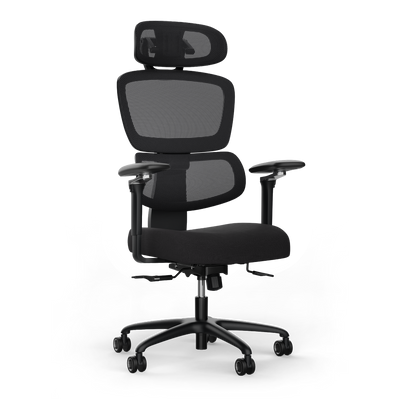
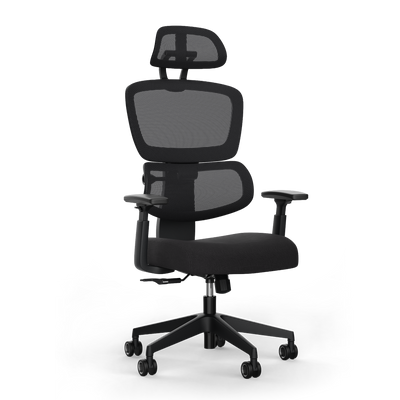
- Promote active sitting: A good office chair allows for micro-movements and supports an upright posture.
- Everything within reach: Position your keyboard, mouse, and screen so that you don't have to twist or lean forward.
These adjustments are fundamental. You can find a detailed guide on how to set up your workplace ergonomically on our blog.
The power of posture changes
Even the best sitting position becomes a problem if you remain in it for hours. The solution is regular alternation between sitting and standing. A height-adjustable desk is the ideal tool for this.
It allows you to switch to a standing position at the touch of a button. This extends your hip and frees the psoas from its shortened position. It makes a big difference to stand up for a few minutes every 30 to 60 minutes.
Prevention is a dynamic process. Your goal should not be the one perfect position, but always the next position.
Micro-movements directly at the desk
Small, inconspicuous movements at your desk keep your muscles supple and prevent tension.
Try these simple movements:
- Pelvic tilting while sitting: Sit on the front edge of your chair. Slowly tilt your pelvis back and forth to mobilize the lumbar spine.
- Knee to chest: While sitting, gently pull one knee to your chest alternately. This stretches the gluteal muscles and relieves the lower back.
- Ankle circles: Slightly extend one leg forward and circle your ankle. This activates the muscle pump in your calves.
The economic consequences of back pain are significant. An analysis showed that musculoskeletal disorders in Germany led to 127.6 million days of inability to work. Prevention through ergonomics and movement is therefore also economically relevant.
Frequent questions about psoas tension
Here we clarify important questions about the psoas. The answers are short, direct, and practical, so you can quickly get clarity if you want to release your psoas tension.
How often should I do the psoas exercises?
For sustainable success, incorporate the stretching exercises into your daily routine. This works well in the morning or as a short break after prolonged sitting. Often, 5 to 10 minutes are enough to maintain mobility and prevent new tension.
You should plan the strengthening exercises two to three times a week. This gives the muscle targeted impulses for stabilization without overstraining it. Listen to your body and never work into a stabbing pain. Consistency is more important than intensity.
Can psoas tension also cause digestive problems?
Yes, this is an often-overlooked point. The psoas runs in direct proximity to organs such as the intestines. If the muscle is severely tense, it can mechanically exert pressure on these organs and impair their function.
In addition, there is the connection to the autonomic nervous system. Stress is a major cause of psoas tension and activates the part of the nervous system that slows down digestion. This can lead to diffuse abdominal discomfort.
A relaxed psoas has a positive effect on the autonomic balance. Deep abdominal breathing for relaxation stimulates the parasympathetic nervous system, the "rest and digest nerve," which promotes digestion.
When should I see a doctor for the pain?
If the pain is very severe or appears suddenly without a recognizable cause, a visit to the doctor or physiotherapist is necessary. This also applies to neurological symptoms such as numbness, tingling, or loss of strength in the legs.
If you do the exercises and the symptoms do not improve after several weeks, you should have it medically clarified. Only then can other medical causes such as a herniated disc be ruled out.
The best prevention against tension begins at the workplace. At DESKSPACE, you will find height-adjustable desks and ergonomic chairs that support you in staying active and preventing pain. Visit us at https://deskspace.de.


