

Chair Exercises: Your Guide to More Movement at Work

Chair gymnastics is an effective method to counteract a lack of exercise and tension in daily office life. The principle is simple. You use your chair as a training device to activate muscles, promote blood circulation, and increase concentration. All of this is possible directly at your workplace.
Why chair gymnastics is important in daily office life
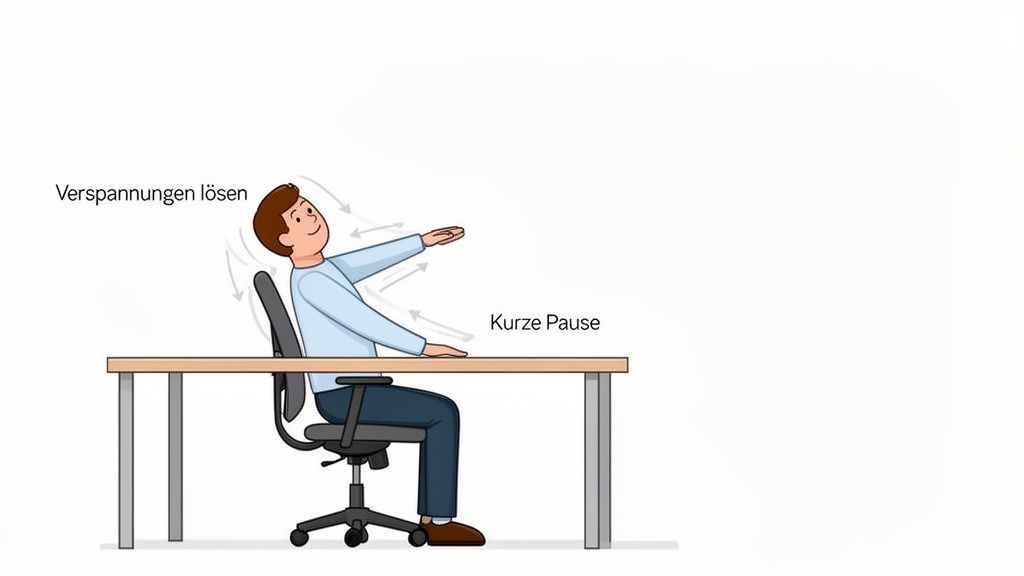 Modern work life forces many people into a rigid position for hours. Long, uninterrupted sitting often leads to muscle tension, back pain, and a general decrease in performance. This is precisely where chair gymnastics comes in. It offers a pragmatic solution that you can implement immediately.
Short, regular exercise units break up monotonous sitting phases. You become consciously aware of your body and actively counteract poor posture. Instead of spending time passively at your desk, you actively shape it and promote your health.
The benefits for body and mind
The positive effects of chair gymnastics are often noticeable after a short time. It's not just about alleviating acute pain, but primarily about ensuring your long-term well-being.
An overview of the benefits of regular gymnastics at the workplace:
| Benefit | Description | Relevance for the workplace |
|---|---|---|
| Better posture | Targeted exercises strengthen the core and back muscles. This stabilizes the spine. | Less back pain and a more upright, confident sitting posture. |
| More energy | Short exercise units stimulate circulation. The brain is better supplied with oxygen. | Concentration increases, the afternoon slump is less severe. |
| Increased flexibility | Regular stretching keeps joints and muscles flexible. It prevents shortening caused by prolonged sitting. | You feel less stiff and more agile, even after a long workday. |
| Stress reduction | Movement helps reduce stress hormones and clear your head. | A quick reset for the mind that helps to deal better with pressure. |
Chair gymnastics is an active contribution to your health and performance directly at the workplace.
A central aspect is prevention. Instead of waiting for the first signs of tension, you proactively integrate movement into your day. This makes a significant difference for your long-term health.
A solution to a widespread problem
The figures are clear. Almost ten percent of all sick days in Germany are due to back problems. These are often caused by hours of sitting at a desk. Chair gymnastics offers a joint-friendly alternative here. It activates muscles and circulation without overstraining you.
Experts recommend a 10-minute program three to five days a week, supplemented by more everyday movement. These units are a good complement to ergonomic office furniture. While a good chair supports correct posture, active movement provides the necessary dynamism.
Learn in our guide how you can otherwise stay healthy and fit when working long hours at your desk. The combination of ergonomics and exercise is an important component for a healthy and productive workday.
Basics for safe training
 Before you start with chair gymnastics, some preparations are important. This ensures your safety and helps you get the most out of each exercise.
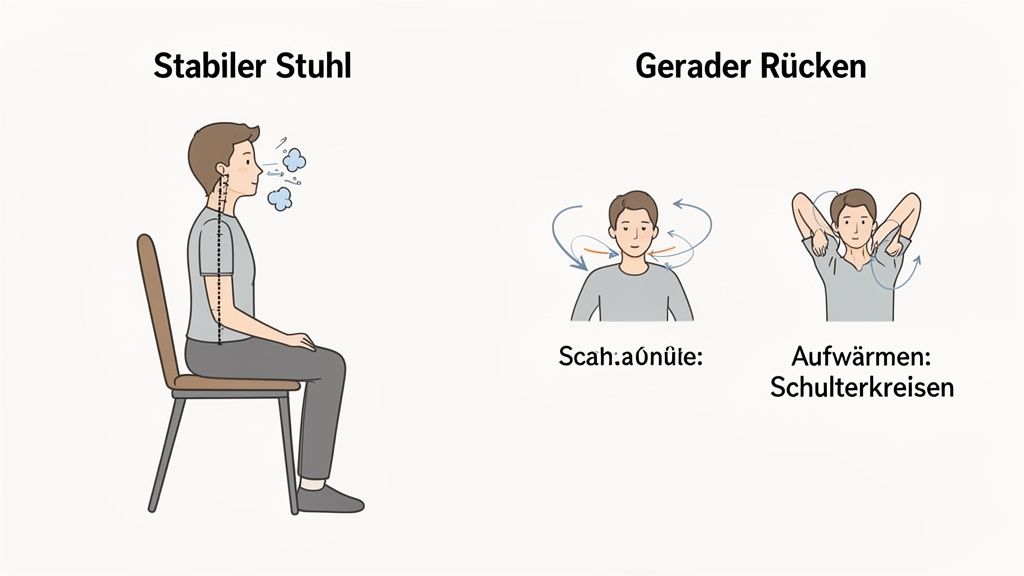
The basis for safe training is the right chair. A wobbly model increases the risk of injury. Use a chair that is firm and ideally without castors on the floor.
Pay attention to these features:
- Stability: The chair must not tip or wobble.
- No castors: An office chair with castors can slip away. A chair with fixed feet is more suitable.
- Firm seat: A non-slip, flat seat gives you the necessary support.
- Suitable height: Your feet should be able to rest flat on the floor. Your knees should form a 90-degree angle.
A well-chosen chair is your foundation. If you are unsure how your office chair should be adjusted, we have a guide on how to adjust your office chair ergonomically. This helps not only with the exercises but also in everyday work.
Correct posture and breathing
Your posture during the exercises is at least as important as the movement itself. Incorrect execution can lead to tension and negate the positive effect. Sit up straight. Consciously pull your shoulders back and down.
Your back remains straight, without hollowing it. Slightly tense your abdominal muscles. This stabilizes your torso and protects your spine.
Pay attention to even and deep breathing. The rule is: exhale during exertion, inhale during relaxation. This supplies your muscles with oxygen and helps you maintain control over the exercises.
Warm up briefly to prevent injuries
A short warm-up prepares your muscles and joints for the strain. Don't skip this step, even if you have little time. A good warm-up program can reduce the risk of injury.
Start with light mobilization exercises. Slowly circle your shoulders forward and then backward. Gently tilt your head from side to side to loosen your neck muscles. These simple movements stimulate blood circulation and prepare your body for chair gymnastics.
Effective exercises for the whole body
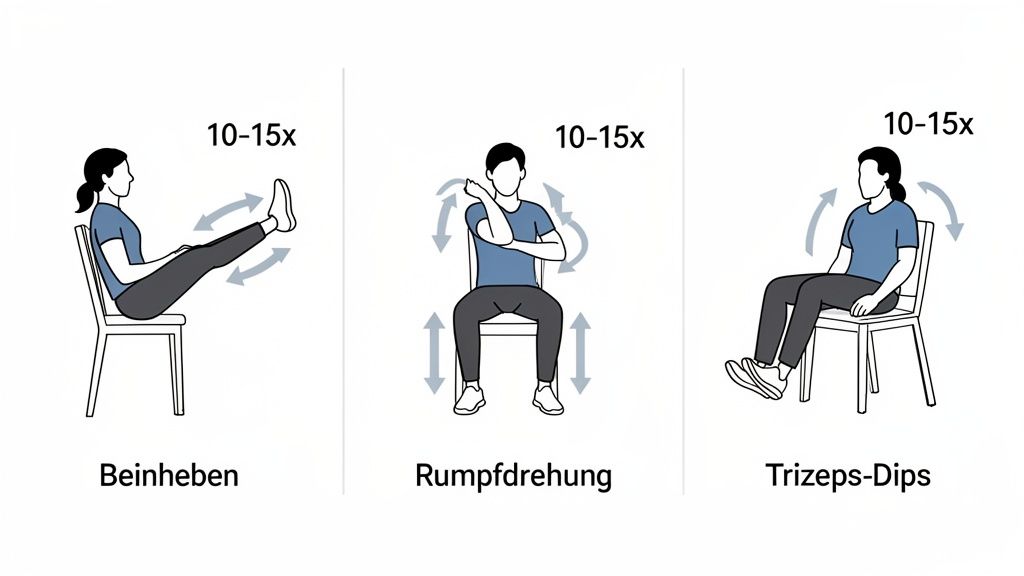
A good program is important to achieve goals with chair gymnastics. It's not about randomly stringing movements together. You should specifically target different muscle groups to create a balanced workout for the body.
The following exercises can be performed directly at the workplace. They cover the most important areas: legs, torso, back, arms, and shoulders. Concentrate on clean and controlled execution with each exercise.
Exercises for legs and glutes
Strong legs and active glutes are the foundation for good posture and relieve the lower back. These muscles are often neglected during prolonged sitting. With these exercises, you reactivate them.
1. Seated Leg Lifts (Focus on front of thigh) This exercise strengthens the quadriceps. This is the large muscle on the front of your thigh. It is important for knee stability.
- Execution: Sit upright on the front edge of your chair. Your feet are hip-width apart and flat on the floor. Tighten your abdominal muscles and lift one leg straight until it is parallel to the floor. Hold the position for two seconds, then slowly lower the leg back down.
- Repetitions: Try to complete 12 to 15 repetitions per side.
- Variation: Hold the leg at its highest point for five seconds. Or perform the movement even more slowly to increase muscle tension.
2. Squats with Chair Support (Focus on glutes and thighs) The squat is one of the most effective exercises for the lower body. The chair serves as a safety anchor and a reference point for the correct depth here.
- Execution: Stand with your back to the chair. Your feet are about shoulder-width apart. Slowly lower your glutes as if you were going to sit down. Briefly touch the seat and then powerfully push yourself back up from your heels. Your back remains straight throughout.
- Repetitions: Start with 10 to 12 repetitions.
- Variation: Perform the movement without touching the seat. Or pause for a moment in the deepest position.
Exercises for core and back
A strong core stabilizes the spine and prevents back pain. These exercises aim to activate the deep muscles in the abdomen and back.
3. Seated Torso Twist (Focus on oblique abdominal muscles) This movement mobilizes the thoracic spine and strengthens the oblique abdominal muscles. It helps release tension in the upper back.
- Execution: Sit upright. Cross your arms in front of your chest or place your hands on your temples. Slowly and controlled twist your upper body to one side. Your pelvis remains stable and facing forward. Return to the center and repeat the exercise to the other side.
- Repetitions: Do 10 twists to each side.
- Variation: Reduce the range of motion until you feel secure.
4. Seated Back Extensors (Focus on lower back) This exercise is an important counterbalance to leaning forward while sitting. It strengthens the muscles along the spine.
- Execution: Slide forward a bit on your chair. Lean forward slowly with a straight back until your upper body almost touches your thighs. Then slowly straighten up again. Use the strength from your lower back.
- Repetitions: Perform 12 to 15 repetitions.
- Variation: Hold briefly in the upright position. Consciously tense your back muscles.
Important safety note: Perform each movement slowly and controlled. Haste is inappropriate here. If you feel pain, stop the exercise immediately. A slight pull during a stretch is normal, true pain is not.
5. Pelvic Tilts While Sitting (Focus on deep abdominal muscles) This is a subtle but effective exercise. It activates the transversus abdominis. This is a deep abdominal muscle that supports the spine.
- Execution: Sit upright. Your feet are flat on the floor. Slowly tilt your pelvis backward so that your lower back slightly rounds and touches the backrest. Then return to the starting position. Tilt your pelvis forward and create a slight hollow back.
- Repetitions: Repeat this movement 15 times.
Exercises for arms and shoulders
The muscles in the arms and shoulders often tense up due to computer work. Targeted strengthening helps stabilize this area and prevent neck and shoulder pain.
6. Chair Dips (Focus on triceps) This exercise strengthens the back of your upper arms. You will need a sturdy chair for this, ideally without castors.
- Execution: Sit on the front edge of the chair. Place your hands directly next to your glutes. Slide your glutes forward off the seat. Now bend your arms and lower your body until your upper arms are parallel to the floor. Then push yourself powerfully back up.
- Repetitions: Start with 8 to 10 repetitions.
- Variation: Place your feet closer to the chair to reduce the load.
7. Shoulder Press without Weight (Focus on shoulder muscles) This movement strengthens the deltoid muscles and improves stability in the shoulder joint.
- Execution: Sit upright. Lift your arms sideways so that your elbows are at shoulder height and form a 90-degree angle. Your palms face forward. Slowly push your hands overhead. Do not pull your shoulders towards your ears. Return to the starting position in a controlled manner.
- Repetitions: Complete 12 to 15 repetitions.
8. Arm Circles (Focus on shoulder mobility) This simple mobilization exercise promotes blood circulation in the shoulder joint and relieves tension.
- Execution: Extend your arms sideways at shoulder height. Begin to draw small circles. Do 15 circles forward and then 15 circles backward.
- Variation: Slowly increase the radius of the circles.
Chair gymnastics is not only suitable for daily office life. It also makes movement accessible to people for whom other sports would be too strenuous. In Germany, six percent of the population is very elderly. For them, chair gymnastics is a good way to stay active. Daily, short sessions can improve stability. They can reduce the risk of falling, which is around 33 percent for people over 65. More insights into why movement is so important in old age can be found on efo-magazin.de.
Practical exercise plans for your active break
Regularity is key in chair gymnastics. More important than long sessions are short, firmly planned movement breaks. These make the biggest difference for your well-being and concentration.
Here are three simple exercise plans you can start with immediately. They combine the exercises in a logical sequence. Choose the plan that best fits your schedule today.
The 5-minute express plan for quick mobilization
This plan is ideal when you're short on time. It's the perfect reset for body and mind. It loosens tense muscles and gets your circulation going. Ideal for the gap between two meetings.
- Shoulder circles: 30 seconds forward, then 30 seconds backward.
- Seated torso twist: 60 seconds slowly and controlled, switching from one side to the other.
- Pelvic tilts while sitting: 60 seconds to gently move the lower back.
- Arm circles: 30 seconds forward, then 30 seconds backward.
- Neck stretch: Gently tilt your head to each side for 30 seconds.
The 10-minute activation plan
This workout specifically activates muscle groups that are often neglected from sitting. It offers a good mix of strengthening and mobilization and fits well into a longer coffee break.
- Warm-up (2 minutes): Start with shoulder and arm circles. Gently stretch your neck.
- Seated leg lifts (2 minutes): Change legs every 30 seconds. Pay attention to a slow execution.
- Seated back extensions (2 minutes): Focus on the movement from the lower back.
- Chair dips (2 minutes): As many repetitions as you can perform cleanly. Quality over quantity.
- Seated torso twist (2 minutes): Mobilize the torso at the end.
Tip: This plan works well against the afternoon slump. The mix of tension and movement brings oxygen to the brain. Your concentration noticeably increases.
The 20-minute full-body plan
If you have more time, this plan is a good choice. It is a balanced full-body workout. It helps you build strength and improve your posture in the long run. Perfect at the end of the workday.
- Warm-up (3 minutes): Light mobilization from head to toe.
- Squats with chair support (3 minutes): 2 sets, with 1 minute of exercise and 30 seconds of rest each.
- Chair dips (3 minutes): Also 2 sets with short breaks.
- Seated leg lifts (3 minutes): Hold for 90 seconds per leg, without putting it down.
- Seated back extensions (3 minutes): 2 sets, focus on tension in the back.
- Seated torso twist & pelvic tilts (3 minutes): Perform both exercises alternately.
- Cool-down (2 minutes): Bring your body to rest with gentle stretches for the neck, shoulders, and back.
Here is an overview of the plans:
Example exercise plans for daily office life
| Plan | Duration | Focus | Example exercise 1 | Example exercise 2 |
|---|---|---|---|---|
| Express Plan | 5 minutes | Quick mobilization, stimulate circulation | Shoulder circles | Seated torso twist |
| Activation Plan | 10 minutes | Strengthening & mobilization, against fatigue | Seated leg lifts | Chair dips |
| Full-body Plan | 20 minutes | Strength building, posture improvement | Squats with chair | Seated back extensions |
Consider these plans as a modular system. You can adapt them at any time to your daily form and fitness level. The most important thing is that you do it. Just start and keep moving.
How to optimally combine exercises and ergonomics
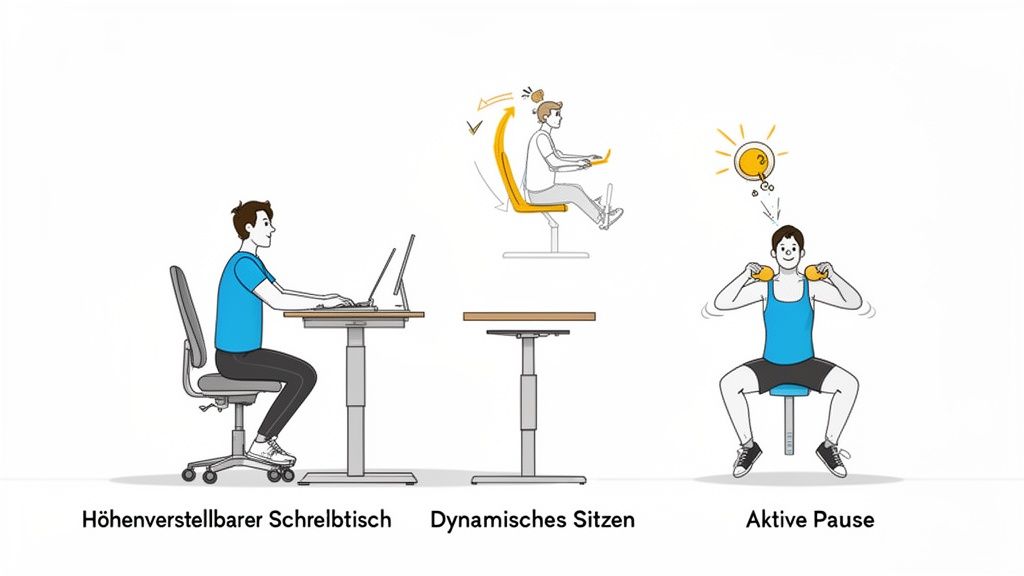
A height-adjustable desk is a good foundation for a healthy workplace. Combined with targeted exercises, you unlock the full potential of your ergonomic setup. Both together help to keep the body active and pain-free.
Imagine your workday as an interplay of three elements: sitting, standing, and conscious movement. Your height-adjustable desk enables the important change between sitting and standing. Chair gymnastics ensures that your sitting phases remain dynamic and strengthening.
Your desk as a partner for movement
A good desk setup helps you integrate movement into your workday. Regular exercise breaks are no longer an interruption, but an integral part of your workflow.
This is how you get the most out of your ergonomic equipment:
- Actively use standing phases: Change position at least once an hour. Consciously correct your posture while standing. Shift your weight from one leg to the other.
- Make sitting phases dynamic: Set an alarm for your 5- or 10-minute exercise breaks. Your ergonomic chair provides stability for the exercises.
- Make movement a routine: Link your exercises to fixed habits. For example: a short mobilization exercise after every longer phone call.
The combination of ergonomics and movement is the key to a sustainably healthy working life. It's about creating an environment that promotes activity. By combining both, you effectively prevent tension and postural damage.
The best ergonomic equipment is of little use if the body remains in the same position for hours. The synergy of a dynamic workplace and regular chair gymnastics makes the difference.
This approach helps you avoid back pain and keep your concentration high. You make your working hours not only more productive but, above all, healthier. Learn more about how to set up your workplace ergonomically. This creates the perfect foundation for your active breaks.
What else you should know about chair gymnastics
Here are answers to frequently asked questions. They should remove any lingering uncertainties so you can start your training motivated and safely.
How often should I do chair exercises?
For sustainable effects, three to five sessions per week is a good goal. Plan about 10 to 15 minutes for each session. Regularity is more important than the duration of a single workout.
Even a daily 5-minute break for mobilization can counteract tension. Integrate the exercises firmly into your daily routine. For example, shortly before your lunch break or as a ritual at the end of the workday.
Is every office chair suitable for the exercises?
Not every chair is an ideal training partner. You train most safely on a stable chair without castors. For exercises like chair dips, armrests can be a hindrance.
Make sure the chair cannot slip away during the exercise. Your feet should be able to rest flat on the floor with a straight back. Often, a simple, sturdy conference chair is more suitable than a dynamic office chair with castors.
Can I lose weight with chair gymnastics?
Chair gymnastics aims to strengthen your muscles, improve flexibility, and promote blood circulation. It stimulates metabolism. However, it is not a classic endurance training designed for high calorie consumption.
Chair gymnastics is a building block for an active lifestyle. If you combine it with a balanced diet and other exercise, muscle building helps to increase your basal metabolic rate. This supports you in weight management.
What do I do if an exercise causes pain?
Pain is a warning signal from your body. If you feel a sharp or unpleasant pain, stop the exercise immediately. A slight pulling sensation during a stretch is normal, true pain is not.
Try with a smaller range of motion or less intensity. If the pain persists, omit this exercise. Concentrate on the exercises that feel good. For persistent or severe pain, you should consult a doctor.
An ergonomic workplace is the basis for a healthy back. Combine your exercises with the adjustable solutions from Deskspace to permanently increase your well-being in the office. Discover the right products now at https://deskspace.de.


