

Office Chair for Tall People: Ergonomics and Comfort

A standard office chair often doesn't fit tall people. The dimensions are designed for average sizes. However, longer limbs and a taller back require appropriate support. An office chair for tall people is therefore not an extra feature, but a necessary investment in your health and concentration.
Why standard chairs are unsuitable for tall people
A tall person in a standard office chair feels like they're wearing shoes that are too small. It might work for a short time, but in the long run, it leads to problems. Normal chairs follow standards for the average person. If you're outside these measurements, you quickly reach ergonomic limits.

You feel these deficiencies directly in your body. Incorrect sitting posture forces your body into an unnatural position. This is not only uncomfortable but can lead to chronic pain in the long term.
The three core problems of unsuitable chairs
The main problems can be reduced to three points:
- Too low seat height: Your knees are above your hips. This increases pressure on the lumbar spine and can impair blood circulation in your legs.
- Insufficient seat depth: The seat surface does not adequately support your thighs. Pressure is concentrated on a small area. Your back muscles constantly have to work against this.
- Too short backrest: The backrest does not support the shoulders. This leads to tension in the neck and shoulder area.
An unsuitable chair forces your spine into an unhealthy C-shape. A good, ergonomic chair supports the natural S-shape of the spine and helps you sit upright.
The dimensions of standard chairs are not designed for individuals who are statistically considered "tall." According to DIN 33402-2, this includes men in Germany over approximately 185.5 cm and women over 172 cm. This group makes up only about 5% of the population. However, they have specific ergonomic needs that conventional chairs ignore. Further information on the basics can be found at buerostuhl24.com.
Long-term health consequences
Minor tension can quickly develop into lasting problems. An unsuitable chair is often the cause of recurring headaches, disc problems, or carpal tunnel syndrome.
Investing in a suitable office chair is an active measure for your health. It not only protects your body but also ensures your concentration and productivity at work. In the next section, you'll learn about the important dimensions for your chair.
The crucial measurements for your body size
Finding the right office chair for tall people depends on three crucial measurements. If seat height, seat depth, and backrest height are not correct, ergonomic sitting is hardly possible. These three factors are the foundation for a healthy posture and relaxed work.

A standard chair ignores these individual requirements. An office chair for tall people is designed to adapt these measurements within an extended range. This ensures that the chair adapts to you and not the other way around.
The correct seat height for long legs
The right seat height is the basis for every other ergonomic adjustment. The rule is simple: your feet must be flat on the floor, while your knees form an angle of about 90 degrees. Your thighs should be parallel to the floor or slope slightly downwards.
If the chair is too low, your knees will be above your hips. This forces the lower back into an unhealthy curve and increases pressure on the intervertebral discs. If it's too high, your feet lose contact with the floor, which disrupts blood circulation in your thighs.
For tall people, seat heights that end at 50 cm are often insufficient. Look for models that can be adjusted to at least 55 cm or higher.
Optimal seat depth to relieve the thighs
The seat depth determines how well your thighs are supported. Ideally, there should be a gap of three to four finger widths (approx. 5 cm) between your knee bend and the front edge of the seat.
This distance is important. If the seat is too short, your thighs receive too little support, and your back muscles have to work harder. If the seat is too long, the edge presses into your knee bends. This can pinch nerves and blood vessels, leading to numbness.
Many standard chairs offer a seat depth of only 40 to 42 cm. A good office chair for tall people should allow for an adjustable depth of up to 50 cm or more.
The correct seat depth distributes your weight evenly and prevents pressure points. This supports blood circulation and prevents fatigue.
The right backrest height for the entire back
The backrest is the most important support partner for your spine. For tall people, a standard backrest often ends in the middle of the back. The upper back and shoulders remain unsupported. This often leads to tension in the neck and shoulder area.
An ergonomic backrest must be high enough to support your entire back up to your shoulder blades. Only then can it support the natural S-curve of your spine and relieve your muscles.
For people over 1.90 m, the backrest should have a height of at least 60 cm from the seat. Models with an adjustable headrest offer additional relief for the neck and head area, especially in a reclined position.
Comparison of dimensions: Standard vs. office chair for tall people
The table compares the typical adjustment ranges of standard chairs with the recommendations for tall individuals.
| Feature | Standard office chair (approx. dimensions) | Recommendation for tall people (> 190 cm) | Why it is important |
|---|---|---|---|
| Seat height | 42 cm - 53 cm | 50 cm - 60 cm | Allows 90-degree knee angle and flat foot contact with the floor to relieve the spine. |
| Seat depth | 40 cm - 45 cm | 45 cm - 52 cm | Optimally supports the thighs and prevents pressure on the knee bends, promoting blood circulation. |
| Backrest height | 50 cm - 58 cm | > 60 cm | Supports the entire back up to the shoulders and prevents neck and shoulder tension. |
These three measurements are your most important selection criteria. A chair that offers suitable adjustment options in these areas lays the foundation for a healthy workplace.
Important ergonomic functions in detail
The right dimensions are the foundation. Suitable ergonomic functions turn an office chair for tall people into a tool for your health. Precise adjustment options such as lumbar support, headrest, armrests, and mechanism determine comfort or tension.

These functions allow you to adjust the chair exactly to your body. They promote dynamic sitting. Remaining rigidly in one position puts uneven strain on the spine. A good chair works with your body.
The lumbar support as the backbone of your chair
Lumbar support is the curve in the lower part of the backrest. Its purpose is to support the natural S-curve of your lumbar spine. Without it, the pelvis tilts backward, the lower back rounds, and pressure on the intervertebral discs increases.
For tall people, a fixed support is often in the wrong place. It presses too high or too low and can do more harm than good.
Therefore, a height and depth adjustable lumbar support is essential. You can position it exactly in the curve of your lower back. When adjusted correctly, it fills the hollow space and supports an upright posture.
The headrest for neck relief
For tall individuals, the headrest is often a problem. On standard chairs, it is frequently located at the neck or between the shoulder blades. This pushes the head forward and causes tension.
A helpful headrest must be adjustable in height and angle. You should be able to adjust it so that it supports the back of your head when you lean back. When working upright, it should not touch you.
Its main task is to relieve the neck and shoulder muscles during rest periods. This prevents headaches and chronic tension.
4D armrests for shoulders and arms
Armrests are more than just a place to rest your arms. They bear a large part of the weight of your arms, thereby relieving tension in your shoulder and neck muscles. If they are incorrectly adjusted, they can have the opposite effect.
4D armrests offer maximum flexibility:
- Height: Adjust them so your forearms rest loosely, without shrugging your shoulders.
- Width: Adjust the distance to your shoulder width so your arms rest naturally at your sides.
- Depth: Slide the pads forward or backward to support your arms during any activity.
- Angle: Rotate the pads inward for typing or outward for more freedom of movement.
This precise adjustment ensures that your arms always receive the correct support. This prevents unconscious tension in the shoulders.
Correct adjustment of all ergonomic elements is crucial. A well-equipped chair only unfolds its potential if it is correctly adjusted to you.
If you'd like to learn more, our guide provides further tips on how to ergonomically adjust your office chair.
The synchronous mechanism for dynamic sitting
Long, rigid sitting harms the intervertebral discs. The synchronous mechanism counteracts this. When you lean back, the backrest tilts backward, and at the same time, the seat surface lowers slightly.
This movement pattern has several advantages:
- Opening of the sitting angle: The angle between the upper body and the thighs becomes larger. This promotes blood circulation.
- Constant contact with the back: Your back always remains in contact with the backrest, thus supporting the spine.
- Muscle activation: The constant changes in movement stimulate the muscles and promote the supply of nutrients to the intervertebral discs.
In Germany, around 17 to 18 million people work sitting down every day. Studies by the Federal Institute for Occupational Safety and Health (BAuA) show that dynamic sitting minimizes health risks. An office chair for tall people with a high-quality synchronous mechanism is an investment in your health. You can find more information about ergonomic standards in BAuA publications.
The combination of these features ensures that your chair actively contributes to your well-being.
What makes a chair for tall people: load capacity and material quality
An office chair for tall people must be more than just larger. Taller individuals often weigh more. Therefore, stability and durability are core requirements. Every component must be designed for higher loads.
Maximum load capacity is a crucial value. Standard office chairs are usually designed for only up to 110 kg or 120 kg. This is not enough for many tall individuals. Models for this target group have load capacities of 150 kg, 180 kg, or more.
This load capacity is the result of a well-thought-out design, where every component is designed for stability.
The foundation: The quality of the components
The stability of a chair depends on its components. From the base to the castors, every element must withstand the higher weight. Only then will the chair be safe and feel sturdy for years.
When assessing quality, pay attention to these three components:
- The base: It is the foundation of the chair. In high-quality models, it is made of solid steel or polished aluminum. These materials are more stable than plastic bases, which can break under load.
- The gas lift: It bears the entire weight. Look for a gas lift of safety class 4. This is the highest class, tested for loads up to 200 kg, and offers maximum safety.
- The castors: The castors must also match the higher overall load. Sturdy, smooth-running castors are necessary. Make sure they match your floor: soft castors for hard floors and hard castors for carpets.
Reinforced components not only ensure safety but also prevent wobbling or creaking. The result is a stable seating experience and a longer lifespan.
A matter of feel: Which upholstery fabric suits you?
The upholstery of an office chair shapes its appearance, seating comfort, and durability. It's about what proves itself in everyday life.
On long working days, good ventilation is important to prevent sweating. At the same time, the fabric must be robust enough for daily use.
Here are the common materials in comparison:
| Material | Advantages | Disadvantages |
|---|---|---|
| Mesh fabric | Very breathable, prevents heat buildup, modern look | Can stretch over time, offers less padding |
| Fabric | Soft, wide color selection, very durable | Less breathable than mesh, more prone to stains |
| Leather/Artificial leather | Durable, easy to clean, elegant look | Hardly breathable, can feel sticky when warm |
Which material is right depends on your preferences. Those who sweat easily will benefit from a high-quality mesh backrest. Those who prefer warmth and coziness will choose a robust fabric cover.
Playing it safe: Certificates as proof of quality
Independent certifications prove the quality of a chair. They are proof that a product has passed rigorous tests for safety, ergonomics, and durability.
The most important seal in Germany is the GS mark for "Geprüfte Sicherheit" (Tested Safety). It is awarded by independent testing institutes such as TÜV. It guarantees that the chair complies with the requirements of the Product Safety Act. For an office chair for tall people, this seal is a clear sign of reliability.
Finding the perfect chair and testing it correctly
The search for the right office chair for tall people is more than just a datasheet comparison. You need to find out if the chair really suits you. This can be achieved with good preparation and a practical test.

The first step is simple: know your own measurements. This allows you to precisely compare them with the product data.
Step 1: Accurately determine your body measurements
Take a moment to measure three crucial dimensions. These numbers will help you immediately rule out unsuitable models.
- Seat height: Sit on a chair with your feet flat on the floor and your knees bent at a 90-degree angle. Measure the distance from the floor to the underside of your thigh behind your knee.
- Seat depth: Sit upright and lean your back against a flat surface. Measure the distance from your buttocks to the back of your knee. Subtract about 5 cm from this value to get your ideal seat depth.
- Shoulder height: Remain seated upright and measure the distance from the seat to the top of your shoulders. This is a good guide for the minimum backrest height.
With these values, you can specifically check the technical data of office chairs.
Step 2: The trial sitting – the checklist for the test
The trial sitting is the most important step. Whether in a store or at home: take your time and try out all the functions. Simulate a real working day.
Use this checklist to systematically check the chair:
- Basic adjustment: Does the maximum seat height match your measured value? Are your feet flat on the floor with a 90-degree angle at your knees?
- Seat depth: Can the seat be adjusted so that there are three to four finger widths of space between your knee bend and the edge of the seat?
- Lumbar support: Is the support adjustable in height and depth? Does it hit the curve of your lumbar spine without pressing?
- Backrest: Does the backrest support your entire back up to your shoulders? Do you feel stable even when moving?
- Headrest: Does the headrest sit at the back of your head or does it press into your neck? Does it only provide support when you consciously lean back?
- Armrests: Can you adjust the armrests so that your forearms rest loosely and your shoulders remain relaxed?
- Freedom of movement: Do you feel dynamic? Does the mechanism support your natural movements when leaning back?
A good chair actively supports you in maintaining a healthy posture for hours, without you having to consciously think about it.
Online purchase and right of return
When buying online, a fair return policy is important. The statutory period of 14 days is often too short to test a chair in everyday life.
Look for providers who offer an extended trial period of 30, 60, or even 100 days. This gives you the security to thoroughly test the chair in your work environment. If you want to learn more about different types of chairs, you can find information in our guide on how to find the right desk chair.
The right solution for your body size
In the end, you need a solution that works. An office chair for tall people is more than a list of features. It must be a coherent overall package that can be precisely adjusted and supports your body.
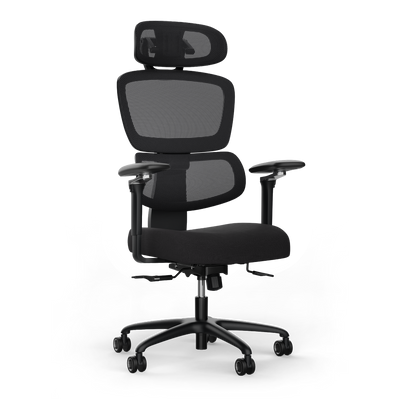
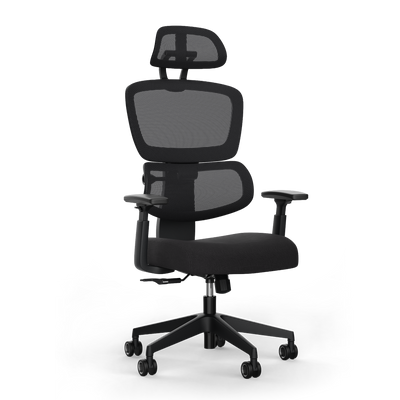
Models like the DESKSPACE MOVE have been specially developed for the needs of tall users. The goal is clear: the chair adapts to your body, not the other way around.
Specifically designed for long legs and a high back
The difference lies in the extended adjustment range. The DESKSPACE MOVE offers a seat height of up to 57 cm and a seat depth of up to 47 cm. These dimensions ensure that even individuals over 1.90 m can adopt an ergonomically correct posture.
A chair that cannot be adjusted high and deep enough cannot fully utilize its ergonomic advantages. Only the right dimensions create the prerequisite for a healthy posture.
In addition, 4D armrests and a height-adjustable lumbar support enable precise fine-tuning. This allows you to raise the armrests to the height of your desk and position the lumbar support exactly where your lower back needs it. Shoulders, neck, and lumbar spine are relieved.
Stability and quality as a secure foundation
Tall people exert greater leverage. Therefore, a reliable construction is just as important as the appropriate dimensions. A load capacity of up to 135 kg, a solid aluminum base, and a gas lift of the highest safety class (Class 4) provide a feeling of security.
The office furniture market in Germany has a volume of around 2.4 billion euros. A growing portion is flowing into high-quality, ergonomic solutions. Health awareness is increasing. Companies and private individuals understand that a specially adapted office chair for tall people is an important investment in comfort and productivity. Further insights into market development are offered by the Industry Office & Work Environment Association (IBA).
This combination of precise adjustment options, extended dimensions, and robust construction makes the difference. This provides you with a sustainable solution for healthy and concentrated work.
Frequently Asked Questions
Here you will find answers to frequently asked questions when looking for the perfect office chair for tall people.
From what height do I need a special office chair?
As a rule of thumb: men from 1.90 m and women from 1.80 m often benefit from a specially adapted chair.
More important than pure body size is ergonomics. Can you place your feet flat on the floor on your current chair, with your knees bent at a 90-degree angle? Does the backrest support your back up to your shoulders? If not, a model for tall people is a worthwhile investment.
Are gaming chairs a good alternative?
Gaming chairs are often designed for tall individuals. However, they are usually optimized for a reclined posture, ideal for gaming sessions.
For concentrated, upright work at a desk, an ergonomic office chair with a synchronous mechanism and adjustable lumbar support is the better choice. It supports active sitting and helps maintain a healthy posture.
A good office chair promotes a productive working posture. A gaming chair is primarily designed for a relaxed posture. Choose the chair that suits your main activity.
What is the difference between an XXL chair and a chair for tall people?
The terms are often used synonymously, but there is a difference in construction focus.
- An office chair for tall people focuses on dimensions: a higher backrest, more seat depth, and a larger adjustment range for seat height.
- An XXL office chair additionally emphasizes high load capacity. These models are often designed for weights over 150 kg and have more robust components.
The best models combine both aspects to accommodate both the dimensions and the potentially higher weight of tall individuals.
How important is a headrest for tall people?
A headrest is only valuable if it fits. On many standard chairs, the headrest for tall people is located at the neck instead of the head. This pushes the head forward and can cause tension.
A height-adjustable headrest is therefore necessary. When adjusted correctly, it supports the back of your head when you lean back, without disturbing you when working upright. This relieves neck muscles and prevents pain.
An ergonomic workplace is the key to greater health and productivity. At Deskspace, you will find solutions that adapt perfectly to your body size.
Discover the right products for your setup now at https://deskspace.de.


