

Top Selection: Best Ergonomic Office Chair for Healthy Work

A good ergonomic office chair is more than just a seat. It is an active investment in your health and concentration. The best ergonomic office chair is one that adapts precisely to your body. It promotes dynamic sitting and does not force you into a rigid posture. This prevents tension and keeps you productive all day long.
How to find the right ergonomic office chair
Finding the perfect office chair can be overwhelming. But if you know some basic criteria, you'll quickly make the right decision. It's not about finding a chair with countless features, but one with the right ones. Your chair must support your body instead of forcing it into an unnatural position.

A good ergonomic chair is based on three essential features. These work together to improve your posture and prevent discomfort from prolonged sitting.
Basic ergonomic requirements
Every person is built differently. That's why individual adjustment options are crucial. Pay attention to these three key points:
- Adjustable armrests: They relieve your shoulder and neck muscles. Ideally, they can be adjusted in height so that your forearms rest relaxed at a 90-degree angle on the tabletop.
- Adjustable lumbar support: This is the core of a good office chair. It supports the natural S-shape of your lumbar spine and actively prevents you from hunching over.
- Synchronized mechanism: This technology provides movement while sitting. It links the tilt of the backrest to that of the seat. This promotes blood circulation and relieves your intervertebral discs with every movement.
Choosing a chair is a personal matter. The goal is to find a model that feels like a natural extension of your body and promotes movement instead of stagnation.
These three ergonomic cornerstones are the basis for healthy work. Only when a chair meets these criteria should you think about material or design. Our guide shows you in detail how to ergonomically adjust your office chair to unleash its full potential.
The demand for health-promoting workplaces is growing. The global market for ergonomic office chairs is estimated at 5.2 billion US dollars for 2024. By 2032, it is expected to grow to 9.2 billion US dollars. This growth shows that the trend towards home offices, in particular, is motivating more people to invest in a high-quality workplace.
The decisive features in direct comparison
The choice of the right ergonomic office chair depends on details that may seem technical. It is precisely these functions that make the difference. They decide whether a chair truly supports you or is merely a seat. It's about the mechanics, the armrests, and the precise adjustment to your back.
A closer look at these components reveals how high-quality models differ from simple standard chairs. Each feature serves a specific purpose for your health and comfort.

Chair mechanism as the heart of dynamic sitting
The mechanism is the engine of your office chair. It controls how the backrest and seat move. There are two basic systems whose differences are crucial for your back health.
A simple rocking mechanism rigidly connects the seat and backrest. When you lean back, the entire chair tilts backward. This allows for movement, but only at a fixed angle that does not optimally support the back.
The synchronized mechanism is the more advanced solution. Here, the backrest tilts more than the seat, usually in a ratio of 2:1 or 3:1. This opens the seat angle, stimulates blood circulation, and relieves the intervertebral discs. This mechanism actively promotes dynamic sitting and is the standard for any high-quality ergonomic office chair.
Armrests from 1D to 4D
Armrests are more than just a resting place. They specifically relieve your shoulder and neck muscles, thus preventing painful tension. Their effectiveness depends directly on their adjustability.
- 1D armrests are only adjustable in height. This is the basis for keeping your arms at a relaxed 90-degree angle to the tabletop.
- 2D armrests can also be adjusted sideways.
- 3D armrests can also be moved forwards and backwards.
- 4D armrests can also be swiveled sideways. They offer maximum adaptability for all activities.
An office chair with 4D armrests gives you the greatest flexibility. You can optimally support your arms in any working position and thus effectively prevent neck tension.
The lumbar support as the backbone of the chair
The lumbar support is the most important feature for stabilizing your spine. It supports the natural S-curve in the lower back. It prevents you from falling into an unhealthy, hunched posture. Here, too, there are significant differences in quality.
A rigid lumbar support is often just a fixed curve in the backrest. It offers basic support but cannot be adapted to your body shape.
A height-adjustable lumbar support is a significant upgrade. You can slide the support precisely to the height of your lumbar spine.
A depth and height adjustable lumbar support is the best option. Here you can regulate position and pressure. The support adapts perfectly to your spinal curvature and offers tailor-made support. You can find more on this important topic in our article about what a lumbar support is and how it helps you.
Further important adjustment options
In addition to the three main features, there are other functions that distinguish a very good office chair from a good one. These details optimize your sitting posture and comfort.
A seat depth adjustment is particularly important for tall or short people. It ensures that there is about a three to four finger-width gap between the back of your knee and the front edge of the seat. This prevents pressure on your thighs.
The seat tilt adjustment allows the seat to be tilted slightly forward. This function aligns the pelvis and supports an upright posture.
The gas lift plays a crucial role in stability and durability. High-quality gas lifts ensure smooth height adjustment and are designed for a higher maximum weight. Pay attention to certifications and the specified load capacity class.
Comparison of core ergonomic functions
This table compares the most important adjustment features of ergonomic office chairs. It explains their specific benefits for your health and comfort.
| Feature | Function | Ergonomic Benefit |
|---|---|---|
| Synchronous mechanism | Coupled tilt of backrest and seat | Promotes dynamic sitting, improves blood circulation, and relieves intervertebral discs. |
| 4D armrests | Adjustable in height, width, depth, and angle | Specifically relieves shoulder and neck muscles in every working position. |
| Lumbar support | Adjustable support for the lower back | Stabilizes the natural S-curve of the spine and prevents a rounded back. |
| Seat depth adjustment | Adjusting seat depth to thigh length | Prevents pressure on the backs of the knees and ensures good blood circulation. |
A good ergonomic chair has more technology than one might think. Each of these features contributes to you getting through the workday healthier and more comfortably.
How to recognize quality and safety: Certificates expose imposters
An office chair is your daily companion. That's why tested quality and proven safety are decisive criteria. They go beyond design or the first impression. Seals and certificates are objective evidence. They show that a chair has withstood stringent tests.

The most important seals offer reliable guidance. They confirm that a product is not only ergonomically well-thought-out but also durable and safely constructed.
The TÜV GS mark for tested safety
The GS mark ("Geprüfte Sicherheit" – Tested Safety) is a well-known test mark in Germany and Europe. TÜV issues it. It certifies that a product meets the requirements of the German Product Safety Act (ProdSG). An office chair with this seal has passed extensive tests.
Tested aspects include:
- Stability: The chair must remain stable against tipping under various loads.
- Load tests: The durability of components such as gas springs, castors, and bases is tested over tens of thousands of cycles.
- Harmful substance testing: Materials such as covers and upholstery are examined for harmful chemicals.
The GS mark is a strong indicator of a robust and safe chair that is designed for daily use.
IGR certificate for proven ergonomics
While the GS mark confirms technical safety, the IGR certificate focuses on ergonomic quality. It is backed by the Institute for Health and Ergonomics e.V., an independent testing body. An IGR-certified chair demonstrably meets high ergonomic standards.
The IGR seal confirms that an office chair actively supports posture and can be optimally adapted to the user. It is a clear sign that the manufacturer takes ergonomics seriously.
A chair only receives this seal if it offers comprehensive adjustment options. These include effective lumbar support, versatile adjustable armrests, and a mechanism that promotes dynamic sitting. The test ensures that the chair actively supports your health.
Material quality and load capacity as further features
Besides certificates, materials and maximum load capacity also provide information about durability. A high-quality base made of steel or polished aluminum is more stable than one made of plastic.
Covers are also important. Breathable mesh backs ensure good air circulation. High-quality fabric covers with high abrasion resistance (indicated in Martindale) remain attractive for a long time. The maximum load capacity should be significantly above your body weight. This provides a safety reserve. Good chairs are often designed for 120 kg to 150 kg.
The German office furniture market reached a volume of 2.9 billion US dollars in 2024. By 2029, it is expected to grow to 3.29 billion US dollars. This stable environment enables providers to impress with TÜV and IGR-certified products designed for durability and user health. You can read more about the developments in the German office furniture market on mordorintelligence.com here.
Which ergonomic chair suits your work routine?
The demands on an office chair are individual. There is no single perfect ergonomic chair for everyone. It is crucial that it is precisely tailored to your needs, your height, and your daily tasks.
Choosing the right model heavily depends on how you spend your day. Analyze your work routine to find out which functions are indispensable for you.

For the home office power user with long working days
You work eight hours or more daily from home. Your focus is on maximum ergonomics and comfort to prevent tension. For you, dynamic sitting and perfect adaptation to your back are a necessity.
Here are the important features for your profile:
- Highly developed synchronous mechanism: It promotes permanent micro-movements. This keeps your intervertebral discs healthy and stimulates blood circulation.
- Depth and height adjustable lumbar support: Your lower back needs precise and adaptable support.
- 4D armrests: Your arms and shoulders must be optimally relieved in every position.
- Seat depth and seat tilt adjustment: These functions allow for fine-tuning of your sitting position.
For long working days, a chair that adapts to your body like a second skin is indispensable. Every adjustment option helps to keep your concentration high and minimize discomfort.
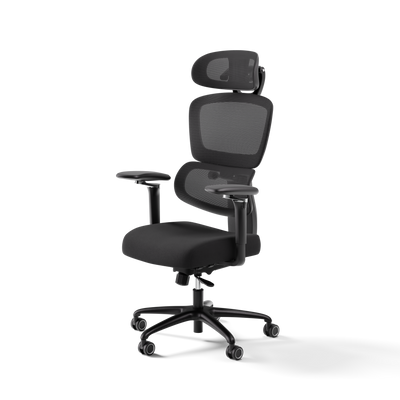
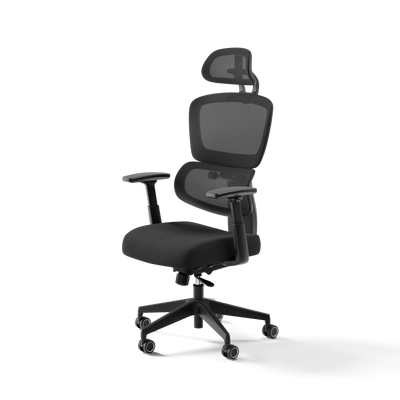
Models like the DESKSPACE MOVE PRO are designed for this requirement profile. It combines all the mentioned adjustment options for intensive work phases. If you already have complaints, you will find tips on choosing the right office chair for back pain in our guide.
For creators and tech pros with high demands on their setup
For you, the workplace is more than just a functional space. It is part of your creative environment and must be aesthetically pleasing. You value design, high-quality materials, and workmanship that matches your equipment. Ergonomics must not be neglected in the process.
Your priorities here are:
- Design and aesthetics: A clear, modern design and high-quality surfaces are crucial. The chair must seamlessly integrate into your setup.
- Material quality: Polished aluminum, noble fabrics, or breathable mesh fabric underline the premium claim.
- Stability and smooth operation: Nothing should wobble or creak here. Smooth-running castors and a solid, quiet mechanism are important.
A model like the DESKSPACE MOTION meets these requirements. It combines minimalist aesthetics with first-class ergonomics.
Adaptation to height and weight
There are no one-size-fits-all ergonomic office chairs. Your height and weight are fundamental factors in the selection. A chair that doesn't fit you cannot fully utilize its ergonomic advantages.
For tall individuals (over 1.90 m):
You need a chair with a generous maximum seat height. Equally important is sufficient seat depth. A high backrest, preferably with an adjustable headrest, is also advantageous.
For short individuals (under 1.60 m):
Look for a low minimum seat height so that your feet are flat on the floor. A shallower seat depth is crucial so that you maintain contact with the backrest.
For higher body weight:
Check the maximum load capacity of the chair. High-quality models are often certified up to 150 kg. A reinforced gas lift and a robust base made of steel or aluminum are essential.
Choosing based on these user profiles helps you narrow down your search. By defining your own needs, you will find the chair that will optimally support you for many years.
An investment that pays off – in your health and productivity
An ergonomic office chair is a long-term investment in your well-being. The price alone only tells half the story. More important are durability, warranty conditions, and whether you can test the chair without risk.
Models in the higher price segment cost more initially. There are good reasons for this. They are made of more robust materials and have more precise mechanisms. An aluminum base holds up better than a plastic one. A certified gas lift withstands thousands of movements. These components ensure that your chair maintains its ergonomic function for years.
What the warranty reveals about quality
The duration of the warranty is an honest indicator of how much a manufacturer trusts its product. It shows how long you can rely on your chair.
- 2-year warranty: This is often only the legal minimum standard.
- 5-year warranty: This signals significantly higher quality.
- 10-year warranty: A ten-year warranty, as offered by DESKSPACE for many models, is a true promise of quality.
Test risk-free – in your own work routine
No data sheet replaces the feeling of sitting in a chair yourself. Only at your own desk do you really feel whether a model suits you. An extensive testing phase is therefore valuable.
A 100-day trial period gives you the security you need for such an important decision. You can try out all the functions in peace and quickly notice whether the chair meets your daily requirements.
This opportunity to test the chair at home removes the risk of a bad purchase.
Awareness of ergonomics has grown significantly, especially since many people work from home. This increased interest is an opportunity for German direct suppliers. Offers such as a 100-day trial period help to find the perfect chair, as also shown by trends in office furniture on accio.com.
Buying an ergonomic office chair is a trade-off between price, quality, and service. A model with a long warranty and a fair trial period gives you the greatest security. This is how you find a reliable partner for healthy working.
Frequently asked questions about ergonomic office chairs
Here we clarify the most important questions about choosing and using ergonomic office chairs. These answers should give you confidence in your purchasing decision.
How long should I sit in an ergonomic chair?
Even the best ergonomic office chair is not a license for rigid sitting. The key is dynamic sitting. Change your sitting position regularly and take a short movement break every hour.
The 40-15-5 rule gives your work hour a healthy structure:
- 40 minutes of dynamic sitting: Actively use your chair's mechanism.
- 15 minutes of standing: Work standing, if you have a height-adjustable desk.
- 5 minutes of active movement: Stand up, walk a few steps, or do stretching exercises.
What is more important: the backrest or the seat?
The answer is not either-or. Both are a system that must be coordinated to optimally support your body.
The backrest with its lumbar support stabilizes your spine in its natural S-curve. It relieves your intervertebral discs.
The seat distributes pressure evenly on your thighs and buttocks. A well-shaped, depth-adjustable seat prevents blood circulation in your legs from being impaired.
An office chair is only truly ergonomic if the backrest and seat form a functional unit. The best lumbar support is of little use if the seat depth is incorrect and vice versa.
Do I need a headrest on my office chair?
A headrest is not a must for everyone, but it is a useful extra for certain ways of working. Whether you need one depends on your habits.
A headrest is particularly useful if you often work in a reclined position. During phases when you are reading, thinking, or on the phone, it can relieve your neck and shoulder muscles.
It is not absolutely necessary for upright work at a desk. Here, your head should be supported by a correct posture of the spine. It is a personal decision that depends on your daily work routine.
Are cheaper chairs really ergonomic?
Ergonomics is not solely a matter of price. A chair doesn't have to be expensive to offer good basic ergonomic support. The most important thing is that it replicates the natural shape of the spine.
With cheaper models, there are often compromises in the durability of the mechanism, the quality of the upholstery, and the precision of the adjustment options. A chair that wobbles after a year was not a good investment.
Therefore, look less at the price and more at reliable quality features: Are there certificates (TÜV/IGR)? How long is the warranty? Can you test the chair extensively? These are the best indicators for a chair that will accompany you healthily through your workday in the long term.
Find the ergonomic office chair that perfectly suits your requirements at Deskspace and benefit from a 100-day trial period. Invest in your health and discover our certified models at https://deskspace.de.


